










Delhi’s ‘Cockroach’ protests challenge Modi’s political image, crackdown on dissent
Student-led demonstrations over alleged voter-roll manipulation and earlier exam-paper leaks have brought opposition groups and young activists into the streets of Delhi, while police restrictions and detentions have intensified debate over democratic freedoms in India.
A wave of protests in New Delhi has challenged the political narrative of Prime Minister Narendra Modi’s invincibility, with student activists, opposition supporters and members of the self-described Cockroach Janta Party (CJP) mobilising against alleged electoral irregularities and government actions.
In an opinion article published by The Guardian on Monday, poet and writer Meena Kandasamy described the demonstrations as a turning point in public resistance to the Bharatiya Janata Party (BJP), which has governed India nationally since 2014. Her account portrays a protest movement combining political demands with satire, music, national symbolism and public defiance.
The article is an opinion piece rather than an independent news investigation. Its interpretation of the protests as evidence that the government is retreating should therefore be distinguished from the reported events themselves.
According to Kandasamy, the first round of CJP-led demonstrations took place in July at Jantar Mantar, Delhi’s designated protest site. Protesters were angered by alleged examination-paper leaks and demanded the resignation of India’s education minister.
The movement subsequently shifted its focus to Chief Election Commissioner Gyanesh Kumar. Kandasamy links the latest mobilisation to reports published by The Indian Express in late September alleging that voter rolls had been subjected to a purge.
The allegations have placed electoral administration at the centre of the protests. Demands for Kumar’s resignation reflect concerns among demonstrators about the integrity of voter registration and the independence of election institutions. However, the Guardian commentary does not establish that electoral manipulation occurred or independently verify the allegations against the commissioner.
Kandasamy argues that the second round of protests presents a greater political challenge because the demands extend beyond the removal of a cabinet minister to questions about the credibility of the electoral system.
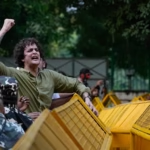
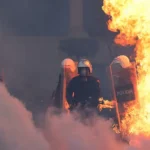
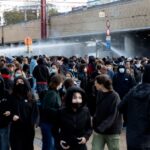
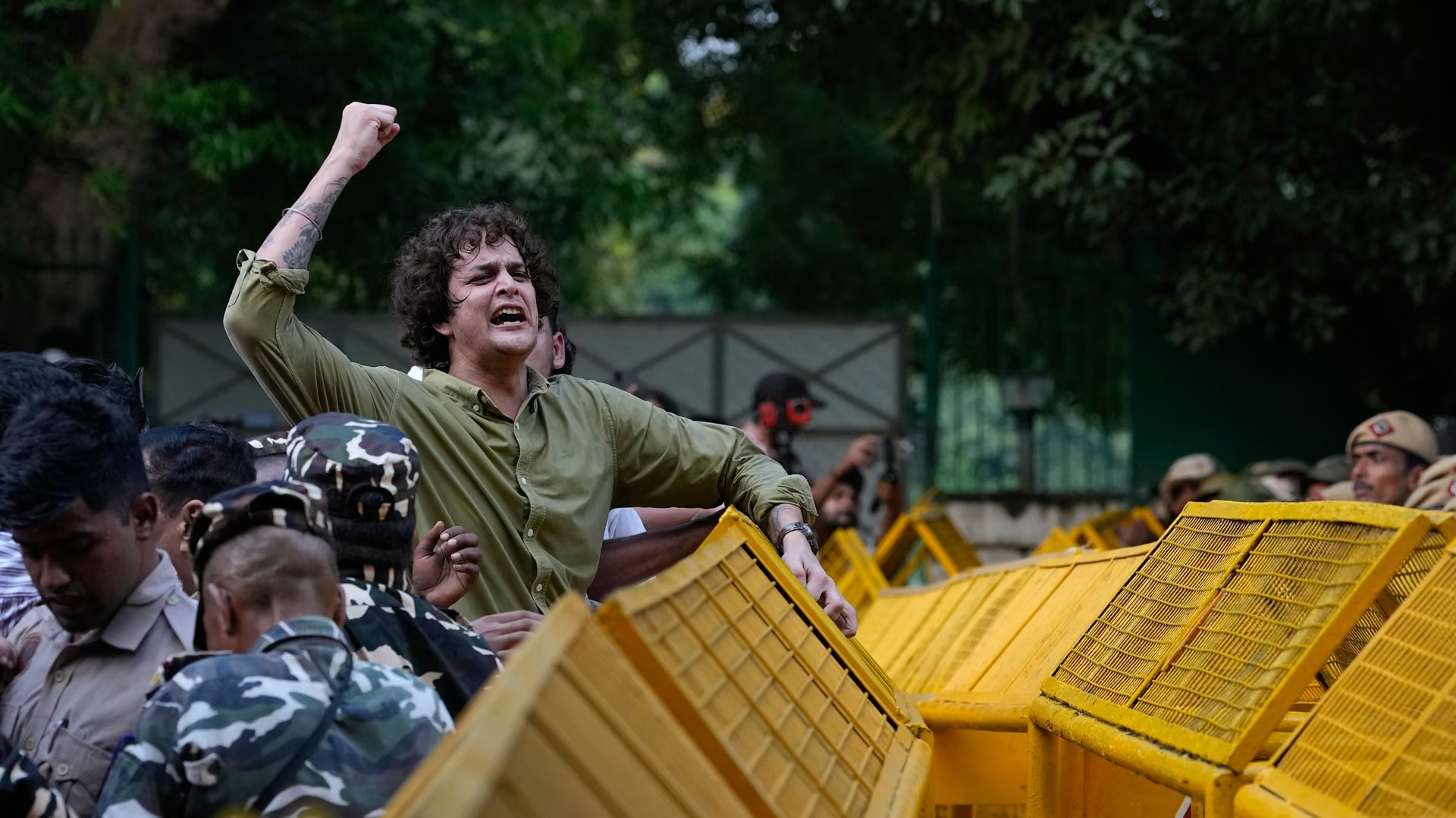
The Guardian article describes extensive security measures surrounding the demonstrations, including the detention of protest organisers, restrictions on access to protest sites and the closure of public transport facilities.
Kandasamy reports that around 90,000 police and security personnel were deployed during the 12 October mobilisation, while 45 metro stations in central Delhi were closed and trains travelling to the capital were cancelled. She also alleges that student activists were detained while travelling to Delhi.
The commentary further reports that CJP leaders Abhijeet Dipke, Saurav Das and Ashutosh Ranka were detained during different stages of the protests. Das and Ranka were reportedly jailed for five days, while Dipke was released on conditional bail after being detained again in connection with a later demonstration.
On 16 October, a planned gathering at Central Park in Connaught Place faced further restrictions. According to Kandasamy, the park was closed, security forces established extensive barricades and activists were detained as they approached the area.
These details form part of the author’s account. The article does not provide a complete official breakdown of arrests, injuries or the legal grounds for every detention.
Beyond the immediate demands, Kandasamy identifies the protests’ distinctive public style as a central feature of the movement. Demonstrators have reportedly used songs, slogans, dancing, satirical placards and the Indian national flag to communicate opposition.
She interprets this combination through the concept of the “carnivalesque”, associated with literary theorist Mikhail Bakhtin. In this framework, humour, spectacle and collective celebration can challenge established hierarchies by making authority an object of ridicule.
One slogan cited in the article translates as: “Whenever Modi is afraid, he pushes the police forward.” The slogan turns the government’s security response into a political message, although it represents protesters’ interpretation rather than evidence of the prime minister’s personal motives.
The use of the national flag also carries symbolic significance. According to Kandasamy, the demonstrations challenge the idea that patriotism belongs exclusively to the ruling party or that dissent can be equated with disloyalty.
This approach gives the movement a communication strategy that extends beyond formal political speeches. Images and videos of young demonstrators confronting security forces can circulate rapidly online, potentially attracting attention beyond the immediate protest sites.
The Guardian account says that the absence of CJP leaders from the front lines during the 10 October demonstrations did not end the protests. Left-wing and Congress-aligned student organisations, activists and elected opposition representatives continued to participate.
Kandasamy also highlights a call by Congress leader Rahul Gandhi ahead of the 12 October mobilisation. She describes the resulting gathering as one of the largest acts of public defiance she had witnessed, though the article does not provide independently verified crowd estimates.
The participation of multiple groups suggests that the demonstrations have drawn support beyond the original movement. Nevertheless, the extent of coordination among student organisations, opposition parties and CJP remains unclear from the commentary alone.
The protests’ future political influence will depend in part on whether these groups can sustain participation and maintain agreement on their objectives.
Digital platforms have become another arena of confrontation. Kandasamy alleges that the authorities have sought to control online communication through an internet shutdown and pressure on social media companies.
She contrasts these measures with the BJP’s earlier success in using digital platforms and messaging networks to communicate political narratives. Her argument is that online spaces can become less predictable when activists use them to distribute protest footage, slogans and alternative interpretations of events.
The article does not independently establish the full scope or duration of the reported internet restrictions, nor does it quantify their impact on the movement. Still, its account highlights the importance of digital communication in contemporary protest politics, particularly when access to physical gathering places is restricted.
Kandasamy also examines the use of Hindu religious imagery in opposition messaging. She cites Rahul Gandhi’s references to Shiva’s tandav—a dance associated with the Hindu deity—and a wedding procession connected to Shiva when describing the 12 October mobilisation.
The author interprets these references as an effort to communicate with Hindu citizens who may support the BJP but are also concerned about employment prospects and the treatment of young people.
Her broader argument is that religious identity and political loyalty are not necessarily fixed. Citizens may identify with a religious tradition while disagreeing with the policies or conduct of a party that claims to represent it.
This remains the author’s political interpretation, rather than a demonstrated shift in the views of Hindu voters generally. The article provides no representative polling evidence showing whether the protests have changed support for the BJP.
The Delhi demonstrations raise questions about electoral accountability, freedom of assembly, police conduct and the role of young people in political mobilisation. They also illustrate how satire, visual imagery and social media can become tools for challenging official narratives.
However, street mobilisation alone does not establish that a government has lost public support or that a change of government is imminent. The Guardian commentary offers a forceful interpretation of the protests, but it does not provide enough evidence to determine their national reach, their effect on voter preferences or their likely electoral consequences.
The immediate issues to watch include the official response to allegations concerning voter rolls, the legal proceedings surrounding detained activists, the availability of protest sites and whether demonstrations continue beyond Delhi.
For India’s political institutions, the central questions concern how allegations of electoral irregularities are investigated and whether citizens can organise and express dissent without arbitrary restrictions. For the protest movement, the challenge is to turn public visibility into sustained engagement with the issues that prompted the demonstrations.
The protests may become an important episode in India’s current political debate, but their long-term significance will depend on verifiable developments—not symbolism alone.
Source
Editorial note: This article is based primarily on Meena Kandasamy’s opinion commentary in The Guardian. Allegations about voter-roll changes, police conduct and government motives should be independently verified before being treated as established fact.
