














India’s voter-roll controversy puts electoral accountability, protest rights under scrutiny
India’s escalating protests over the revision of electoral rolls have developed into a wider dispute over election administration, citizens’ voting rights and the government’s response to dissent. As opposition parties demand the resignation of Chief Election Commissioner Gyanesh Kumar, Prime Minister Narendra Modi has defended India as the “mother of democracy”, even as detentions and restrictions on demonstrations intensify scrutiny of the authorities’ handling of the unrest.
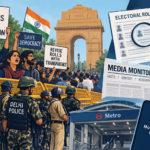
According to CNBC’s report published on 13 October 2026, thousands of people joined opposition leaders in a march towards the Supreme Court in New Delhi on 12 October to challenge the Election Commission’s Special Intensive Revision (SIR) of voter lists. The protest followed the detention of activists, politicians, lawyers, online commentators and some journalists during demonstrations over the preceding weekend. The dispute is now being fought on several fronts: in the courts, on the streets and through competing claims about the integrity of the electoral process.
The central issue is the scale and implementation of the SIR exercise. CNBC reported that approximately 130 million names had been removed from electoral rolls, while the Election Commission has defended the revision as a measure to eliminate deceased, duplicate, relocated and otherwise ineligible entries. The governing Bharatiya Janata Party (BJP) has cited those categories to justify the deletions. Opposition parties argue that the process risks excluding eligible voters and demand greater transparency over how decisions were made.
The distinction between removing an outdated record and disenfranchising an eligible citizen is crucial. A deleted entry does not, by itself, establish that an eligible voter has been denied the vote. Equally, a stated objective of cleaning electoral rolls does not establish that every deletion was correct. A credible assessment requires disaggregated data on the reasons for removal, notices sent to affected voters, appeals submitted, and the number of people successfully restored to the rolls.
There are also discrepancies in the published figures describing why names were removed. CNBC reported the BJP’s breakdown as 28 million deceased voters, 68 million who had relocated, 10 million duplicate entries and 30 million people who were absent or untraceable. Reuters has reported a different estimate for relocated voters. These figures should not be treated as a fully reconciled national dataset without further clarification from the Election Commission.
The question is not merely how many names have disappeared from the lists. It is whether the process has applied consistent standards across states and communities, whether affected people have been informed, and whether the appeals system can restore eligible voters before elections take place.
The controversy should not be read as though the legality of every aspect of the SIR process has already been settled—or as though the entire exercise has been declared unlawful.
In May 2026, India’s Supreme Court upheld the Election Commission’s authority to conduct the SIR exercise challenged in Bihar. The court also distinguished removal from an electoral roll from a determination that a person is not an Indian citizen. That ruling provides important legal context, but it does not automatically resolve every subsequent dispute over implementation, individual deletions or the nationwide exercise.
On 12 October, opposition leaders led by Rahul Gandhi and Mallikarjun Kharge marched towards the Supreme Court after the chief justice declined their request for a meeting. The opposition subsequently pursued a formal legal route against the Election Commission and the revision process. CNBC’s report says the petition challenged the voter-list changes; Reuters’ coverage provides further context on the demands for the commissioner’s resignation and the SIR process.
Formal judicial proceedings are significant because they can require the parties to address specific evidence rather than relying only on competing political statements. Questions about the data used to delete names, the procedure followed in disputed cases and the availability of effective remedies are more amenable to judicial examination than broad accusations of electoral fraud.
The legal process also needs to be assessed on its own terms. Filing a petition does not prove the allegations it contains, just as a previous ruling upholding the authority to revise does not establish that every subsequent decision was properly made.
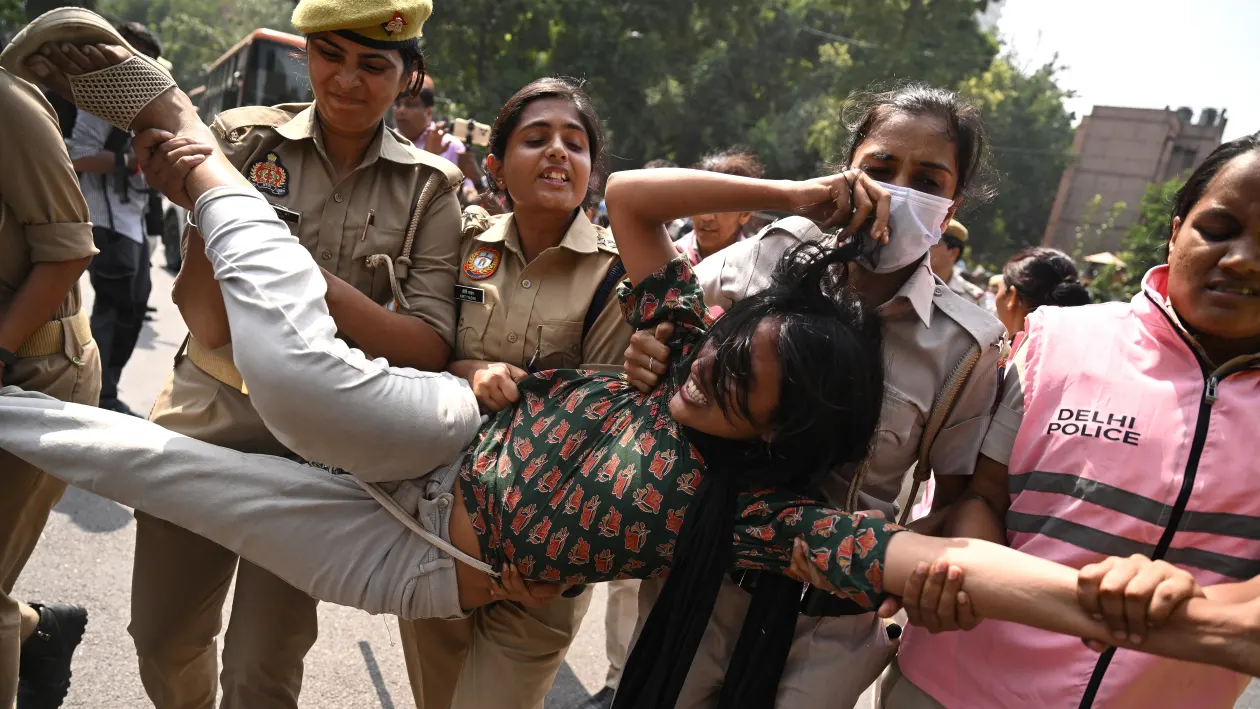
The dispute has expanded beyond voter registration to include the treatment of demonstrators. CNBC reported that police detained protesters, opposition politicians, lawyers, online commentators and some journalists during the weekend crackdown. Authorities also prevented the use of Jantar Mantar, a prominent protest location in New Delhi, for further demonstrations.
The United Nations human rights office expressed concern over reports of mass detentions on 10 October and urged Indian authorities to respect the right to peaceful assembly. It called for restraint by law-enforcement officers and the release of anyone arbitrarily detained.
Human Rights Watch, in a statement published on 13 October, also called for an end to what it described as abusive policing and arbitrary detentions. The organisation reported allegations of excessive force, restrictions on movement and internet suspensions. These are findings and characterisations advanced by a human rights organisation; the Indian authorities’ response and evidence concerning individual incidents remain relevant to a complete assessment.
India’s Ministry of External Affairs rejected the UN human rights office’s intervention as unwarranted interference in the country’s internal affairs, according to CNBC. This response reflects a disagreement over international scrutiny, but it does not resolve the factual questions about particular detentions or the proportionality of restrictions imposed on public gatherings.
Pasted text.txt
The right to peaceful assembly is especially important when citizens are challenging the conduct of an institution responsible for administering elections. Governments may impose lawful restrictions to address specific public-order risks, but restrictions and enforcement measures should be necessary, proportionate and open to scrutiny. Blanket or excessive restrictions can make it harder for citizens to seek accountability through public protest.
The emergence of the youth-led Cockroach Janta Party (CJP) has added a distinctive element to the protests. The movement initially gained attention through its satirical political identity and had previously mobilised around other grievances, including exam-paper leaks. It subsequently made the Election Commission and the voter-roll revision a central focus of its protests. Reuters’ 13 October reporting describes the movement alongside the opposition Congress party as a significant part of the mobilisation.
The participation of a youth-led movement alongside established opposition parties broadens the constituencies involved, but it does not necessarily mean that all participants share the same political objectives or strategy. The opposition’s campaign is focused on the Election Commission, electoral procedures and the commissioner’s resignation; the CJP also brings its own protest identity and history.
CNBC quoted analysts who warned that an aggressive police response could draw more people into demonstrations. Michael Kugelman of the Atlantic Council said that heavy-handed tactics could increase anger and galvanise larger crowds. Teneo’s Arpit Chaturvedi similarly described the crackdown as significant compared with earlier protest responses. These are assessments of the risks of escalation, not proof that wider unrest is inevitable.
The authorities therefore face two distinct challenges: responding to protests while maintaining public order, and addressing the underlying concerns sufficiently to prevent the dispute from becoming more entrenched. The effectiveness of that response will depend not simply on controlling crowds but also on whether credible answers emerge about the voter-list revision.
Speaking at a Bloomberg New Economy event on 13 October, Modi described India as the “mother of democracy” and said that a wide range of issues were openly debated. The statement presented India’s democratic traditions as a source of national legitimacy. Its timing, amid demonstrations over electoral administration and allegations of excessive restrictions on protest, has brought attention to the relationship between democratic ideals and institutional practice.
A country’s democratic standing cannot be assessed from political rhetoric alone, nor can it be determined by the existence of protests alone. More concrete indicators include whether electoral institutions publish transparent procedures, whether citizens can challenge decisions that affect their voting rights, whether courts can independently review disputes and whether peaceful critics can assemble without disproportionate interference.
The Election Commission’s stated objective of removing ineligible entries is compatible with the general need for accurate electoral rolls. But accuracy also requires safeguards against the exclusion of eligible voters. An effective system must demonstrate not only that it can remove invalid entries but also that it can identify and correct errors before they affect participation in elections.
Similarly, the presence of judicial and administrative procedures matters only if people can access them in practice. If the burden of proving eligibility is difficult for poor, elderly, migrant or otherwise vulnerable citizens, a formally available appeal process may not be enough to prevent exclusion. These concerns need to be tested against evidence about the actual procedures, outcomes and experiences of affected voters rather than assumed from the total number of deletions.
Three sets of information would help establish the scale and nature of the problem.
First, the Election Commission should provide consistent, state-by-state data on the reasons for deletions, the number of affected voters notified, and the number of names restored after objections or appeals. The totals should be reconciled across official statements and published reports.
Second, the legal process should clarify what records and procedural safeguards were used in disputed cases. Where eligible voters were wrongly excluded, the speed and effectiveness of the remedy will be as important as the original decision.
Third, allegations of excessive force or arbitrary detention should be assessed against documented incidents, legal grounds for detention, access to legal assistance and the outcomes of any complaints or judicial review. The UN and human rights organisations have raised concerns, while the Indian government has disputed the international criticism. Independent, case-specific evidence is necessary to evaluate those competing positions.
These steps would help distinguish administrative errors from systemic problems, and isolated enforcement incidents from broader restrictions on peaceful assembly.
India’s voter-roll controversy has become a test of both electoral administration and democratic accountability. The removal of millions of entries does not, on its own, prove mass disenfranchisement; nor does the stated aim of removing ineligible voters establish that the revision has been carried out without error. The evidence must show whether eligible citizens were excluded, whether decisions were transparent and whether effective remedies are available.
The response to protests is a separate but connected measure of institutional accountability. Restrictions on assembly and mass detentions risk deepening mistrust if authorities cannot demonstrate that their actions are lawful and proportionate. Meanwhile, opposition allegations require scrutiny through evidence and formal proceedings rather than being treated as fact.
The decisive question is whether India’s institutions can demonstrate, through transparent data, accessible appeals, independent review and respect for peaceful dissent, that the electoral process remains fair to eligible voters. That test is more substantive than any political slogan—and more consequential for public confidence than the outcome of a single protest.
Sources
- CNBC, Priyanka Salve — As ‘Cockroach’ protests grow over alleged voter fraud, Modi defends India as ‘mother of democracy’, 13 October 2026.
- Reuters — What is fuelling India’s protests over changes to voter lists?, 13 October 2026.
- Reuters — Modi’s three-pronged challenge, 13 October 2026.
- United Nations — UN rights office urges release of ‘arbitrarily detained’ protesters, 10 October 2026.
- Human Rights Watch — India: End Crackdown on Protesters, Arbitrary Detentions, 13 October 2026.
- The Indian Express — Supreme Court upholds the legal validity of the SIR process, 27 May 2026.
- The Indian Express — Supreme Court considers priority hearings for voters deleted from West Bengal’s electoral roll, October 2026.
- Amnesty International — India: Authorities trampling on human rights in crackdown on electoral roll protests, 2 October 2026.
