




















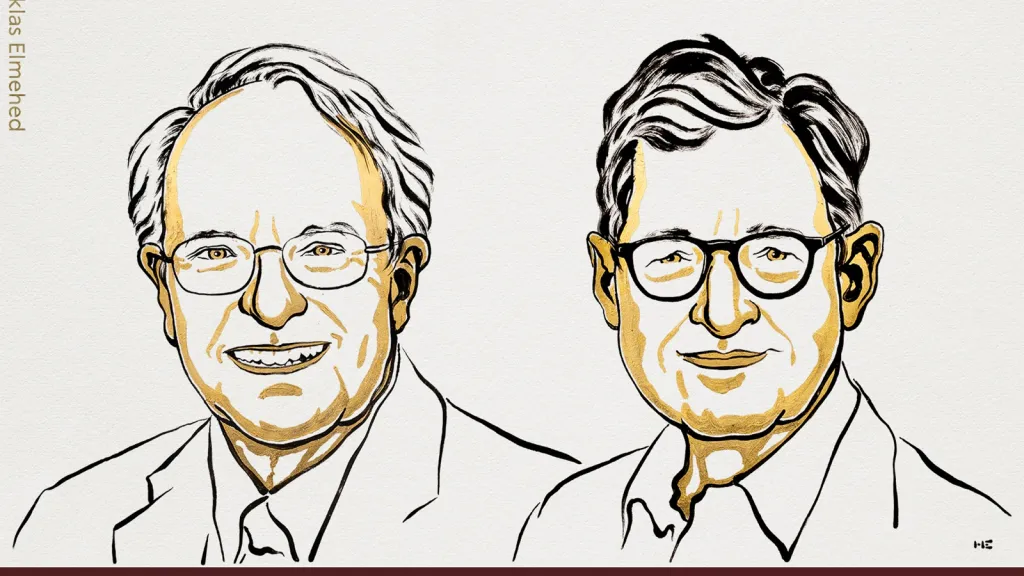
Nobel economics prize goes to Hall, Woodford for reshaping stabilisation policy
The US economists’ research helped lay the foundations for modern macroeconomic models used to assess how monetary and fiscal policy can limit economic volatility.
Two US economists, Robert E. Hall of Stanford University and Michael Woodford of Columbia University, have won the 2026 Sveriges Riksbank Prize in Economic Sciences in Memory of Alfred Nobel for research that transformed the theoretical foundations of economic stabilisation.
The Royal Swedish Academy of Sciences announced the award on Monday, 12 October, recognising their work on the “microeconomic foundations of macroeconomic stabilisation”. Their research helped establish models that explain how the decisions of households and businesses influence the wider economy, strengthening the analytical tools available to governments and central banks as they respond to recessions, inflationary pressure and economic shocks. The Academy’s official announcement describes the contribution as a foundation for better-timed fiscal and monetary policy. Reuters also reported that the prize carries 12 million Swedish kronor, equivalent to approximately $1.2 million.
Macroeconomics examines economy-wide outcomes such as inflation, employment, production and consumption. Microeconomics, by contrast, studies decisions made by individual consumers, households and businesses. Hall and Woodford’s recognised contribution lies in connecting these levels of analysis.
Economic models built around broad statistical relationships can help identify patterns, but policymakers also need to understand why those patterns emerge and how people might respond when policy changes. A household deciding whether to spend or save, for example, may react not only to its current income but also to expectations about future earnings, prices and interest rates. A business setting prices or planning investment likewise considers expected future costs and demand.
By incorporating such behaviour into macroeconomic models, economists can better analyse how millions of individual decisions interact to produce changes in overall economic activity. The Academy says this approach has improved the theoretical basis for stabilisation policies used by governments and central banks. Royal Swedish Academy of Sciences.
One important implication of this research is that monetary policy operates partly through expectations. Central banks influence economic conditions through interest rates, but their communication about the likely direction of policy can also affect decisions made by households, firms and financial markets.
Woodford’s work has been particularly influential in the theoretical development of modern monetary policy and forward guidance—the communication of a central bank’s intentions regarding future policy. By shaping expectations, a central bank may influence borrowing, spending, investment and price-setting decisions before every policy effect is visible in the economic data.
The Guardian’s coverage of the announcement highlighted the importance of forward guidance and the difficulties policymakers faced during the 2008 financial crisis, when interest rates in major economies fell towards historically low levels while unemployment remained elevated. The episode illustrated why central banks needed to consider tools beyond conventional interest-rate adjustments. The Guardian’s economics coverage.
This does not mean communication alone can control inflation or prevent recessions. Policy effectiveness also depends on the nature of the shock, the credibility of institutions, financial conditions and how households and businesses actually respond.
The Academy’s explanation places the laureates’ work in the context of debates over economic stabilisation that intensified during the oil crises of the 1970s. That period brought a difficult combination of weak growth, high unemployment and high inflation, challenging the assumptions underpinning some established models.
Hall and Woodford helped advance an approach in which macroeconomic models are grounded more explicitly in the behaviour and expectations of individual economic actors. The resulting New Keynesian framework retained a role for stabilisation policy while developing more detailed explanations of how policy decisions affect economic activity and prices.
It would therefore be misleading to characterise their achievement simply as rejecting Keynesian economics. The Academy recognised their contribution for developing a more rigorous theoretical basis for understanding when and how stabilisation policies can work. The Guardian likewise describes their work as part of the New Keynesian paradigm. The Guardian.
The award has immediate relevance to the policy challenges facing economies exposed to energy-price shocks, volatile consumer demand and changing inflation expectations.
When energy prices rise sharply, households may cut other spending, businesses may face higher production costs and workers may seek higher wages to compensate for declining purchasing power. A central bank must assess whether inflation is likely to persist, while a government must consider the effects on household incomes, public finances and economic activity.
Models that incorporate individual behaviour and expectations can help policymakers evaluate how different interventions might influence these responses. The Academy’s prize committee argues that the laureates’ work has provided a stronger theoretical foundation for the models now used by central banks and governments to manage economic fluctuations.
However, better models do not guarantee better outcomes. Economic forecasts remain uncertain, and a policy response that is appropriate for a demand-driven recession may be less suitable for an inflationary shock caused by disrupted energy supplies. Decisions still require judgement, reliable data and an assessment of the circumstances confronting each economy.
The award’s formal name is the Sveriges Riksbank Prize in Economic Sciences in Memory of Alfred Nobel. It was established by Sweden’s central bank in 1968 and first awarded in 1969. Unlike the five original Nobel Prizes specified in Alfred Nobel’s will, the economics award was created separately, although it is administered within the Nobel award framework.
The 2026 prize recognises the theoretical foundations behind an important part of contemporary economic policymaking. For governments confronting inflation, weak growth or sudden external shocks, the challenge is not simply to intervene, but to understand how policy changes influence decisions throughout the economy—and to act at the right time.
