
















Repeated Riyadh airport attacks raise regional stakes; Iran offers mediation
Saudi Arabia faces mounting pressure to protect civilian aviation and strategic infrastructure as Houthi strikes intensify and Tehran seeks a diplomatic role in the escalating confrontation.
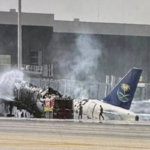
Saudi Arabia is confronting a sharp escalation in cross-border attacks after repeated strikes on King Khalid International Airport in Riyadh killed civilians and disrupted aviation, while Iran has offered to facilitate dialogue between the kingdom and Yemen’s Houthi movement. The developments have opened a new diplomatic question: whether Tehran can help contain the confrontation or whether the attacks will draw more regional powers into the conflict.
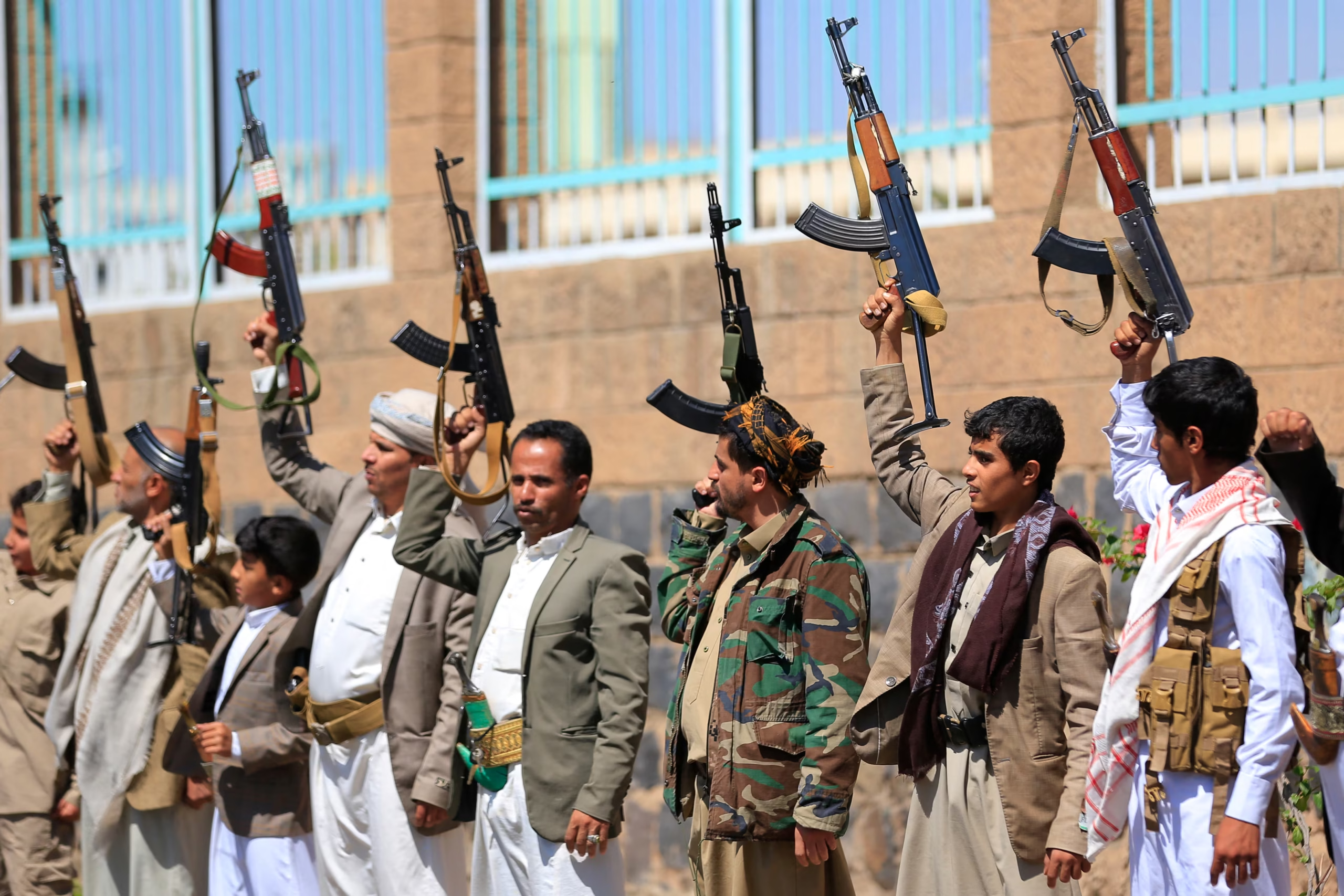
The latest reported strike on Riyadh airport killed one person and injured 11 others, according to Saudi authorities. The victim was identified as a Pakistani national. The attack followed a much deadlier strike on 10 October, for which Saudi authorities initially reported 12 deaths and more than 300 injuries. The death toll from that earlier incident subsequently rose to 13 after an Indian national died from injuries sustained in the attack. The Houthis have claimed responsibility for the airport strikes, according to reporting by Al Jazeera and other international news organisations.
The attacks have exposed the immediate challenge facing Saudi Arabia: protecting major civilian transport facilities while avoiding a wider escalation that could threaten its security, economic interests and regional relationships. Airport operations have faced disruption, and foreign governments have issued travel warnings. The US State Department has urged Americans to exercise extreme caution when using Saudi airports, citing attacks affecting facilities in Riyadh and Dammam.
Against this backdrop, Iranian Foreign Minister Abbas Araghchi spoke with Saudi Foreign Minister Prince Faisal bin Farhan Al Saud. Iran said it was prepared to assist in facilitating dialogue between Saudi Arabia and Yemen, where fighting between the Houthis and forces aligned with the internationally recognised government has intensified.
Araghchi argued that relying on military action while disregarding political solutions would complicate the crisis. The offer is significant because Iran maintains close ties with the Houthis, although Tehran denies that it directly controls the group’s decisions. Whether Riyadh will accept Iran’s proposed role, and whether Tehran can persuade the Houthis to halt their attacks, remain unresolved questions.
The proposal also comes amid a separate diplomatic impasse between Washington and Tehran. Iranian security chief Mohsen Rezaei said the United States had accepted some of Iran’s conditions for an agreement to end the war but described Washington’s response as inadequate. He did not specify which conditions had been accepted or rejected. Tehran has linked a reopening of the Strait of Hormuz to its demands, adding another layer of uncertainty to negotiations over the wider conflict.
Iran’s dual position—as a participant in the broader confrontation and a prospective facilitator of Saudi-Houthi dialogue—creates a difficult test for regional diplomacy. An offer to mediate does not, by itself, demonstrate that Tehran can secure compliance from the Houthis. Any meaningful de-escalation would depend on the willingness of the parties involved to negotiate and on whether the movement’s military and political objectives could be addressed.
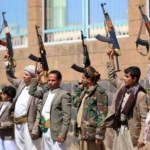
The airport attacks are part of a wider deterioration in the security environment surrounding Yemen. Fighting between Houthi forces and the internationally recognised government has intensified following the breakdown of a United Nations-brokered ceasefire that had largely held since 2022. Clashes have been reported across several fronts, including Taiz, while the Houthis have expanded their threats beyond the immediate battlefield.
The consequences are increasingly humanitarian as well as military. The International Organization for Migration’s mission in Yemen reported that more than 213,000 people had been displaced since hostilities escalated in September. Women and children account for about 60 per cent of those displaced, according to the organisation’s reported figures. Many people have fled areas affected by fighting, particularly in Taiz, and require shelter, food and protection.
The reported casualty figures from individual strikes and the wider conflict should be treated with care. Some information has come from Saudi authorities, while casualty and damage claims relating to strikes inside Yemen have also been reported by Houthi-affiliated media and the Houthi-run health authorities. Independent verification is not available for every claim.
For Riyadh, the danger is that a conflict concentrated in Yemen could increasingly affect critical infrastructure inside Saudi Arabia. The airport strikes demonstrate how attacks can create casualties and disrupt civilian movement far from the principal battle lines. They also increase pressure on Saudi authorities to respond while weighing the potential costs of a prolonged confrontation.
The escalation is unfolding amid wider risks to regional energy flows. The Strait of Hormuz is a critical route for global oil shipments, and the broader US-Israel war on Iran has added uncertainty to Gulf energy markets. Saudi Arabia’s East-West pipeline, which transports crude oil towards the Red Sea port of Yanbu, provides an alternative export route that bypasses Hormuz.
That alternative, however, does not eliminate the kingdom’s exposure to regional instability. Rising tensions around Yemen, the Red Sea and the Bab el-Mandeb strait can create additional risks for shipping and energy logistics. Saudi Arabia therefore faces interconnected security challenges: protecting its territory, maintaining access to export routes and preventing attacks from undermining confidence in its transport and economic infrastructure.
Oil prices remained elevated in early trading on 12 October, with Brent crude reported above $100 a barrel, despite pressure from expectations of additional Russian supply. Market movements reflect several factors, including the wider war and uncertainty over energy shipments; they should not be attributed to the airport attacks alone.
Saudi Energy Minister Prince Abdulaziz bin Salman has reiterated the kingdom’s commitment to reliable energy supplies and highlighted the East-West pipeline’s role in maintaining export options. The importance of this infrastructure is likely to increase if instability around Hormuz or the Red Sea persists.
The attacks have prompted condemnation from regional governments. Turkey, Pakistan, Egypt and Saudi Arabia issued a joint statement condemning the strikes and holding the Houthis responsible. The statement called for the attacks to stop and expressed support for Saudi Arabia’s right to take legitimate measures to protect itself.
The response carries particular significance because Turkey and Pakistan have a defence pact with Saudi Arabia. The agreement raises questions about how the countries might coordinate in the event of further attacks, although public commitments to collective defence should not be treated as evidence that either country has decided to join offensive military operations.
The United States has also signalled concern about the situation. Any expansion of its involvement against the Houthis would risk linking the Yemen front more directly to the broader war involving Iran. Such a development could increase pressure on regional governments to choose between supporting Saudi security, pursuing diplomacy and avoiding a wider regional war.
At the same time, Iran’s proposed mediation could provide an opening for communication. Its effectiveness will depend on whether the offer leads to concrete talks and whether the Houthis are prepared to negotiate over the attacks and the wider conflict in Yemen.
Saudi Arabia now faces a difficult choice between retaliation and de-escalation. A forceful response could be intended to deter further attacks, but it could also provoke additional strikes and deepen the conflict. Restraint, meanwhile, would not guarantee that the attacks would stop or that the Houthis would accept a diplomatic settlement.
Iran’s offer presents a potential channel for dialogue, but it should not be mistaken for a breakthrough. The immediate tests will be whether Saudi Arabia engages with the proposal, whether Tehran can facilitate credible contact with the Houthis and whether attacks on civilian infrastructure cease.
The wider implications extend beyond the security of a single airport. Continued escalation could affect aviation, regional trade, energy logistics and the movement of people across the Gulf and the Red Sea. For Saudi Arabia and its partners, the challenge is to strengthen civilian protection without turning a dangerous confrontation into a broader regional war.
The central uncertainty is not simply whether Saudi Arabia can intercept the next attack. It is whether the parties can prevent repeated strikes from becoming the trigger for a much wider conflict.
Sources: Al Jazeera; Reuters; Saudi authorities and official statements; International Organization for Migration.
