




















Houthis claim new ballistic missile strike on Riyadh airport
Yemen’s Houthi movement has claimed a new ballistic missile strike on the main international airport in Saudi Arabia’s capital, escalating a widening confrontation with Saudi-backed Yemeni forces that has pushed the country’s renewed civil war closer to the kingdom’s territory.
Houthi military spokesman Yahya Saree said Thursday that the group had targeted King Khalid International Airport in Riyadh and claimed the missile hit its target and disrupted airport operations. He also warned international airlines against continuing to operate through Saudi airspace.
Saudi authorities had not immediately confirmed the latest Houthi claim. Reuters reported that the statement came only hours after Saudi Arabia said an earlier attack on the same airport had killed one person.
The latest claim follows a series of Houthi attacks on Saudi targets this week. Saudi authorities said attacks on airports in Riyadh and Abha had killed three people and injured dozens, marking a sharp escalation after fighting intensified inside Yemen.
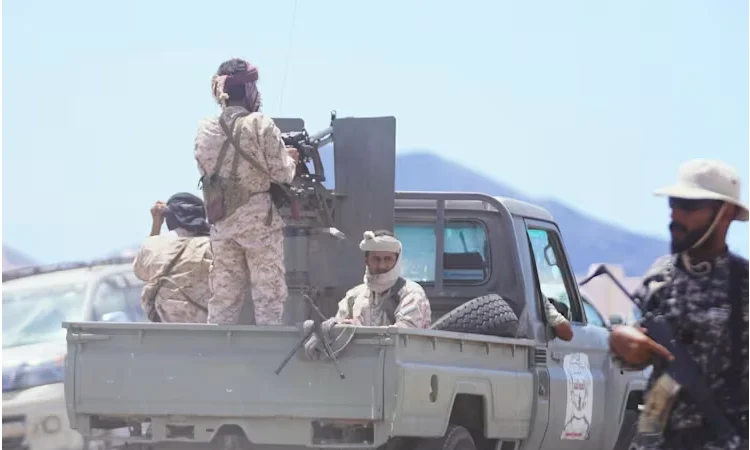
The attacks are unfolding alongside a major Saudi-backed counter-offensive by Yemen’s internationally recognised government. President Rashad al-Alimi announced the operation, known as “Dawn of Yemen”, with the stated aim of reclaiming Houthi-held territory and ultimately restoring government control over Sanaa.
Government forces, backed by Saudi air power, have claimed advances around the strategic Bab al-Mandeb Strait and the Red Sea coast, including areas around Dhubab and Mocha. The Houthis have disputed some of those battlefield claims, while independent reporting has indicated that fighting remains intense around Taiz and the southern approaches to Bab al-Mandeb.
The strategic geography is central to the renewed conflict. Bab al-Mandeb connects the Red Sea with the Gulf of Aden and is one of the world’s most important maritime passages. Control of territory around the strait gives the Houthis leverage over a major international shipping route while also bringing the group closer to Saudi Arabia’s southern and western security interests.
The renewed fighting follows major Houthi territorial gains in September, when the group expanded along Yemen’s western coast and captured Mocha and territory around Bab al-Mandeb. The Saudi-backed counter-offensive is therefore not simply an attempt to contain missile attacks; it is also an effort to reverse those territorial gains.
For Riyadh, the threat is particularly sensitive because the Houthis are no longer limiting their attacks to the battlefield inside Yemen. Airports, oil infrastructure and other strategic facilities in Saudi Arabia have increasingly become part of the conflict. Earlier this week, Saudi authorities confirmed damage and casualties at airports in the kingdom’s south following Houthi attacks.
The conflict is also beginning to acquire a broader regional dimension. Saudi Arabia has been providing extensive military backing to the Yemeni government, while the Houthis remain aligned with Iran. Reuters reported that Saudi Arabia has re-entered the Yemen war at a time of wider regional confrontation, increasing the risk that the Yemeni battlefield could become another front in the broader struggle involving Riyadh and Tehran.
The humanitarian cost is already mounting. The United Nations has said more than 200,000 people have been displaced inside Yemen since the latest escalation, adding another layer to a conflict that has already produced one of the world’s most severe humanitarian crises.
The airport strikes also carry an economic dimension. Repeated attacks on aviation infrastructure can disrupt passenger traffic, insurance arrangements and international airline operations, while threats to Saudi airspace could affect the kingdom’s wider connectivity. Any sustained disruption would come at a particularly sensitive time for Saudi Arabia, whose economic transformation plans depend heavily on international tourism, investment and air connectivity.
For the Houthis, attacks on Saudi infrastructure demonstrate that the group retains the ability to strike far beyond the immediate front lines. For Riyadh and the Yemeni government, however, the military response is aimed at changing the territorial balance that allowed the Houthis to project that threat in the first place.
That creates a difficult cycle: Saudi-backed forces are attempting to push the Houthis away from the Red Sea and Bab al-Mandeb, while the Houthis are responding by taking the conflict deeper into Saudi territory.
The immediate question is therefore not only whether the latest Riyadh airport strike claim can be independently verified. It is whether the renewed Yemen offensive will remain a contained campaign over territory and strategic waterways or develop into a prolonged regional confrontation with growing consequences for civilian aviation, maritime trade and an already fragile Yemeni population.
