








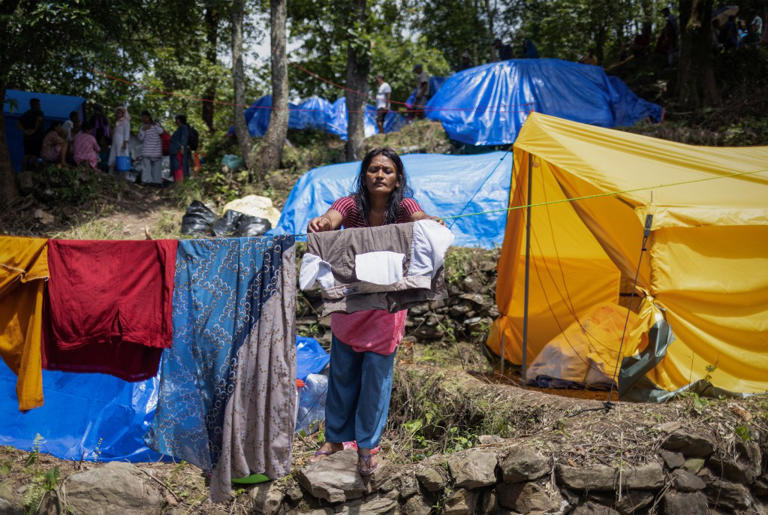
“I am waiting to see if I can find any remains of my son”
For 53-year-old Rajesh Ram, a photograph of his missing son is now more than a family memory. It is a symbol of the answer he has been waiting for since devastating floods swept through Nepal’s Himalayan region.
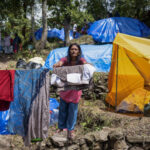
Ram’s son, Suroj Kumar, a garage mechanic in Betrawati, disappeared when a massive wall of freezing water and debris surged through the area. Ram searched for him but could not find his body. Now, like thousands of other families, he is relying on DNA testing to discover whether unidentified remains belong to his missing relative.
“I am waiting to see if I can find any remains of my son,” Ram told AFP.
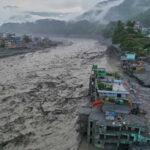
The identification effort has become a forensic challenge on an extraordinary scale after a glacial and rock collapse on the Nepal-China border on August 26 triggered catastrophic flooding. The surge of water and debris devastated communities downstream, leaving bodies scattered across a wide area and thousands of people unaccounted for.
Nepali disaster authorities have recovered 1,454 bodies, but around one-third are only partial remains. So far, just 112 bodies have been identified and returned to their families, while another 5,285 people remain missing in Nepal, including hundreds of foreigners.
Across the border, China has reported 43 deaths and 519 people missing, according to state media. Combined, the reported toll stands at nearly 1,500 dead and about 5,800 missing.
For Nepal’s forensic specialists, the numbers represent a challenge far beyond the normal capacity of the country’s laboratories.
Two forensic laboratories in Kathmandu are processing thousands of samples. Mukul Pradhan, chief scientific officer at the National Forensic Science Laboratory, said his laboratory would normally analyse between 1,000 and 1,500 samples in an entire year, often for paternity cases or criminal investigations.
It is now processing thousands of samples from the disaster.
In total, 3,685 forensic samples are undergoing DNA testing, including more than 1,300 collected from recovered bodies. Blood samples can generally be profiled more easily, while samples taken from teeth and bones can require several days of processing.
The challenge is not simply extracting DNA. A DNA profile from unidentified remains has to be compared with a reference profile from a relative before authorities can establish a match.
“Just by extracting a DNA profile is not enough to identify someone,” said Nirajan Thapa, chief of the biology section at the National Forensic Science Laboratory. “We have to extract a DNA profile from their relatives and then compare.”
That requirement has turned the identification operation into a vast matching exercise involving both the dead and the living. Authorities must build profiles from recovered remains while simultaneously collecting reference samples from relatives searching for missing family members.
The geography of the disaster has made the process even more difficult.
Some bodies were carried far downstream by the floodwaters, meaning remains may have travelled considerable distances from where people were last seen. Unlike an earthquake or a conventional accident, where remains are often concentrated within a relatively defined area, the flood has created what Thapa described as a much larger forensic scenario.
The remains themselves also present different technical challenges. Some are fragmented or incomplete, reducing the amount of usable biological material available to investigators.
More than 1,200 bodies have already been buried, but authorities have carefully numbered and tagged them so that they can be retrieved if DNA testing eventually establishes a match.
For families, however, scientific identification offers both hope and another period of uncertainty.
Nepali police spokesman Abi Narayan Kafle acknowledged the distress caused by the delays, saying authorities understood the pain of families and that forensic and police teams were working to identify the dead.
Several countries have provided assistance. Teams from neighbouring India and China, as well as South Korea, have joined the effort, while fingerprint specialists from the United States and Singapore are also assisting Nepali authorities.
With international support, experts expect DNA matching to begin within a few weeks. But for families such as Ram’s, even a few weeks can feel immeasurably long.
Some relatives of the missing have already held symbolic cremation ceremonies without recovering the bodies of their loved ones. Such rituals provide a form of closure in circumstances where physical confirmation remains impossible.
The disaster has therefore created a second, quieter crisis alongside the immediate destruction: the struggle to establish who died.
For forensic scientists, it is a question of DNA profiles, reference samples, databases and laboratory capacity. For families, it is much more personal. Every unidentified body represents the possibility of an answer, while every unmatched DNA sample prolongs uncertainty.
In the aftermath of a disaster measured in thousands of deaths and missing people, identification is not merely a technical procedure. It is the final link between a recovered body and a family waiting to know what happened to someone they love.
For Ram and thousands of others across Nepal, that answer now depends on science—and on whether a fragment of DNA can finally re
