

















Germany’s Gen Z protests highlight growing fears over jobs, housing, political exclusion
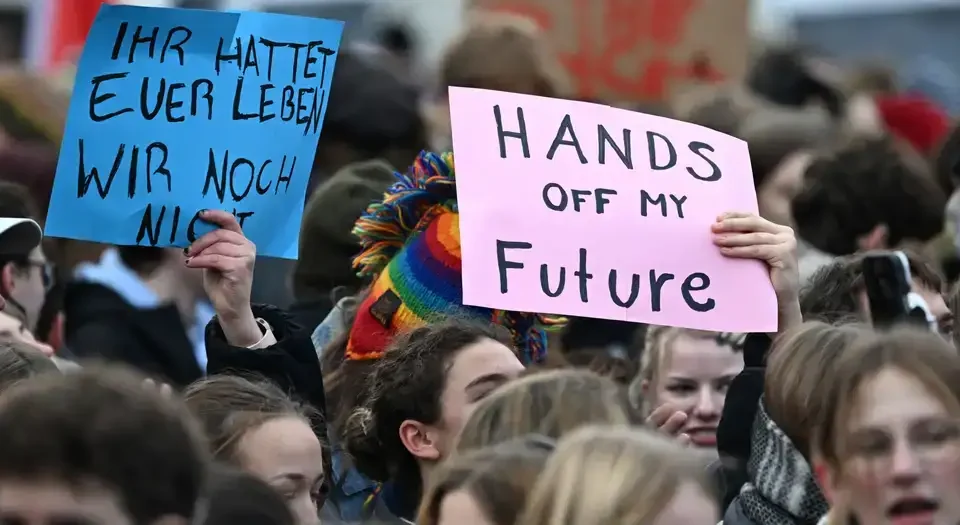
Young people across Germany took to the streets on Friday, 20 November, demanding greater attention to their concerns over employment, housing affordability, climate policy and their role in political decision-making. Demonstrations took place in 73 towns and cities, reflecting wider frustration among a generation that is better educated than its predecessors but increasingly uncertain about its economic future.
The protests, organised around the message that young people want a say in decisions shaping their lives, came amid growing difficulties for university graduates and vocational training completers seeking stable employment. Finding affordable accommodation in major cities has also become increasingly challenging, making it harder for young adults to establish independent lives.
The demonstrations formed part of a wider wave of youth protests across Europe on World Children’s Day. Participants argued that political leaders and public institutions frequently discuss young people’s futures without giving them meaningful opportunities to influence decisions.
Economic uncertainty fuels youth frustration
For many young Germans, education no longer guarantees the economic security they expected. Employment opportunities are becoming harder to secure, while housing costs and broader financial pressures delay independence.
The concerns reflect findings highlighted in the United Nations Population Fund’s (UNFPA) 2026 World Population Report, Succeeding Generations: Empowering Young People to Chart the Future. Researchers surveyed 109,000 people across 73 countries.
The report identifies an important contradiction: young people worldwide are more educated than previous generations, with 78% of adolescents completing at least lower secondary education. Yet finding work is increasingly difficult, and informal employment is growing.
Economic uncertainty also affects major life decisions. According to the report, many people do not achieve financial independence until their mid-to-late twenties, while stable partnerships and parenthood are often delayed until their early-to-mid thirties.
Young people say political participation is often symbolic
Beyond economic pressures, protesters are challenging what they see as their limited influence over public policy.
Florian Brod, 25, a Youth Delegate for Sustainable Development representing young people from Germany at United Nations conferences, highlighted the gap between the size of the younger population and its political representation.
He cited figures indicating that almost half of the world’s population is under 30, while only 2.6% of parliamentarians globally belong to that age group.
Brod argued that younger generations will live longest with the consequences of today’s decisions, particularly those concerning employment, housing and climate protection, yet remain underrepresented in the institutions shaping those policies.
He also questioned whether youth participation in international conferences translates into genuine influence. Without access to preparatory briefings, preliminary negotiations and relevant documents, young representatives often have little opportunity to shape final outcomes.
Erik Sczygiol, an 18-year-old former deputy secretary-general of the German Conference of Student Representatives, described a similar experience. He said young people are sometimes invited to political discussions only after legislation has already passed through numerous drafts, leaving little room for their proposals to influence the final decision.
He also criticised media coverage that focuses heavily on possible disorder at demonstrations while giving limited attention to the demands motivating young people to protest.
Debate over protests and public perceptions
The demonstrations have also exposed tensions over how youth activism is portrayed in Germany.
Sczygiol criticised political and media rhetoric that, in his view, risks portraying entire demonstrations as potential security threats because of the actions of a small minority.
One example cited in the DW report was a suggestion by the youth wing of the conservative CDU/CSU in Berlin-Mitte that the German army should be deployed against demonstrations. A headline in the tabloid Bild also focused on young male protesters known to police and the possibility of disorder.
Sczygiol argued that legitimate security concerns should be addressed without overshadowing the issues raised by demonstrators.
Global South representation remains a concern
The debate over youth participation extends beyond Germany and Europe.
Medical student Amelie Belosevic, who represented Germany as a Youth Delegate at the World Health Assembly in Geneva in May, welcomed the participation of youth representatives from 25 countries. However, she raised concerns about the limited representation of young people from developing regions.
Citing UNFPA figures, she noted that 90% of the world’s 1.8 billion young people live in the Global South, while only eight delegates came from the region at the event. She argued that this left Africa, Latin America and large parts of Asia with limited representation.
Belosevic also called for better employment prospects for young people entering the workforce and sustainable pension systems that will remain viable for future generations.
She said the long-standing expectation that children would enjoy better lives than their parents could no longer be taken for granted.
A widening generational question
Germany’s Gen Z protests point to a broader question facing governments: whether economic growth, educational progress and formal opportunities for political participation are translating into a realistic prospect of a secure future for younger generations.
The concerns extend beyond employment and housing. They involve climate policy, social protection, democratic representation and whether young people can influence decisions that will shape their lives for decades.
The challenge for political institutions is not simply to invite young people into discussions, but to give them meaningful influence over policy-making. Without that, formal participation risks remaining symbolic, while frustration over an uncertain future continues to grow.
Sources: Deutsche Welle (DW), Oliver Pieper, “Gen Z in Germany: Better educated, bleaker future”, 21 November 2026: https://p.dw.com/p/5PhAV. The report draws on the UNFPA 2026 World Population Report, Succeeding Generations: Empowering Young People to Chart the Future.