




















Tunisia’s unemployment crisis exposes gap in economic growth, opportunity
With 26.6% of university graduates unemployed, Tunisia faces mounting pressure to turn economic recovery, public-sector recruitment promises and investment plans into real jobs.
For Cherine Ghanmi, a university degree was supposed to offer a route out of poverty. More than a decade after graduating in 2012, she remains unemployed and financially dependent on the parents who sacrificed to support her education. Her experience reflects a wider problem in Tunisia: obtaining qualifications does not necessarily lead to work, financial independence or upward mobility.
The country’s National Institute of Statistics (INS) reported that unemployment among higher-education graduates rose to 26.6% in the second quarter of 2026, up from 24.2% in the previous quarter. The disparity between men and women was particularly stark. Unemployment among female graduates reached 35.6%, compared with 14.2% among male graduates. Overall unemployment stood at 14.9%, while the rate among people aged 15–24 was 35.4%.
The figures reveal a structural challenge that economic growth alone has yet to resolve. Tunisia’s problem is not simply whether the economy expands, but whether investment and production generate enough jobs—and whether those opportunities reach young people, women and communities outside the main economic centres.
On 27 September, unemployed graduates began a roughly 300-kilometre march from Menzel Bouzaiane in central Tunisia towards the capital, Tunis. Organisers called it the “Dignity March”, framing the journey as a demand for employment and for the implementation of legislation intended to provide long-term unemployed graduates with a route into public-sector work.
The march began with 23 participants, according to organisers, and grew as more people joined along the way. Police stopped the group at Borj Cedria on 6 October, preventing it from continuing collectively towards the area near the presidential palace.
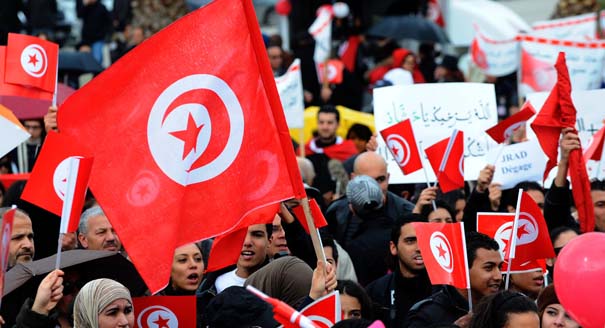
The march took place against a broader backdrop of dissatisfaction. On 17 October, thousands of people joined a demonstration in Tunis organised by the Tunisian General Labour Union (UGTT), opposition groups and civil society organisations. Participants protested against deteriorating living conditions, unemployment and restrictions on political freedoms.
Reuters reported that demonstrators also raised concerns about recurring electricity and water cuts, medicine shortages and the government’s economic management. The convergence of employment demands with wider public grievances suggests that frustration is no longer confined to individual groups or policy areas.
The government has introduced legislation intended to address long-term graduate unemployment, but the gap between legal commitments and practical outcomes remains a central source of frustration.
Law No. 38 of 2020, which provided for exceptional recruitment of long-term unemployed graduates, stalled during implementation amid financial constraints. A new measure, Law No. 18 of 2025, provides for exceptional recruitment into the public sector and civil service. Published in Tunisia’s Official Gazette on 23 December 2025, the law envisages phased recruitment over a period of no more than three years from publication.
The legislation provides a framework for recruitment, including registration through a digital platform and criteria for selecting eligible applicants. But a legal commitment does not itself guarantee that positions will be available at the scale required, that recruitment will proceed on schedule or that applicants will obtain suitable employment.
For graduates who have spent years waiting, the credibility of the policy depends on transparent eligibility rules, published timetables, adequate funding and visible progress. Delays risk deepening distrust in institutions already facing public criticism.
Public-sector recruitment can provide opportunities for some applicants, but it cannot by itself resolve a nationwide employment problem. Sustainable improvement also requires private businesses to expand, new enterprises to emerge and investment to create productive work across different regions.
Tunisia’s economic performance offers a mixed picture. The World Bank reported that the economy grew by 2.7% in 2025 and 2.4% year on year in the first half of 2026. It projected growth of 2.3% for the full year, reflecting a recovery in agriculture, mechanical and electrical industries, and tourism.
These figures indicate continued economic activity, but they do not establish that growth is creating sufficient employment for new graduates or reducing long-term joblessness. The increase in graduate unemployment between the first and second quarters of 2026 illustrates the disconnect.
Anis Ben Said, a tax adviser and university professor quoted by Al Jazeera, argued that Tunisia’s challenge lies in the economy’s ability to convert skills into production, investment and employment. Weak investment, infrastructure shortcomings and unreliable public services can all limit the ability of businesses to expand.
This matters particularly in disadvantaged regions, where access to capital and established business networks may be limited. If economic activity remains concentrated in better-connected areas, graduates from marginalised communities may face additional barriers even when they possess relevant qualifications.
Unemployment is only one part of the pressure on households and businesses. Water scarcity and electricity interruptions have added to Tunisia’s economic difficulties, affecting both everyday life and the ability of enterprises to operate reliably.
In its September 2026 Tunisia Economic Monitor, the World Bank identified water security as an increasingly important factor in the country’s economic prospects. It warned that severe water scarcity, rising import prices and imbalances in public finances remained significant vulnerabilities.
Water shortages can disrupt agriculture, tourism and industrial production. Electricity interruptions can force businesses to suspend operations, lose customers or absorb additional costs. For small enterprises operating on narrow margins, repeated disruptions can threaten their survival and reduce their capacity to employ workers.
Infrastructure investment should therefore be viewed not only as public expenditure but also as a potential foundation for productivity, private investment and job creation. The economic return depends, however, on effective project selection, maintenance and delivery.
The graduate unemployment figures highlight another structural weakness. With unemployment affecting more than one in three female graduates, women face substantially greater difficulty entering the labour market than their male counterparts.
That gap represents more than an individual hardship. When educated women cannot find work, the economy loses potential output, household incomes remain lower than they could be, and public and private investment in education produces a weaker return.
Reducing this disparity requires more than expanding the number of graduates. It also requires a labour market capable of absorbing their skills, accessible employment opportunities and policies that address barriers to women’s participation in paid work.
The same concern applies to young people more broadly. A prolonged period without employment can erode professional skills, weaken confidence and encourage migration. In the supplied Al Jazeera report, a young barber expressed a desire to leave Tunisia by sea, reflecting the desperation that can emerge when people see few prospects at home. Such testimony cannot measure the scale of migration intentions, but it illustrates the human consequences of persistent economic insecurity.
President Kais Saied has presented his political project as an effort to tackle corruption and the failures of the established political class. Since consolidating power in 2021, however, he has faced criticism from opponents and rights groups over the weakening of democratic checks and balances. The government rejects accusations that its actions amount to authoritarian rule.
The October 17 demonstration brought these political concerns together with complaints about unemployment, public services and living standards. Reuters described it as one of the largest protests against Saied in years, reflecting a rare mobilisation across parts of Tunisia’s fragmented opposition and civil society.
Economic grievances do not automatically translate into a single political position. But when joblessness, unreliable services and unfulfilled policy commitments persist, they can undermine public confidence in the government’s capacity to deliver tangible improvements.
For Tunisia, the challenge is therefore both economic and institutional: policies must generate measurable results, and citizens need credible ways to assess whether promises are being implemented.
Tunisia’s graduate unemployment crisis cannot be solved through recruitment legislation alone, nor can moderate economic growth guarantee better living standards without a stronger connection between production and employment.
The immediate test is whether the government can implement its recruitment framework transparently while improving the conditions for private investment, enterprise creation and reliable public services. Progress will need to be measured through actual jobs created, sustained reductions in graduate unemployment and better labour-market outcomes for women and disadvantaged regions.
For graduates such as Ghanmi, the value of education is ultimately judged not by the certificate they receive but by whether it enables them to build a secure and independent life. Tunisia’s wider economic challenge is to make that expectation realistic again.
Sources: Tunisia’s National Institute of Statistics, employment and unemployment indicators for the second quarter of 2026; World Bank, Tunisia Economic Monitor: stronger water management could unlock growth, protect jobs and build resilience; Reuters, Tunisians stage biggest protest in years against President Saied; and Tunisia’s National Assembly, legislative record for Law No. 18 of 2025.
