


















Bangkok protests put IMF austerity advice under scrutiny
Campaigners urge the IMF and World Bank to prioritise climate finance, fairer taxation and social protection, while the Fund argues that vulnerable economies must address worsening fiscal imbalances.
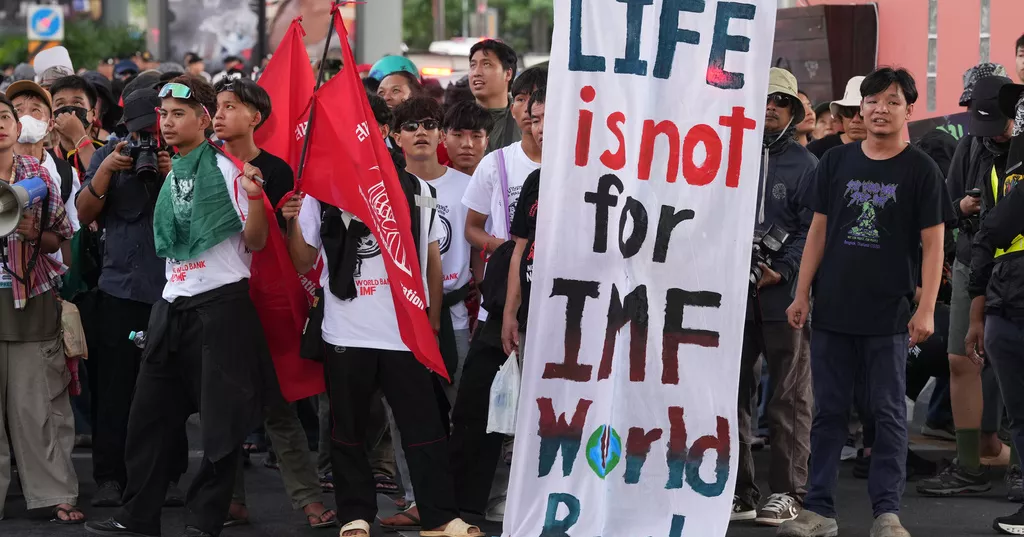
Protesters and development advocates have called on the International Monetary Fund (IMF) and World Bank to reconsider their approach to debt and public spending, warning that fiscal tightening could deepen poverty in developing countries already struggling with rising energy and food costs.
The demonstrations took place on Friday as finance ministers, central bank governors and other policymakers gathered in Bangkok for the IMF and World Bank annual meetings, held from 12 to 18 October. The discussions come amid inflationary pressures linked to the conflict involving the United States and Iran, elevated borrowing costs and mounting public debt.
Among those joining the protest was Sombat Chuekrod, a 51-year-old coconut farmer who travelled more than 200 kilometres to Bangkok. He urged the international financial institutions to reconsider policies that, in his view, risk placing additional pressure on people already living on limited incomes.
“Thai people are already poor. Please don’t make them any poorer,” he said, according to Agence France-Presse.
Protest organisers called for greater emphasis on climate finance and tax reforms that could generate public revenue without placing a disproportionate burden on low-income households. They also opposed broad reductions in subsidies and social expenditure at a time when the cost of living is rising.
The IMF’s position centres on the need for governments to address high debt and rebuild financial buffers after successive crises, including the Covid-19 pandemic and geopolitical shocks.
At the Bangkok meetings, the Fund’s latest economic outlook pointed to resilience in global growth but warned that the recovery remained uneven. Economies exposed to high energy prices and rising financing costs, particularly vulnerable low-income oil-importing countries, face significant risks.
IMF Deputy Director of Research Petya Koeva Brooks acknowledged that the position of vulnerable economies was more difficult but told AFP that governments still needed to address their fiscal balances, either by reducing expenditure or increasing revenue.
The Fund has advocated making energy and food subsidies introduced during the Iran-related crisis more targeted. Such measures can reduce the cost of universal subsidies while directing limited public resources towards households most in need of assistance.
However, the design and implementation of targeted support remain contentious. Identifying eligible households can be difficult, while people just above eligibility thresholds may also struggle with rising prices. Poorly timed or inadequately funded changes can leave vulnerable families exposed before alternative assistance reaches them.
Oxfam executive director Amitabh Behar described the situation as an “inequality emergency”, arguing that fiscal consolidation could undermine public health, education and social security if governments respond to economic pressures through indiscriminate spending cuts.
Lidy Nacpil, one of the protest organisers, said governments in the Global South were being forced to prioritise debt payments over essential services. She called for reforms to address what campaigners regard as unfair debt burdens and unequal access to international finance.
The concerns reflect a broader development challenge: governments need to maintain debt sustainability while protecting investment in human capital and social infrastructure. Spending cuts may improve short-term fiscal indicators, but reductions in health, education and social protection can impose longer-term economic and social costs.
The UN Development Programme has also warned that withdrawing energy subsidies entirely could expose millions more people to poverty. As reported by AFP, the agency cautioned that 130 million people could be pushed into poverty if such support were cut completely. The estimate underscores the potential scale of the risk, although the outcome would depend on the measures adopted and the availability of alternative assistance.
Reza Baqir, a former governor of Pakistan’s central bank who now works in sovereign advisory services at Alvarez & Marsal, said governments must balance the needs of their citizens with the conditions attached to IMF programmes. He also stressed the importance of domestic governance reforms that could strengthen revenue collection, build fiscal reserves and reduce reliance on external assistance.
Christina Segal-Knowles of the Rockefeller Foundation described developing countries as facing two difficult options: borrowing at high interest rates or making deep spending cuts that could undermine development objectives. She called for a renewed approach to growth and investment, including more affordable financing for countries in need.
These arguments point to a financing gap that cannot be resolved solely through expenditure reductions. Countries with weak tax bases, high debt-service costs and limited access to affordable credit may struggle to fund infrastructure, climate adaptation and essential services even when they pursue fiscal reforms.
For the IMF, the challenge is to support credible debt management without worsening the economic vulnerability that makes countries dependent on emergency financing. For governments, improving domestic revenue mobilisation and public spending efficiency may help create more room for social investment, but such reforms take time and can be politically difficult.
The protests in Bangkok highlight a longstanding disagreement over the role of international financial institutions in shaping economic policy. Critics argue that lending conditions can constrain national choices and place the burden of adjustment on lower-income citizens. The IMF, meanwhile, maintains that governments cannot indefinitely sustain large deficits and rising debt without confronting the associated risks.
Neither fiscal consolidation nor continued borrowing is cost-free. The consequences depend on which taxes are raised, which expenditures are reduced, how quickly changes are introduced and whether vulnerable households receive effective protection.
The central policy question is therefore not simply whether governments should cut spending. It is how they can stabilise public finances while preserving the services, investment and social safeguards needed for sustained development.
As the annual meetings conclude, campaigners are pressing the IMF and World Bank to give greater weight to those distributional consequences. Their demands reflect a wider concern among developing countries that the burden of repeated global crises should not fall disproportionately on people with the least capacity to absorb another economic shock.
Sources
- Agence France-Presse (AFP), via Bangladesh Sangbad Sangstha (BSS), 17 October 2026.
- International Monetary Fund, World Economic Outlook, October 2026. IMF October 2026 outlook and briefing
- Associated Press, reporting on protests and inequality during the Bangkok annual meetings, October 2026.
- United Nations Development Programme, warning on poverty risks from energy-price shocks and subsidy withdrawal, as reported by AFP.
