


















Hezbollah admits seized explosives intended for attacks on Israeli troops
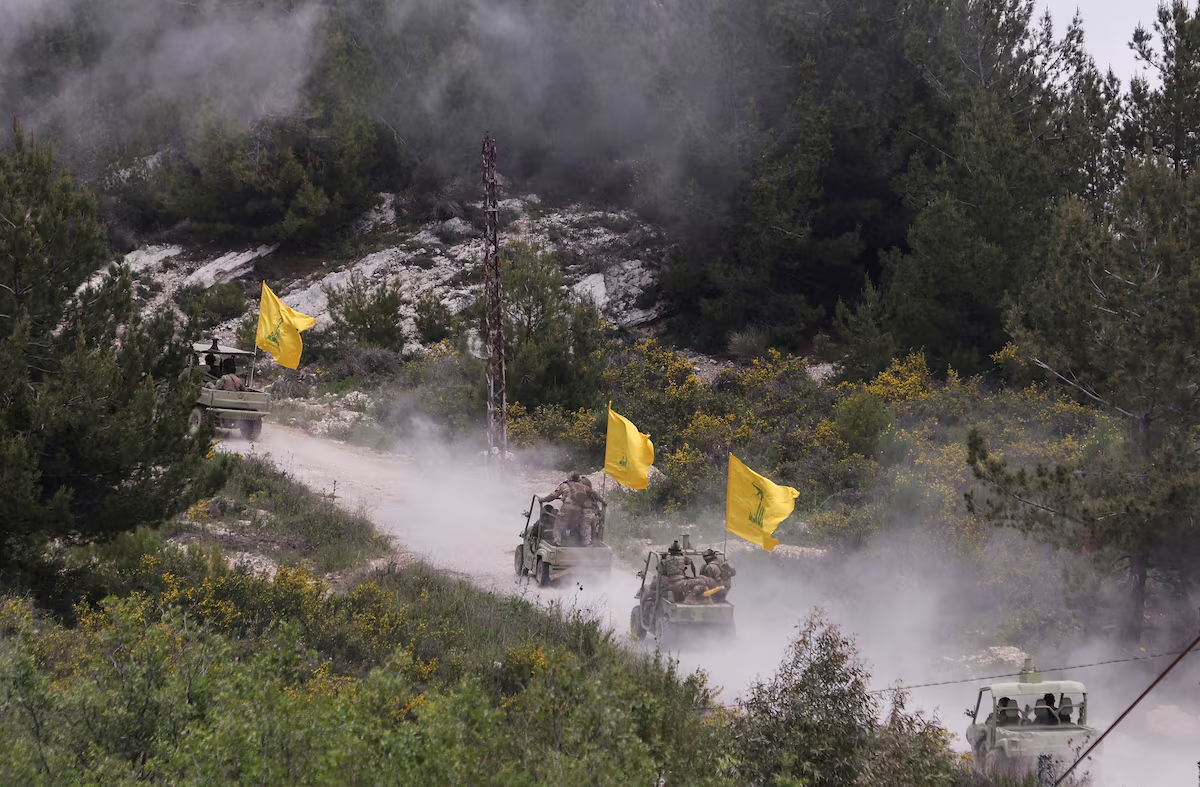
Hezbollah’s acknowledgement that explosives confiscated by Lebanese security forces belonged to the group has sharpened the confrontation between the armed movement and a government seeking to bring all weapons under state control. The admission also exposes the difficulty of enforcing Lebanon’s disarmament policy while Israeli forces remain in Lebanese territory and cross-border hostilities continue.
Reuters reported on 15 October that Hassan Fadlallah, a Hezbollah lawmaker, said the group intended to use the seized explosives against Israel. Lebanese security forces had intercepted a vehicle carrying hundreds of kilograms of explosives at a checkpoint in the eastern Bekaa region the previous week, arresting two people. A Hezbollah official and a Lebanese security source told Reuters the materials were intended for explosive drones targeting Israeli troops.
The intended targets are central to Hezbollah’s justification, but they do not resolve the dispute over the group’s authority to possess and transport weapons. Fadlallah said Hezbollah had contacted security agencies to establish ownership and demanded the return of the explosives and the release of those detained. The Lebanese state, however, has been seeking to end independent armed activity outside its control.
The seizure had initially raised fears that the explosives might be used for car-bomb attacks or other destabilising operations inside Lebanon. Hezbollah’s subsequent exclamation points instead to a claimed military purpose across the border. That claim is attributed to the group and sources cited by Reuters; it does not independently establish how the materials would have been deployed.
Lebanon’s government banned Hezbollah’s military activities on 2 March, after the group fired rockets at Israel in support of Iran, drawing Lebanon further into the regional war. The decision sought to reverse years in which Hezbollah maintained substantial freedom to move military equipment around the country.
The group’s supply network has also faced pressure beyond Lebanon’s borders. Its main weapons route through Syria was disrupted after Bashar al-Assad was ousted in late 2024. Syrian authorities have since announced repeated seizures of weapons near the Lebanese border that they say were intended for Hezbollah.
Lebanese security forces had seized and destroyed Hezbollah weapons depots during 2025 as part of efforts to establish state control over arms. Those efforts were put on hold when the latest war erupted, according to Reuters. The explosives seizure therefore tests whether the government can enforce its policy during an active regional conflict.
President Joseph Aoun reiterated the government’s position during a telephone call with US Secretary of State Marco Rubio on 15 October. According to the Lebanese presidency, Aoun said the army and security forces were implementing measures to prevent armed displays, confiscate weapons and ammunition, and combat smuggling. He added that judicial authorities would pursue cases referred to them.
The dispute is complicated by the terms of a US-brokered framework under which Lebanon has pledged to disarm Hezbollah, with Israeli forces expected to withdraw gradually in return. Hezbollah has rejected disarmament while Israeli troops remain on Lebanese land, while Israel says its continued operations in southern Lebanon are directed against the group.
Aoun urged Washington to pressure Israel to halt attacks on southern Lebanese communities, stop bulldozing activities and allow farmers to access their land safely. The competing demands leave Beirut facing pressure from both sides: it is expected to curb Hezbollah’s military autonomy while seeking an end to Israeli operations on its territory.
The explosives case illustrates the gap between a government’s formal commitment to a state monopoly on weapons and its ability to enforce that commitment amid conflict. Hezbollah’s admission provides Lebanese authorities with a clearer account of the seized cargo, but it also confirms that the group continues to move military material despite the ban.
The broader question is whether Lebanon can implement disarmament without a parallel reduction in the Israeli military presence. Unless the security arrangements underpinning the agreement become more effective, enforcement actions risk becoming isolated episodes rather than a durable transfer of control to the state.
Source:
Reuters — Hezbollah says it owned confiscated explosives, meant to attack Israel — 15 October 2026. Original reporting on Hezbollah’s admission, the seizure and Lebanon’s disarmament policy.
Reuters — Rubio urges Lebanon not to return confiscated explosives to Hezbollah, US official says — 15 October 2026. Follow-up reporting on Washington’s response and the diplomatic implications.
Associated Press (AP) — Hezbollah claims confiscated explosives and denies assassination plans — 15 October 2026. Additional reporting on the cargo’s reported weight and composition, arrests and the competing claims about its intended use.
Axios — Rubio urges Lebanon to resist Hezbollah pressure over seized explosives — 15 October 2026. Additional context on the political significance of the seizure and US pressure on Beirut.
