




















China’s gold buying hedges against financial, geopolitical risk
Beijing is expanding its gold reserves as central banks diversify their assets and Chinese households seek alternatives to uncertain investments. The shift may gradually reshape reserve management, but it does not yet threaten the US dollar’s global dominance.
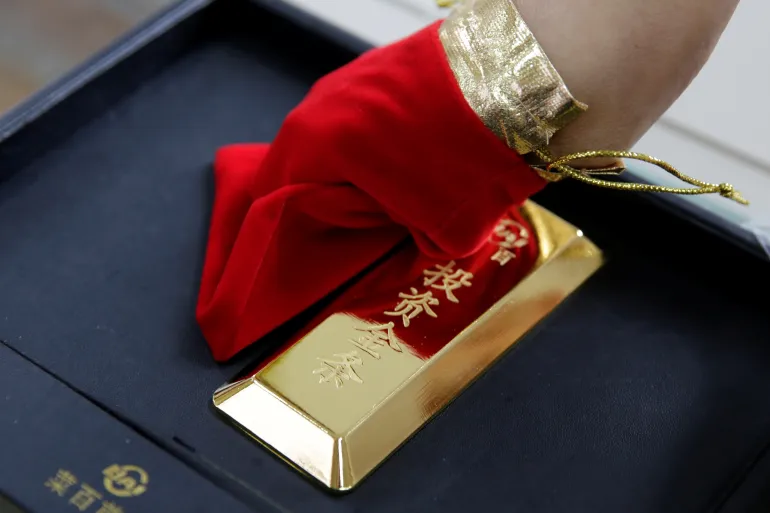
China is stepping up its gold purchases as it seeks to protect its financial reserves from geopolitical tensions, sanctions risks and uncertainty surrounding the global economy. The strategy reflects a broader effort to diversify assets traditionally held in foreign currencies and government bonds, particularly those denominated in US dollars.
The People’s Bank of China (PBoC) bought gold for a 23rd consecutive month in September, adding approximately 23 tonnes, according to figures cited by the World Gold Council. The purchase lifted its reported gold holdings to around 2,410 tonnes, marking the central bank’s largest monthly addition since October 2023. Gold accounted for 8.5% of China’s official reserves at the end of September, up from 5.5% at the end of 2024.
The increase comes amid growing concern among governments about the vulnerability of overseas financial assets during geopolitical disputes. Following Russia’s invasion of Ukraine in 2022, Western governments froze approximately $300bn in Russian central-bank assets held abroad. The episode highlighted how assets located within another jurisdiction can become inaccessible when political relations deteriorate.
For Beijing, domestically held gold offers a form of protection against that risk. Unlike a government bond, gold does not represent a financial claim on another country and cannot be frozen through restrictions imposed on a foreign issuer in the same way as overseas securities. However, gold prices fluctuate, and the metal does not generate interest income, meaning it is a hedge rather than a risk-free substitute for conventional reserves.
China’s strategy also reflects concerns about the scale of US federal debt and the concentration of its international reserves in dollar-based assets. US Treasury securities remain important to global financial markets because of their liquidity and the depth of the market in which they are traded. But holding a substantial volume of another country’s debt exposes an investor to that country’s financial, monetary and political decisions.
US Treasury data show that mainland China held approximately $590.7bn in Treasury securities in August 2026, down from about $699.2bn a year earlier. The decline is consistent with a reduction in China’s reported Treasury holdings, although it does not, by itself, establish that gold purchases caused the change. Valuation movements and other portfolio decisions can also affect reported holdings.
Gold accumulation nevertheless gives Beijing another way to distribute risk across different asset classes. It may become especially valuable during periods of sanctions, financial disruption or declining confidence in government debt. Yet China still needs foreign currencies to settle trade, service international obligations and support cross-border payments.
The US dollar therefore retains structural advantages that gold cannot replicate. It is widely used in international trade and finance, while US Treasury securities provide a large, liquid market for institutions managing substantial reserves.
The more plausible outcome is gradual diversification rather than a sudden abandonment of the dollar. If China and other central banks consistently allocate a greater share of their reserves to gold, demand for some conventional reserve assets could change over time. The broader impact would depend on how many countries follow the same strategy and how quickly their portfolios change.
China’s private gold market tells a related but distinct story. While the central bank is managing national reserves, households are seeking ways to preserve personal savings amid uncertainty over the domestic economy and competing investment options.
The China Gold Association reported that purchases of gold bars and coins increased by 28.4% in the first half of 2026 compared with the same period a year earlier. Weakness in equity markets and continuing problems in the property sector have helped sustain interest in gold as an alternative store of value.
For households concerned about falling property prices or uncertain returns from other investments, gold offers a tangible asset that can be held outside conventional financial products. But it carries risks of its own. Prices can decline sharply, and buyers may face transaction costs and differences between purchase and resale prices.
The recent price decline also illustrates that gold does not always rise when geopolitical or economic uncertainty intensifies. A stronger US dollar and higher returns on government debt can make interest-bearing assets more attractive than gold, which produces no income.
The distinction matters for interpreting Chinese demand. Official purchases are part of a long-term reserve-management strategy, whereas household buying can respond more directly to market sentiment, investment alternatives and domestic economic confidence.
China is not alone in expanding its gold holdings. Several emerging-market central banks have increased their purchases as governments seek to diversify reserves and reduce exposure to risks associated with assets held overseas.
Poland has emerged as a prominent buyer. World Gold Council data show that its central bank purchased 31 tonnes in the first quarter of 2026 and added a further eight tonnes in July. Such activity suggests that gold’s role in reserve management extends beyond China’s particular relationship with the United States.
The trend is not uniform, however. Countries differ in their reserve structures, liquidity needs and exposure to international sanctions. India, for example, has maintained substantial gold holdings, but its reported purchases have been more limited recently than in 2024.
China’s reported holdings also remain well below those of the United States, whose official gold stockpile stood at approximately 8,133 tonnes at the end of 2025. The comparison shows that China’s purchases are significant as a strategic direction, even though the country has not matched the US in the absolute size of its gold reserves.
The wider significance of China’s gold buying lies less in an imminent challenge to the dollar than in the changing priorities of reserve managers. Financial security, geopolitical autonomy and diversification are becoming increasingly important alongside liquidity and returns.
If central banks continue to increase gold allocations, the shift could influence demand for government bonds, reserve portfolios and the global gold market. But gold cannot replace foreign-exchange reserves in every function, and sustained purchases do not guarantee higher prices. Interest rates, currency movements, investor demand and central-bank selling can all affect the market.
For policymakers and investors, the key question is whether the current accumulation represents a limited response to heightened uncertainty or a lasting rebalancing of global reserves. China’s purchases point towards the latter possibility, but the pace and scale of any transformation remain uncertain.
The broader lesson is that countries are seeking more flexibility in how they protect national wealth against external shocks. Gold provides one option. The dollar, supported by deep financial markets and its central role in international transactions, remains difficult to replace.
Sources: World Gold Council — Central bank gold reserves by country; World Gold Council — Central bank gold statistics; US Department of the Treasury — Major foreign holders of Treasury securities; Federal Reserve Bank of St Louis — China’s US Treasury holdings.
