



















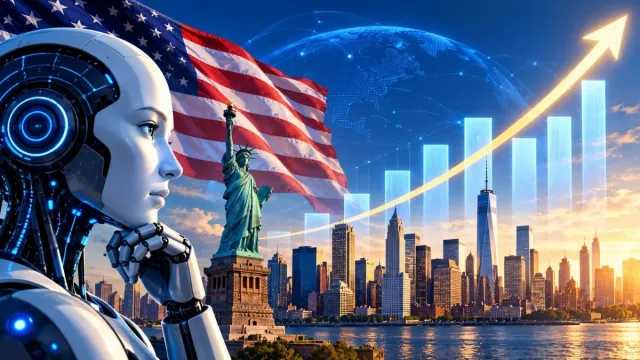
Anthropic sees AI potentially lifting US GDP to $44 trillion by 2030
Co-founder Jack Clark says accelerating AI could transform scientific discovery and create new industries, while warning that job disruption and safety concerns demand urgent international rules
Artificial intelligence could dramatically expand the US economy over the next four years, but realising that potential would require technological breakthroughs, new industries and safeguards against risks ranging from job displacement to biological and cyber threats, according to Anthropic co-founder Jack Clark.
Speaking at the International Monetary Fund and World Bank annual meetings in Bangkok on Saturday, Clark said one of Anthropic’s internal economic models suggested that US economic output could reach $44 trillion by 2030 under certain conditions. That would represent an increase of almost 50% from the current level of just over $30 trillion.
The projection is an internal scenario, not an established economic forecast. Clark himself acknowledged that the figure sounded far-fetched, arguing that such an expansion would require AI to keep improving and generate new industries and inventions capable of supporting substantially greater economic activity.
His remarks highlight a central question for policymakers and investors: whether AI’s rapid technical progress can translate into sustained economy-wide productivity gains, rather than remaining concentrated in a relatively small number of technology companies.
Clark argued that AI is accelerating scientific discovery and could help researchers tackle complex problems in mathematics, engineering and biology. AI systems could also support scientists through large numbers of specialised assistants, potentially speeding up research and the development of new medicines.
Such advances could generate economic benefits beyond the technology sector. Breakthroughs in healthcare, manufacturing and engineering could improve productivity, create new products and services, and open markets that do not yet exist.
However, the economic impact would depend on more than the capabilities of AI models. Businesses would need to adopt the technology effectively, workers would require appropriate skills, and innovations would have to translate into commercially useful products and services.
Clark’s projection therefore rests on several assumptions about the pace of technological improvement and the economy’s ability to turn that progress into additional output. The report does not establish that these conditions will be met by 2030.
AI’s impact on employment remains one of the major uncertainties surrounding its economic potential. Clark acknowledged that some occupations with high exposure to automation, including customer service and call-centre work, were already experiencing job losses.
At the same time, he said AI was supporting employment in areas such as scientific research and could create opportunities in entirely new industries. Whether those emerging jobs compensate for displaced employment remains an open question.
The transition could also create uneven outcomes across sectors and countries. Economies with strong digital infrastructure, skilled workers, reliable electricity and access to computing capacity may be better positioned to capture AI-related investment. Countries lacking these foundations risk receiving fewer benefits, even as the technology reshapes global production.
Clark argued that more countries could participate in the AI economy by helping develop the computing infrastructure needed to run advanced systems. But expanding access would require substantial investment and would not, by itself, guarantee that the resulting economic gains would be widely distributed.
Alongside the potential economic gains, Clark urged governments to establish stronger safeguards as AI capabilities advance. He warned that increasingly powerful systems could be misused in biological research and cyber operations, including activities involving biological or digital weapons.
He identified biological research as an area requiring particularly strict human oversight and transparency. Although he said AI remained under human control, he warned that the opportunity to establish effective safeguards was shrinking as the technology became more capable.
The challenge for regulators is to develop rules that reduce the risk of serious harm without unnecessarily obstructing beneficial research and innovation. Because AI systems and their applications operate across national borders, Clark argued that international cooperation would be essential.
The debate also extends to economic stability. AI-related investment has become an important source of optimism for markets and businesses, but expectations of rapid productivity gains could create vulnerabilities if commercial returns fall short of what investors anticipate.
Clark’s comments come as Anthropic prepares for a potential initial public offering in November. The company has attracted substantial investor interest, although Reuters reported on 15 October that some investors were discussing a valuation of around $1.5 trillion, below earlier expectations of approximately $2 trillion.
The valuation discussion illustrates the distinction between expectations for AI’s long-term economic impact and the commercial performance of individual companies. Even if AI delivers significant productivity gains, that does not guarantee that every AI business will meet investor expectations or justify its projected valuation.
For policymakers, the challenge is broader than predicting the size of the AI market. They must consider how productivity gains will be measured, how employment transitions will be managed, whether infrastructure investment will be accessible to developing economies, and how safety standards can keep pace with technological progress.
The $44 trillion scenario offers a picture of what Anthropic believes may be possible under favourable conditions. It does not establish what the US economy will produce by 2030. The outcome will depend on the interaction of technology, investment, public policy, labour markets and the emergence of new sources of economic value.
Sources: This report draws on Reuters’ coverage of Jack Clark’s economic projection and policy warnings, the IMF’s official programme for its 2026 Annual Meetings, which lists Clark among the speakers discussing AI and the global economy, and the Associated Press’ report on AI risks and regulatory concerns raised during the meetings. Reuters’ report on investor expectations for Anthropic’s potential IPO valuation provides additional financial context. The GDP figure is attributed to Anthropic’s internal modelling and should not be interpreted as an independently validated forecast.
