







France’s protests expose the economic pressures behind political crisis
Mass demonstrations over living costs and deteriorating school conditions have renewed pressure on Emmanuel Macron’s government, while clashes and arrests raise questions about public order, social inequality and political accountability.
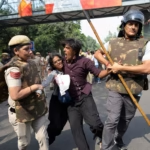
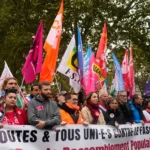
France has experienced another day of mass demonstrations against rising living costs and poor school conditions, with clashes between protesters and police leading to nearly 1,000 arrests on Saturday. The demonstrations remained largely peaceful for much of the day, but confrontations in Paris, Marseille, Bordeaux and other cities prompted police to deploy tear gas and water cannon. The scale of the mobilisation suggests that the unrest is not simply a law-and-order problem: it reflects broader dissatisfaction with living standards, public services and the government’s response to social demands.
The French Interior Ministry estimated that 410,000 people participated in Saturday’s protests, while trade unions put the figure at approximately 800,000. According to reporting by Reuters, around 110,000 people joined the main demonstration in Paris. The gap between the official and union estimates reflects competing assessments of the turnout, but both figures indicate a substantial nationwide mobilisation. Authorities deployed approximately 70,000 police officers and gendarmes in an effort to prevent a repeat of the previous weekend’s widespread disorder.
The latest demonstrations follow protests on 17 October that drew hundreds of thousands of participants and were followed by extensive looting, property damage and clashes with police. The unrest initially grew from student demonstrations over school conditions before broadening into a movement addressing the cost of living, inequality and public services. Businesses reported substantial damage from the earlier disturbances, adding an economic cost to the political crisis.
The protests have brought together concerns that are related but not identical. Rising living costs affect household purchasing power, while poor school conditions and inadequate public services shape perceptions of whether government spending and policy are meeting everyday needs. Students, workers and trade unions have called for improvements in education, better-resourced public services and measures to address financial pressures.
These demands point to a wider question facing advanced economies: how effectively can economic growth translate into improved living standards for households experiencing pressure on their budgets? France has substantial public institutions and social protection mechanisms, but the existence of these systems does not eliminate disagreements over the affordability of daily life, the quality of public services or the distribution of economic resources.
The protests alone do not establish that a single economic factor caused the unrest. Nor do the accounts of individual demonstrators establish how widely each grievance is shared. However, the breadth of the mobilisation, from students to organised labour, indicates that the demonstrations have moved beyond a narrowly defined dispute over schools. Their expansion suggests that economic concerns are increasingly intersecting with broader questions of trust in government and the perceived responsiveness of public institutions.
For policymakers, this presents a challenge that cannot be resolved through policing alone. Security measures may prevent violence and protect businesses, but they do not address the demands that bring people onto the streets. A sustained response would require the government to explain its economic choices, engage with organised labour and students, and demonstrate whether practical improvements to public services and household finances are possible.
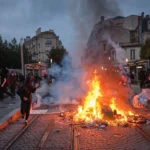
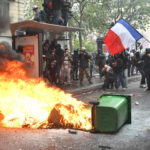
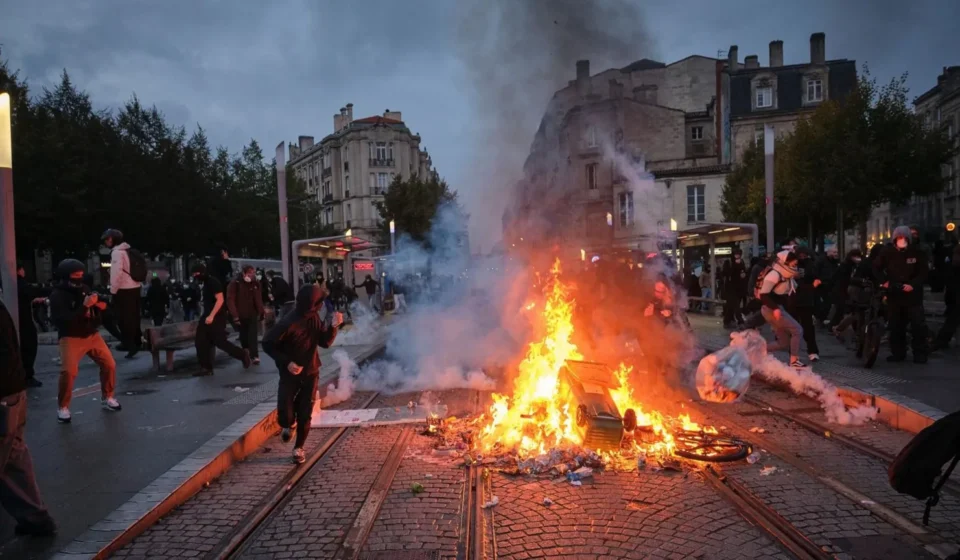
The authorities’ strategy on Saturday combined a substantial security deployment with restrictions on demonstrations in several locations. The result was a day of large rallies followed by isolated but serious clashes. Police used tear gas and water cannon in several cities, while some groups set fire to barricades, damaged property and threw objects at officers.
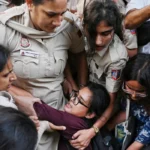
Interior Minister Laurent Nuñez said nearly 1,000 people had been arrested and warned that the total could rise. He also reported two people seriously injured, one in Toulouse and another in Clermont-Ferrand. These figures describe the scale of the police response, but arrests should not be treated as proof that every person detained committed a violent offence. The circumstances and legal outcomes of individual cases remain relevant.
The distinction between peaceful demonstrators and those involved in violence is central to assessing the unrest. A large protest movement can include people with different motives and methods. The actions of masked groups involved in vandalism do not, by themselves, establish the intentions of the wider crowd. Equally, the existence of legitimate grievances does not justify attacks on people, businesses or public property.
The French government must therefore navigate two responsibilities: protecting public safety and preserving the ability of citizens to demonstrate peacefully. Restrictions and large police deployments may reduce immediate risks, but if they are perceived as suppressing dissent rather than distinguishing lawful protest from violence, they could intensify the political dispute.
The experience of the previous weekend has increased pressure on the authorities to prevent further destruction. Yet the effectiveness of the response should be assessed not only by whether streets remain calm, but also by whether law enforcement is proportionate, legal proceedings are fair and peaceful political participation remains possible.
The demonstrations have become a political challenge for President Emmanuel Macron’s government as France approaches its next presidential election, scheduled for 2027. Political opponents have sought to attribute responsibility for the unrest to the government, while protesters have voiced frustration over taxation, living costs, school conditions and their prospects for the future.
The approaching election gives the demonstrations additional significance. Political parties can use the unrest to argue that the government has failed to respond to economic insecurity or to maintain public order. But the existence of public anger does not, by itself, determine how voters will behave or which political forces will benefit. The impact will depend on how the crisis develops, the credibility of competing policy proposals and whether the government can demonstrate tangible progress.
The protests also create an opening for parties offering sharply different responses to France’s economic and social difficulties. The far-right National Rally has faced demonstrations opposing its political agenda, while left-wing groups and trade unions have supported demands for economic and public-service reforms. These competing mobilisations show that dissatisfaction with the current situation does not translate into a single political programme.
For the government, the central task is to address the underlying concerns without allowing the public debate to be reduced to a choice between disorder and repression. Restoring calm may be necessary in the short term, but a durable political response requires credible engagement with the economic and social issues driving participation.
France’s unrest has occurred alongside demonstrations and confrontations elsewhere in Europe. The BBC reported arrests following a student protest in Barcelona, clashes involving anti-government demonstrators in Albania’s capital, Tirana, and tensions in Brussels. Authorities in Milan mounted a major security operation amid fears of renewed violence.
The events do not establish that a single coordinated movement is operating across the continent. National protests can emerge from different domestic circumstances, even when concerns such as affordability, inequality and dissatisfaction with public services are shared. The similarities nevertheless raise questions about how governments across Europe are responding to social pressure and how local grievances can expand into wider challenges to political legitimacy.
For the European economy, the immediate costs of unrest include damage to shops and other businesses, disruption to transport and commercial activity, and the expense of extensive policing. The longer-term implications are less direct and depend on whether the protests alter policy, investment confidence or political outcomes. It would be premature to infer a broad economic downturn from the demonstrations alone.
The more important issue is whether governments can respond to social discontent before it becomes entrenched in cycles of confrontation. Security operations can contain immediate disorder, but economic and institutional grievances require political solutions. Failure to distinguish between the two risks leaving the causes of unrest unresolved.
Three developments will help determine the direction of the crisis: whether the government can engage protesters and organised labour over their demands; whether authorities can prevent renewed violence while protecting peaceful assembly; and whether the demonstrations translate into sustained political pressure ahead of the 2027 election.
The difference between the official turnout estimate and the unions’ figure also illustrates the importance of transparent reporting. Reliable assessments of participation, arrests, injuries and property damage are necessary to understand the scale of the unrest without exaggerating or minimising it. The same standard should apply to claims about the causes of the demonstrations and the political preferences of those involved.
France’s immediate challenge is to restore public safety after successive weekends of unrest. Its broader challenge is to address the economic pressures and public-service concerns that have brought large numbers of people into the streets. Treating every demonstrator as a threat would obscure the diversity of the movement; treating every act of violence as an acceptable expression of grievance would undermine public safety and the rights of others.
The future course of the protests will depend partly on the government’s response. But the underlying question extends beyond one president or one election: whether democratic institutions can demonstrate that public concerns about living standards, education and inequality lead to meaningful political engagement rather than recurring confrontation.
Sources: Associated Press — More than 400,000 protest across France as Paris clashes erupt, Reuters — Violence flares in Paris after largely peaceful protests across France, Le Monde — Viral footage of violence from French protests fuels competing narratives.
