


















Pakistan leads global debt to China ranking
Developing economies across Asia and Africa account for the largest outstanding obligations to Chinese creditors, renewing debate over infrastructure financing, debt sustainability and financial dependence.
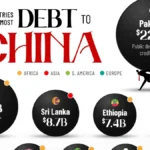
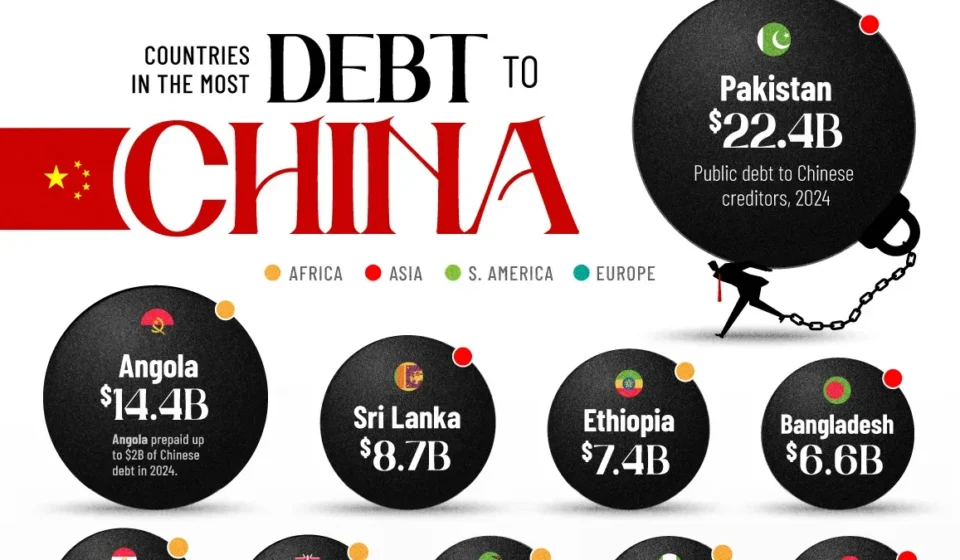
Pakistan owed Chinese creditors $22.38 billion at the end of 2024, the largest amount among countries covered by a new global ranking published by Visual Capitalist. Angola followed with $14.40 billion, ahead of Sri Lanka at $8.69 billion and Ethiopia at $7.44 billion. Bangladesh ranked fifth, with $6.63 billion in outstanding long-term public and publicly guaranteed debt to Chinese creditors. Egypt, Kenya, Zambia, Nigeria and Laos completed the top 10, each owing between $5.31 billion and $5.91 billion. The figures are drawn from the World Bank’s International Debt Statistics and cover reported debt balances in 2024, rather than all forms of borrowing from China.
The ranking highlights the scale of China’s role in financing infrastructure and development across emerging economies. In Pakistan, Chinese funding has supported power generation, transmission infrastructure and transport projects under the China–Pakistan Economic Corridor. Completed projects had added more than 8,900 megawatts of electricity capacity to Pakistan’s grid by late 2024, according to the Visual Capitalist analysis. In East Africa, Chinese loans financed about 90% of the cost of Kenya’s Mombasa–Nairobi railway, connecting the capital with the country’s principal seaport. Chinese contractors have also participated in railway construction and related infrastructure elsewhere in the region. Such investments can improve transport links, electricity supply and productive capacity, although their economic returns depend on utilisation, project costs and the ability to generate sufficient revenue.
The risks become more pronounced when debt repayments compete with spending on public services and economic development. Angola’s outstanding debt to Chinese creditors stood at $14.40 billion in 2024, down from its 2018 peak of $22.9 billion, according to the analysis. Its repayment capacity remains exposed to global oil prices. Pakistan, meanwhile, received a one-year extension from China in March 2025 to repay a $2 billion loan, illustrating how refinancing and repayment extensions can become important tools for managing financing pressures. Such arrangements may ease immediate cash-flow constraints, but they do not necessarily eliminate the underlying debt burden.
The figures have also fuelled debate over so-called “debt-trap diplomacy”, the argument that large loans can create financial dependence and give creditors strategic leverage. Sri Lanka, which owed Chinese creditors $8.69 billion in 2024, is frequently cited in discussions surrounding Chinese-financed infrastructure, including the Hambantota port. However, the scale of a country’s debt to China alone does not establish that it has been deliberately trapped in unsustainable borrowing. Domestic fiscal decisions, project viability, foreign-exchange earnings, global market conditions and borrowing from other creditors all influence debt distress. The ranking should therefore be read as a measure of outstanding exposure to Chinese creditors, not as a direct league table of countries facing the greatest risk of default.
For the global economy, the central question is not simply how much developing countries owe Beijing, but whether the investments financed by those loans generate enough economic and fiscal returns to service the debt. Countries with substantial Chinese obligations face different circumstances: oil revenues influence Angola’s repayment capacity, infrastructure and refinancing needs shape Pakistan’s position, and debt sustainability depends on a broader mix of creditors and economic conditions in Bangladesh and other borrowers. Transparent loan terms, credible project assessments, stronger revenue collection and prudent borrowing remain important to ensure that development finance supports long-term growth rather than intensifying fiscal pressure.
Sources: Visual Capitalist: Ranked — Countries With the Most Debt to China (published 22 October 2026), Republished ranking with the full top 35 countries and debt figures, World Bank: Bangladesh’s external debt by creditor, World Bank: Pakistan’s external debt by creditor, World Bank: International Debt Report 2025 and data resources.
