

















Bangladesh-India ties tell different stories across South Asian media
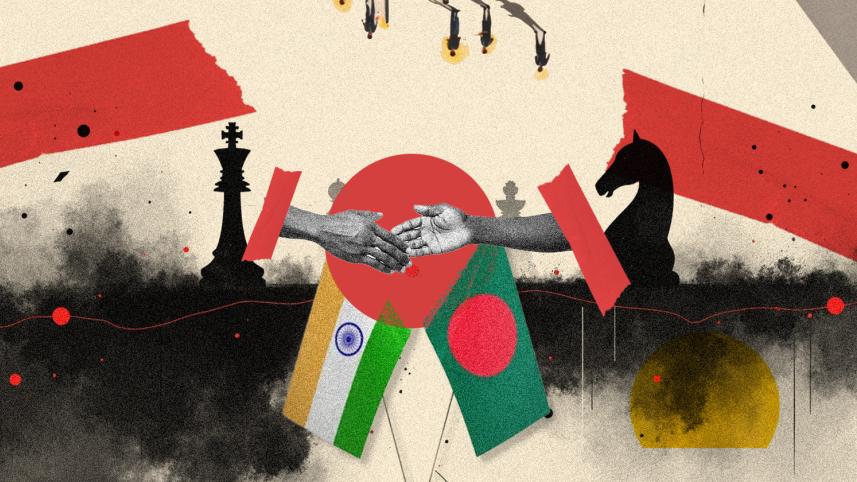
TLE Desk: The relationship between Bangladesh and India is being described across South Asian media through markedly different narratives, even as the two neighbours continue to trade, negotiate and maintain official contact amid political and diplomatic differences.
In Bangladesh, recent coverage has increasingly presented the relationship as one of rebalancing. Indian media and strategic commentary, meanwhile, have tended to place greater emphasis on New Delhi’s security concerns, political uncertainty and the future of its influence in Bangladesh. At the same time, business coverage on both sides points to a less dramatic reality: commercial interests continue to connect the two economies even when politics becomes strained.
The contrast has become particularly visible after Bangladesh’s Prime Minister Tarique Rahman did not attend the BRICS summit hosted by India in New Delhi earlier this month. Deutsche Welle reported that Bangladesh’s absence raised fresh questions about bilateral relations, with the unresolved issue of former prime minister Sheikh Hasina’s presence in India remaining an important obstacle to normalisation. The report also noted that relations had improved since Rahman took office but remained far from fully normalised.
For Bangladeshi audiences, however, the relationship is increasingly being discussed not only through the question of India but through Bangladesh’s wider foreign-policy options. Recent analysis in The Daily Star argues that Dhaka is attempting to navigate relations with India, China and the United States while maintaining greater strategic flexibility. The framing shifts the central question from whether Bangladesh remains within India’s traditional sphere of influence to how Dhaka can manage relationships with several major powers simultaneously.
That is a significant narrative change.
For years, much of the bilateral discussion was organised around the idea of Bangladesh-India friendship, historical ties and regional connectivity. The current coverage increasingly asks what kind of relationship Bangladesh wants in an environment where China, the United States, Japan and other external powers are also important to its economic and strategic interests.
Some Indian media and commentary take a more security-oriented approach. Bangladesh’s developing relationship with China, questions over the future of Indian influence and political developments in Dhaka are often treated as matters with direct strategic implications for New Delhi. A recent Times of Bangladesh analysis, for example, criticised sections of Indian television and digital media for treating Bangladesh primarily through India’s strategic interests, particularly following Bangladesh’s engagement with China.
Such criticism itself has become part of the regional media narrative. Bangladeshi commentators increasingly question whether Indian coverage treats Bangladesh as an independent political actor or primarily as a security and geopolitical concern for India.
But the economic story is considerably more complicated than the political headlines suggest.
Bangladesh’s exports to India increased 7.67 per cent year-on-year to $335.2 million in July-August of the 2026-27 financial year, according to Export Promotion Bureau data reported by bdnews24.com. The previous year’s figure for the same period was $311.3 million. Despite diplomatic tensions, the data indicate that bilateral trade has not collapsed.
The broader trade relationship remains heavily asymmetric. Bangladesh exported about $1.75 billion worth of goods to India in fiscal 2025-26, while its imports from India were substantially larger, leaving Bangladesh with a bilateral trade deficit of more than $12 billion.
That imbalance is itself framed differently on the two sides.
In Bangladesh, the trade deficit is frequently presented as evidence that Dhaka needs greater market access for its products in India. In recent discussions with Indian officials, Bangladesh Bank Governor Md Mostaqur Rahman called on India to increase imports from Bangladesh to help improve the bilateral trade balance. He also proposed expanding cooperation in cross-border digital payments, including Bangla QR, and invited greater Indian investment in technology, manufacturing and industrial sectors.
Indian officials, meanwhile, have recently emphasised removing barriers to trade and investment. India’s Deputy High Commissioner in Dhaka, Pawan Kumar Badhe, called for stronger bilateral commercial ties and proposed a business-to-business task force between the two countries. He also urged the removal of tariff and non-tariff barriers.
The difference between political and economic narratives is therefore striking. While political coverage frequently describes the relationship as strained, business officials on both sides are simultaneously discussing ways to increase trade.
The situation at the border provides another example.
In early September, import-export activity through Bangladesh’s Hili land port was suspended for six days because of an indefinite strike by Indian traders. When the strike ended, trade resumed and trucks again began moving between the two countries. BSS reported that the suspension had caused financial losses for traders, while passenger movement through the immigration checkpoint continued normally.
Here, the story is not primarily about geopolitics. It is about traders, transport workers, customs officials and trucks waiting at a border.
That human dimension is often lost when bilateral relations are reported only through diplomatic statements.
The same is true of energy. Nepal, India and Bangladesh are becoming increasingly interconnected through electricity trade, but India’s regulatory decisions remain important to the flow of Nepali electricity to Bangladesh. Recent reporting showed that India renewed approval for Nepal to import up to 654 megawatts, while permits for several Nepali hydropower projects exporting electricity to Bangladesh had expired.
The episode demonstrates a wider South Asian reality: regional economic integration increasingly depends not only on political agreements but also on regulatory decisions made by the region’s largest economy.
For Bangladesh, this makes the relationship with India difficult to separate from questions of energy security, transport connectivity, border trade and access to markets.
Water remains perhaps the most politically sensitive example.
The unresolved Teesta water-sharing agreement continues to occupy an important place in Bangladeshi coverage. The Daily Star recently described the river as increasingly connected not only to water allocation but also to Indian federal politics, agriculture, climate change and the wider strategic relationship between Dhaka and New Delhi. The proposed 2011 arrangement envisaged 42.5 per cent of the dry-season flow for India and 37.5 per cent for Bangladesh, but opposition from West Bengal prevented the agreement from being concluded.
The significance of this framing is that the Teesta is no longer treated simply as a bilateral technical dispute.
For Bangladeshi media, it can represent questions of water security and sovereign rights. In Indian coverage, particularly when West Bengal’s interests are considered, the issue can instead be framed around the needs of Indian states, farmers and federal politics.
The same river consequently becomes a different political story depending on which side of the border is telling it.
The divergence becomes even clearer when security issues enter the news cycle. Indian outlets frequently focus on illegal migration, border enforcement and smuggling. Recent Indian reporting on a joint Directorate of Revenue Intelligence and Border Security Force operation, for example, described the seizure of around 12 kilograms of foreign-origin gold worth nearly 170 million Indian rupees in operations linked to smuggling routes through Bangladesh.
Bangladeshi media can approach border developments from a different starting point, often giving greater attention to border deaths, treatment of Bangladeshi nationals and the conduct of Indian border forces.
The difference does not necessarily mean that one side is reporting facts while the other is inventing them. More often, the selection of facts changes the perceived nature of the relationship.
An Indian report centred on illegal migration produces a security narrative.
A Bangladeshi report centred on border deaths produces a rights and sovereignty narrative.
A business report on rising exports produces an economic-interdependence narrative.
A diplomatic report on BRICS produces a strategic-realignment narrative.
All four can describe elements of the same bilateral relationship.
This is why the Bangladesh-India story is particularly useful for South Asian media monitoring. The question is not simply whether newspapers are pro-India or anti-India, or whether Bangladeshi outlets are nationalist while Indian outlets are strategic.
The more revealing question is which relationship each newsroom is constructing for its audience.
In one narrative, India is Bangladesh’s indispensable neighbour and largest regional economic partner. In another, India is a powerful neighbour whose influence needs to be balanced against relations with China and other powers. In Indian strategic coverage, Bangladesh can appear as a crucial security and connectivity partner whose political direction has consequences for India’s northeast and Bay of Bengal interests.
Meanwhile, businesses on both sides are dealing with a much more practical reality.
A Bangladeshi exporter wants access to Indian consumers. An Indian company wants access to Bangladesh’s market. A truck driver wants the border to remain open. A factory wants uninterrupted supplies. A power producer wants its electricity approved for export. A farmer wants predictable water flows.
Those interests do not disappear when diplomatic relations become tense.
That is perhaps the central contradiction visible in current South Asian media coverage: politics is becoming more contested while economic interdependence remains difficult to unwind.
The emerging Bangladesh-India story is therefore not simply one of friendship or confrontation. It is a relationship being renegotiated across several layers at once—diplomacy, trade, energy, water, border security and regional geopolitics.
And the media are telling those layers differently.
For regional media researchers, that difference is the story itself. The same border can be a security frontier in one newspaper, a commercial corridor in another and a symbol of sovereignty in a third. The same trade figures can be used to demonstrate economic resilience, structural imbalance or the continuing importance of bilateral relations.
The facts overlap. The frames do not.
That gap between what happened and what the audience is encouraged to see as the meaning of what happened offers one of the clearest windows into South Asia’s changing regional narrative.
