



















Agentic AI signals paradigm shift in industrial robotics
Researchers at UC Berkeley and NVIDIA are developing a system in which AI agents generate, simulate and refine robot-control programmes, potentially reducing the time and data required to bring new robotic capabilities into industrial settings.
Artificial intelligence could be changing how industrial robots are developed and programmed, as researchers explore a new approach known as agentic robotics. The method uses teams of AI agents to generate robot-control programmes, test them in simulated environments and improve their performance before deployment in physical machines.
Ken Goldberg, a robotics professor at the University of California, Berkeley, and Spencer Huang, director of robotics engineering at NVIDIA, are among the researchers developing the approach. In a report published by UC Berkeley News on 9 November, Goldberg described it as a fundamental change in how robots are controlled, potentially addressing two longstanding constraints: the extensive engineering required to programme robots and the enormous quantities of data needed to train them.
The research combines agentic AI with simulation and a structured framework for organising robotic tasks. Rather than requiring engineers to programme every behaviour individually or train robots through vast collections of demonstrations, AI agents can assemble individual skills into complete programmes, test different approaches and revise them when failures occur.
Robotics has traditionally relied on two broad approaches. In model-based robotics, engineers directly programme the systems responsible for perception, movement planning and physical control. This offers a structured way to develop robot behaviour but can require substantial engineering work.
Model-free approaches, by contrast, allow robots to learn behaviours from demonstrations through techniques such as imitation learning. However, these methods depend on large amounts of training data and can take considerable time and resources to develop.
Goldberg has previously highlighted what he called a “100,000-year data gap” between the information available to train language models and the data needed to teach robots real-world physical skills.
Agentic robotics is intended to bridge part of that divide. The researchers argue that AI agents can generate and refine robot programmes using existing task information and simulations, reducing the need to collect additional physical training data for every behaviour.
The method is built around a framework called Graph-as-Policy. It breaks complex robotic assignments into smaller skills, such as locating an object, planning a grasp and moving a robotic gripper without causing collisions. AI agents then connect those components into a larger programme.
Using NVIDIA’s Isaac simulation framework, the agents can rehearse the programme across different task conditions, identify failures and revise their approach. Human engineers remain responsible for interpreting the results, fine-tuning programmes and verifying their reliability.
A demonstration involving a sponge and a metal bar illustrated how the system can work. Researchers Eric Kaiyuan Chen and Shuangyu Xie, both postdoctoral researchers working with Goldberg, gave OpenAI’s Astra model access to a simulation interface and a short video of a robot wiping ink from a metal bar.
According to Goldberg, the model developed and refined a physics simulation in less than an hour. The simulation reproduced details of the task, including the deformation of the sponge as it interacted with the metal surface.
The researchers then combined the simulation with their Graph-as-Policy framework. The AI generated a robot-control programme and repeatedly tested and improved it in the simulated environment. When the resulting programme was transferred to a physical robot, it worked.
The process also exposed a limitation. During one trial, the robot pushed the metal bar over because it had not reliably inferred the object’s mass. Researchers used video of the failed attempt to help the AI improve the simulation, revise the control programme and test another approach.
The example demonstrates an important feature of the method: failure can become information for subsequent refinement rather than requiring engineers to restart the entire programming process.
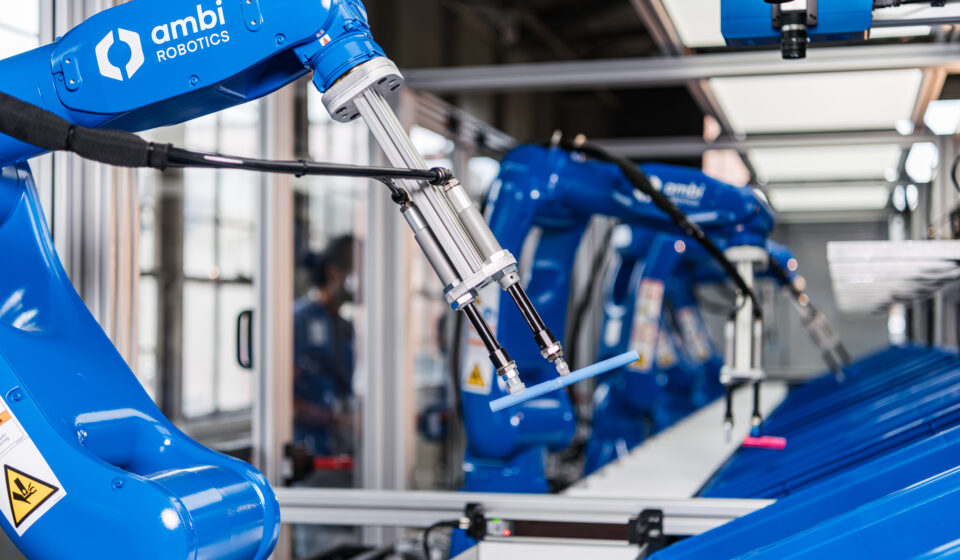
The approach has also been tested in a commercial environment. Berkeley-based Ambi Robotics, which develops systems for logistics and warehouse order fulfilment, used agentic robotics methods to analyse parcel-sorting data and test updates to robot behaviour.
The company reported an increase in capacity equivalent to more than 15,000 additional packages sorted annually per robot. The change has since been deployed across 30% of its US fleet.
Jeff Mahler, Ambi Robotics’ co-founder and chief technology officer, said the method had helped convert production data into improvements in robot behaviour while keeping engineers involved in the process.
The result points to a potential commercial advantage in industries where tasks are repetitive and performance can be measured at scale. Warehousing, logistics and manufacturing could benefit from systems that can test operational changes more quickly and improve throughput without requiring extensive manual reprogramming.
However, the reported productivity gain comes from a particular industrial application. It does not establish that comparable improvements will occur across all types of robots or working environments.
Goldberg and his collaborators are releasing open-source code built on NVIDIA’s Isaac simulation framework to allow other researchers and developers to experiment with the approach.
They have also introduced the Variational Automation Benchmark, or VABAR, intended to provide an industry-focused standard for evaluating robotic performance across different industrial tasks.
Such benchmarks are important because improvements demonstrated in a single simulation or factory environment may not translate automatically to other conditions. Standardised testing can help researchers compare systems and assess how reliably they perform across different tasks.
The work is being presented at the Conference on Robot Learning, alongside the release of the research tools. The researchers’ longer-term objective is to make robot programming faster and more adaptable while retaining the verification and control required in industrial systems.
The immediate implications are most visible in industrial environments, where tasks are structured, repetitive and supported by measurable production data. More adaptable robots could help businesses improve productivity, reduce programming time and respond more quickly to changes in operational requirements.
The technology is not yet a demonstration that general-purpose household robots are ready for everyday domestic work. Goldberg cautioned against expecting robots to fold laundry reliably in the near future. Physical environments remain unpredictable, and systems must still demonstrate dependable performance outside controlled simulations.
The approach also places human oversight at the centre of the development process. AI agents can generate and test programmes, but engineers must assess how those programmes work, verify their safety and determine whether they are suitable for deployment.
For the robotics industry, the significance may lie less in replacing human engineers than in changing how they work. If AI agents can automate parts of programme generation, testing and refinement, engineering teams may be able to develop and adapt robotic systems with fewer manual iterations.
Goldberg compared the moment with the public release of the World Wide Web in 1993 and the arrival of ChatGPT in 2022, describing agentic robotics as a practical combination of classical control theory, physics and rapidly developing agentic coding.
Whether the approach becomes a broad industrial standard will depend on its performance across different machines, tasks and operating conditions. Its early results nevertheless suggest that agentic AI could help address some of the longstanding barriers to scaling physical automation.
Sources
- UC Berkeley News — Recent advances in AI are creating a ‘paradigm shift’ for robotics, 9 November 2026
- Agentic Robotics — UC Berkeley research overview
- Graph-as-Policy — Research paper
- Variational Automation Benchmark (VABAR)
- RoboSimStudio — Simulation demonstrations
- NVIDIA Isaac — Robotics simulation framework
