








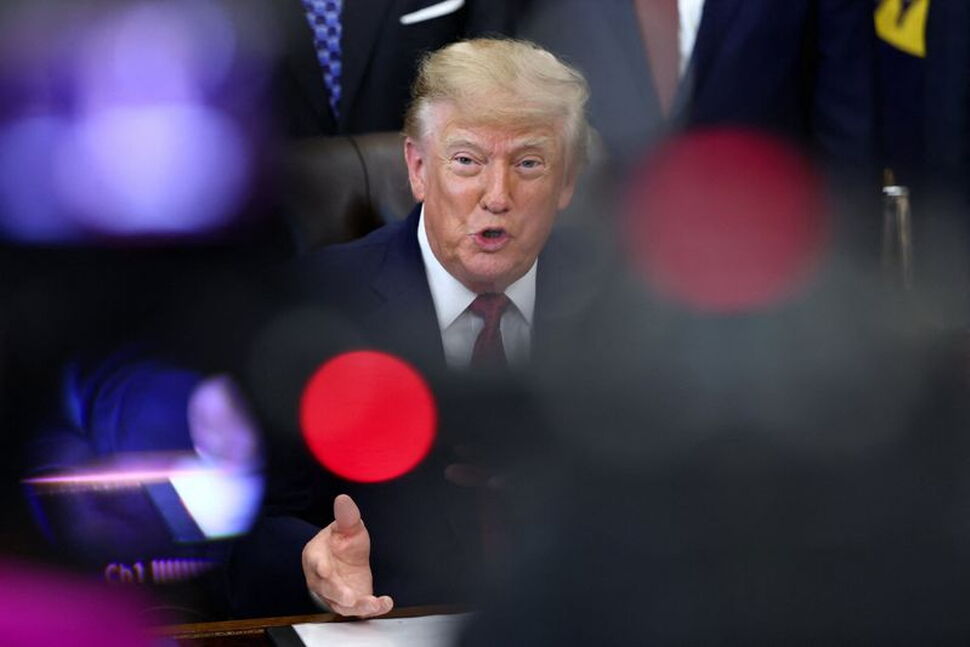
Nobel Peace Prize faces a political shadow as Trump spectre looms over Oslo
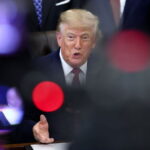
The Nobel Peace Prize has always carried a political weight beyond the identity of its recipient. This year, however, that weight is particularly visible before the winner has even been announced, as the “spectre” of US President Donald Trump hangs over Friday’s decision in Oslo.
Trump’s own campaign for the prestigious prize has been unusually persistent. Since returning to the White House in January 2025, the Republican president has repeatedly expressed his desire for the award and made clear his disappointment at not receiving it.
But experts cited by AFP say his prospects appear limited, pointing to the political controversies surrounding his administration, including its confrontation with Iran, territorial ambitions involving allies and criticism of international institutions and the media.
The significance of Trump for this year’s prize, however, goes beyond whether his name appears on the committee’s confidential list of nominees.
Whatever the Norwegian Nobel Committee decides, analysts believe the choice could be interpreted through the prism of the US president’s policies and his relationship with international institutions.
Trump is “the spectre in the room”, said Haakon Gjerlow, head of the Peace Research Institute Oslo (PRIO).
For the committee, that creates an unusual dilemma: how to make an independent decision while recognising that the political consequences of the award could be significant.
Gjerlow suggested that the committee may have to consider whether its decision could produce unintended consequences, particularly in its relationship with the White House.
The Nobel Institute, however, insists that political pressure does not determine its decisions.
Kristian Berg Harpviken, secretary of the Norwegian Nobel Committee, told AFP that lobbying and attempts to influence the committee were nothing new. Such pressure, he said, was discussed but did not determine the deliberations or the final decision.
That tension between independence and political consequence has become particularly important because the Peace Prize is not simply an award for an individual achievement. It can also function as a global statement about the values the committee believes deserve recognition at a particular moment.
Last year’s award went to Venezuelan opposition leader Maria Corina Machado, a choice that was broadly compatible with Trump’s political outlook. Machado subsequently gave Trump her Nobel medal, saying he deserved it after the capture of Venezuelan President Nicolas Maduro, although she did not secure the political support from Trump that she had sought.
This year’s committee could therefore face pressure to select a recipient whose work is difficult to interpret as a direct confrontation with the US president.
Among the possibilities mentioned by experts are humanitarian and children’s-rights organisations, including Save the Children, as well as Ukrainian children’s rights activist Mykola Kuleba, who has campaigned for the return of children taken to Russia from occupied Ukrainian territories.
Another possible direction could be Sudan, where Emergency Response Rooms have built a large volunteer network providing assistance to people caught between war and hunger.
But the committee could also choose a recipient whose work directly touches some of the most contentious questions in international politics.
Experts cited by AFP have mentioned Francesca Albanese, the UN special rapporteur on the occupied Palestinian territories; Pope Leo XIV; the Committee to Protect Journalists; and international judicial institutions such as the International Criminal Court and the International Court of Justice.
Such choices would inevitably carry a stronger political interpretation, particularly at a time when the role of international institutions is being openly contested by powerful states.
Nobel historian Asle Sveen described the present international environment as an “age of predators”, pointing to leaders including Trump, Russian President Vladimir Putin and Israeli Prime Minister Benjamin Netanyahu. He argued that major powers increasingly favour spheres of influence over a rules-based international order and suggested that international courts represent an obstacle to that approach.
Those comments reflect one of the central questions surrounding this year’s prize: whether the committee will emphasise humanitarian work, defend international institutions or use the award to draw attention to threats to peace and international law.
The committee has 287 nominees to consider, although the identities of nominees remain secret for 50 years. Being nominated also does not mean that an individual or organisation is endorsed by the committee, and nomination lists should not be treated as predictions of the eventual winner.
The broader context is unusually bleak.
According to PRIO, 65 armed conflicts involving at least one state actor were recorded in 2025, the highest number since records began in 1946. That figure illustrates the difficult environment in which the Nobel Committee is making its decision: war has become widespread, humanitarian crises are multiplying and international institutions face growing political pressure.
Harpviken acknowledged the deterioration in the global security environment, saying the world was not moving in the right direction. But he also stressed that individuals and organisations continue to undertake work aimed at building peace.
That may ultimately be the central message of this year’s prize.
The Nobel Committee cannot end wars simply by awarding a medal. Nor can a Peace Prize resolve disputes between states or reverse the weakening of international institutions. What it can do is place global attention on a particular person, organisation or principle at a moment when the international system is under strain.
And that is why Trump’s presence in the background matters even if he is not the recipient.
The committee’s decision will inevitably be read not only as a recognition of the laureate’s work, but also as a reflection of what the Nobel institution considers most urgent in an increasingly fragmented international order.
On Friday, the name announced in Oslo will therefore tell only part of the story. The larger story will be what the choice says about peace, international cooperation and the values the committee believes deserve protection at a time when all three are under pressure.
