




















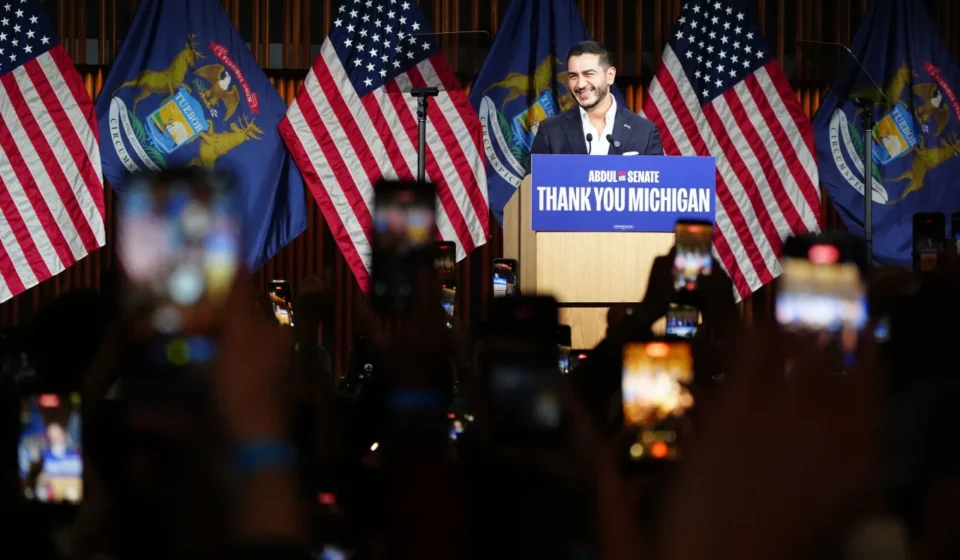
Who is Abdul El-Sayed? Democrats make US Senate history
The Democratic Party has secured control of both chambers of Congress in a sweeping midterm victory, while Michigan’s Abdul El-Sayed is set to become the first Muslim elected to the US Senate. The results mark a major setback for President Donald Trump and reshape the political landscape ahead of the 2028 presidential election.
The Democratic Party has won control of both the US House of Representatives and the Senate in the 2026 midterm elections, delivering a major political setback to President Donald Trump and his Republican Party. The results include a series of unexpected victories in traditionally Republican states and a historic breakthrough in Michigan, where Democrat Abdul El-Sayed is projected to defeat Republican former congressman Mike Rogers.
The outcome gives Democrats control of Congress for the final two years of Trump’s current presidential term, creating a new balance of power in Washington. The party is positioned to exert greater influence over legislation, federal spending and congressional oversight of the administration.
CNN, ABC News and other major US media organisations projected Democratic victories in both chambers. Reuters also reported El-Sayed’s victory in Michigan, describing it as a historic moment for Muslim representation in American national politics.
The results follow a campaign shaped by economic concerns, rising household costs, the war involving Iran and dissatisfaction with the administration. Democrats made gains in states where Republicans had previously enjoyed substantial electoral advantages, indicating that the political consequences of national issues extended well beyond the most competitive traditional battlegrounds.
Abdul El-Sayed, a 42-year-old physician and former public health official, is projected to defeat Republican candidate Mike Rogers in Michigan’s Senate race. His victory makes him the first Muslim elected to the United States Senate.
El-Sayed entered the contest after Democratic Senator Gary Peters decided not to seek re-election, leaving an open seat. He emerged as the Democratic nominee after defeating a more moderate rival in the party primary and subsequently campaigned on a progressive platform focused on healthcare, household affordability and reducing corporate influence in politics.
His policy priorities included Medicare for All, a universal healthcare proposal, and campaign finance reform. He also took a critical position on US military support for Israel, an issue that became a major point of contention during the campaign.
Rogers, a former congressman, Army veteran and former FBI agent, received support from Trump and prominent Republican figures. His campaign sought to portray El-Sayed as too progressive for Michigan and raised questions about his foreign policy positions and political associations.
El-Sayed also faced attacks from Republican figures over alleged links to the Muslim Brotherhood. He denied any such affiliation. Reuters reported that the allegations lacked supporting evidence, while Democrats condemned the attacks as Islamophobic.
The race became more contentious in its final days when Democratic Representative Haley Stevens, who had competed against El-Sayed in the primary, publicly endorsed Rogers. The endorsement exposed divisions within the Democratic Party over Israel, progressive politics and the direction of its electoral strategy.
Despite the controversy, El-Sayed secured the projected victory, retaining the Michigan seat for Democrats and giving the party a historic new figure in the Senate.
The Senate results represent one of the most consequential elements of the election. Democrats flipped several seats previously held by Republicans, including contests in states that have traditionally been difficult territory for the party.
According to CNN projections, Democratic candidates won Republican-held seats in Iowa, Kansas, Maine, North Carolina, Ohio, South Carolina and Texas. The results substantially changed the chamber’s political balance and enabled Democrats to regain control.
The victories in Kansas and South Carolina were particularly significant because both states have long been associated with Republican dominance in Senate elections.
In Kansas, Democrat Adam Hamilton was projected to win, ending a long period without a Democratic Senate victory in the state. In South Carolina, Democrat Annie Andrews was projected to defeat Republican candidate Darline Graham, securing a seat that had remained in Republican hands for decades.
Texas also delivered a major result for Democrats. James Talarico was projected to defeat Republican Attorney General Ken Paxton in the Senate race, while Democratic candidate Gina Hinojosa was projected to defeat incumbent Republican Governor Greg Abbott in the gubernatorial contest.
In Maine, Democrat Troy Jackson was projected to defeat five-term Republican Senator Susan Collins. The result removed one of the most prominent Republican figures from the Senate and added to the scale of the Democratic gains.
Democrats also retained several seats, including those held by Georgia Senator Jon Ossoff and other candidates in states where Republicans had hoped to make gains.
Some races remained unresolved or too close to call in the initial reporting. Nevertheless, major US media organisations projected that Democrats had secured the numbers required to control the Senate.
Democrats also regained control of the House of Representatives, completing their takeover of both chambers of Congress.
The House results reflected gains across several regions, including competitive districts where Republicans had sought to strengthen their position through redistricting and campaign spending. Democrats also retained seats that had been targeted by Republican challengers.
The party’s return to control of the lower chamber is expected to elevate Representative Hakeem Jeffries, the current Democratic leader in the House, to the position of Speaker if Democrats formally organise the chamber.
Control of the House gives Democrats authority over committee leadership, legislative scheduling and a significant part of congressional oversight. It also provides them with greater capacity to investigate executive-branch decisions and scrutinise federal agencies.
With the Senate also projected to be under Democratic control, the election has fundamentally changed the institutional relationship between the White House and Congress.
Trump said he was willing to accept the election results and work with Democrats, although he rejected the suggestion that the Republican losses represented a personal rejection of his presidency.
In an interview with The New York Times, the president said he would accept the outcome. He also congratulated Democrats, saying they had performed well.
However, in comments to Fox News, Trump argued that the results were not a direct assessment of his performance. He said he did not view the Republican losses as a personal setback and maintained that his administration had delivered strong results on the economy and other issues.
Trump also acknowledged that the war involving Iran had contributed to the Republican Party’s difficulties. In a separate interview with The Wall Street Journal, he described the conflict as one factor behind the election outcome.
His comments suggest that the White House recognises the influence of foreign policy and economic conditions on the results, even as the president seeks to distance himself from responsibility for the party’s defeat.
The election had become closely associated with Trump’s presidency. He had campaigned for Republican candidates and used his political influence to support key Senate contenders. Several of those candidates subsequently lost to Democrats.
The Democratic gains came amid public concern over the cost of living, inflationary pressures, fuel prices and the economic consequences of the conflict involving Iran.
These issues affected the political environment in which Republican candidates campaigned. Rising household expenses and uncertainty over energy costs created challenges for a party seeking to defend its record in government.
The election also demonstrated the difficulty of separating local contests from national political sentiment. Candidates in several states faced questions about their relationship with Trump, the administration’s policies and the wider economic situation.
The results do not establish that every voter rejected the same policies or supported the same Democratic agenda. However, the breadth of the party’s gains indicates that Republican candidates faced a difficult national political environment, including in states where the party had previously held a strong advantage.
Democratic control of both chambers is likely to change the legislative environment for the remainder of Trump’s term.
The party will have greater influence over congressional committees, investigations, spending negotiations and the consideration of legislation. It can also use its control of the House to increase scrutiny of administration policies and officials.
However, control of Congress does not automatically mean Democrats can enact their entire legislative programme. Presidential veto powers, Senate voting requirements and internal divisions within the party will continue to shape what can pass into law.
The new congressional majority could also produce more frequent confrontations between the White House and lawmakers. Disagreements over federal spending, immigration, healthcare, taxation, foreign policy and executive authority are likely to become central issues.
The change in congressional control may therefore bring a period of legislative conflict as well as stronger oversight of the administration.
The midterm results will also influence the political calculations of both parties ahead of the 2028 presidential election.
For Democrats, victories in traditionally Republican states could strengthen arguments that the party can compete across a wider electoral map. El-Sayed’s Senate victory may also give the party’s progressive wing greater visibility in debates over healthcare, economic inequality, corporate influence and US foreign policy.
For Republicans, the results raise questions about candidate selection, the political consequences of Trump’s leadership and the party’s ability to retain support among voters concerned about economic conditions.
Trump has said it is too early to identify potential Republican presidential candidates for 2028, although he described the party as having a strong pool of political talent.
The immediate significance of the election, however, lies in the transfer of congressional control. Democrats now have the opportunity to shape the legislative agenda and scrutinise the administration during the final two years of Trump’s presidency.
The election has produced two defining outcomes: a historic expansion of Muslim representation in the US Senate through Abdul El-Sayed’s projected victory, and a major shift in federal political power as Democrats regain control of Congress. The extent to which the new majority can translate its electoral gains into legislation and policy changes will become a central question in American politics over the coming months.
Sources
- Reuters — Abdul El-Sayed becomes first Muslim elected to US Senate
- Associated Press — Democrats win the US House and Senate as voters deliver a strong rebuke to Trump and Republicans
- CBS News — Abdul El-Sayed wins Michigan 2026 Senate election, CBS News projects
- ABC News — 2026 midterm election live results
- CNN — 2026 midterm election live coverage
