




















Australia raises interest rates to 18-year high
A split policy decision highlights the Reserve Bank of Australia’s balancing act between persistent inflation and weakening household demand, with markets increasingly expecting rates to remain unchanged in December.
Australia’s central bank raised its benchmark interest rate to an 18-year high on Tuesday, but a divided vote and changes to its policy statement suggested that the tightening cycle may be approaching its peak.
The Reserve Bank of Australia (RBA) increased the cash rate by 25 basis points to 4.85%, marking its fifth rate hike this year. However, the decision was supported by six members of the nine-member board, while three voted to leave rates unchanged. The unusually narrow split indicated growing concern among policymakers about the economic costs of further monetary tightening.
The RBA also removed an explicit reference to the possibility of additional rate increases from its policy statement, although it maintained that it would take whatever action it considered necessary to bring inflation sustainably back to target.
Financial markets interpreted the decision as a less hawkish signal. The Australian dollar fell 0.3% to $0.6977, while investors increased their expectations that the central bank would hold rates at its December meeting.
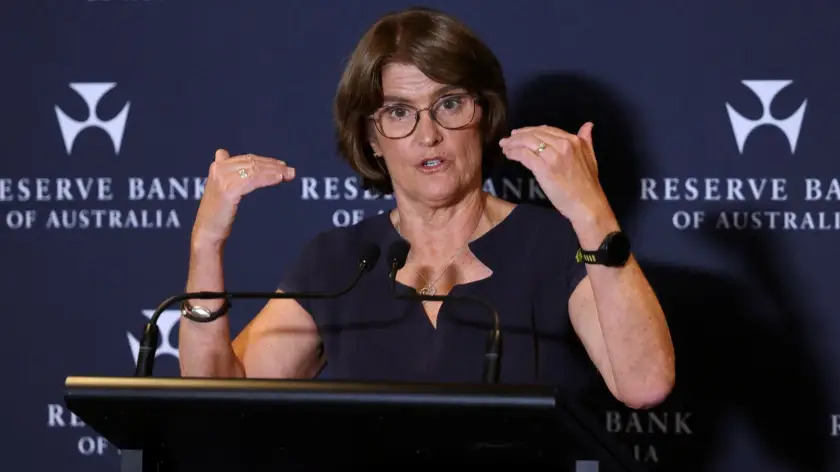
RBA Governor Michele Bullock said the next move in interest rates remained uncertain. She noted that the three dissenting board members had placed greater weight on downside risks, including weakness in the housing market and rising unemployment.
Bullock also suggested that the five rate increases delivered this year made it appropriate to pause and assess how the economy responds to tighter monetary conditions. However, she cautioned that inflation risks remained tilted to the upside.
The central bank’s updated forecasts underline the difficulty of the decision. Headline inflation is projected to reach 4.5% in the fourth quarter before easing towards the RBA’s target range of 2% to 3% in the second half of next year. Unemployment, meanwhile, is forecast to rise above 5% over the next two years.
The decision came after stronger-than-expected inflation data for the third quarter and earlier hawkish signals from policymakers. Thirty of the 32 economists surveyed by Reuters had expected a rate increase, while financial markets had priced in an 88% probability of a hike before the announcement.
The effects of higher borrowing costs are becoming increasingly visible in Australia’s housing market and household finances.
The housing market is on course for what Reuters described as its largest downturn in four decades. Falling property values and reduced housing activity could weaken household spending through negative wealth effects, while also affecting businesses connected to property transactions, including real estate agencies, conveyancing firms and removal companies.
The labour market is also showing signs of softening. Australia’s unemployment rate reached 4.7%, its highest level in five years. Although the RBA still considers the labour market relatively tight and a source of inflationary pressure, further deterioration could strengthen the case for keeping rates unchanged.
Stephen Smith, a partner at Deloitte Access Economics, said the divided vote reflected the difficult trade-offs facing policymakers as households reduce spending and businesses encounter weaker demand. He warned that the latest increase could raise the risk of a sharper-than-expected slowdown in economic growth next year.
Despite signs of economic weakness, inflation continues to constrain the central bank’s options.
Underlying inflation accelerated to 3.7% in the third quarter, reaching a two-year high after remaining above the RBA’s 2% to 3% target band for more than five years.
Policymakers are also concerned that elevated oil prices could feed into broader domestic price pressures and influence inflation expectations. The central bank’s statement said further tightening in financial conditions was warranted in response to the revised inflation outlook and continuing upside risks.
The challenge is that monetary policy operates with a lag. Higher interest rates can gradually reduce demand and inflation, but their effects may become more pronounced in household consumption, employment and business investment over time.
Several economists believe the latest increase may mark the end of the current tightening cycle, although they caution that the outlook remains dependent on incoming economic data.
Sally Auld, chief economist at National Australia Bank, said the RBA appeared increasingly comfortable with the assessment that monetary policy was already restrictive. She added that the central bank would remain sensitive to any unexpected acceleration in inflation.
Adam Boyton, head of Australian economics at ANZ, also said the cash rate was at or close to its peak and that his bank was not forecasting another increase. He suggested that inflation could turn out marginally lower than expected, while unemployment might reach the RBA’s projected peak of 5.1% sooner than anticipated.
The RBA’s 125 basis points of rate increases this year have more than reversed the 75 basis points of monetary easing delivered in 2025. The tightening has placed Australia among the more hawkish developed economies, contrasting with the Federal Reserve’s decision to hold rates earlier this month and the Reserve Bank of New Zealand’s recent pause.
The latest decision illustrates the narrowing room for manoeuvre facing Australia’s central bank. Maintaining restrictive monetary conditions may be necessary to bring inflation under control, but further increases could deepen pressure on households, housing activity and businesses.
For financial markets, the split vote and removal of the explicit reference to further increases have strengthened expectations of a pause. However, the RBA has not committed to a fixed policy path, and renewed inflationary pressure could still prompt additional action.
The central bank’s next decisions will depend on whether price pressures begin to ease without a more substantial deterioration in employment and economic activity. The challenge is to bring inflation back within the target range while avoiding an unnecessarily sharp slowdown in the wider economy.
Sources: Reuters, Australia’s central bank lifts rates to 18-year high, split vote points to pause ahead; Reserve Bank of Australia, monetary policy decisions and economic forecasts; Australian Bureau of Statistics, inflation and labour market statistics.
