
















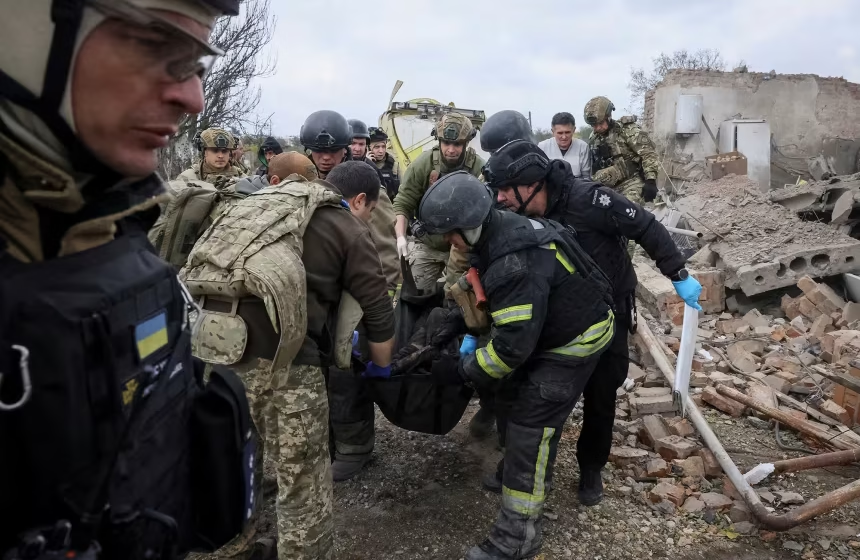
Russian strike on Ukrainian humanitarian shelter kills at least 33
An attack involving at least nine bombs destroyed an underground shelter and aid distribution centre in Zaporizhzhia region, killing civilians and emergency responders as Russia intensified strikes on Ukraine’s infrastructure.
At least 33 people have been confirmed dead and another 50 remain unaccounted for after Russian forces dropped at least nine bombs on a building being used as a civilian shelter and humanitarian aid centre in southeastern Ukraine, according to Ukrainian officials cited by CNN.
The attack took place on Monday in Komyshuvakha, in the Zaporizhzhia region, where civilians had gathered to receive humanitarian assistance. President Volodymyr Zelensky described the incident as one of the deadliest attacks of the war. Local governor Mykhailo Semikin said the building contained a reinforced underground basement designed to withstand most strikes, but the force of the explosions caused the concrete structure to collapse and a fire to break out.
The facility had originally been constructed with European Union funding as a protected school basement, allowing classes to continue during wartime. As fighting moved closer to the area, however, its use changed. Local authorities had been operating it as an administrative centre and humanitarian distribution hub rather than a functioning school.
The attack occurred while humanitarian aid was being distributed, according to Zelensky. Ukrainian authorities said the initial bombing was followed by another strike as emergency services and residents were responding.
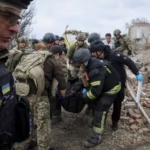
At least two first responders, identified locally as Denys Konovalenko and Oleksiy Sushchevsky, both aged 44, were killed after reaching the scene. Ukrainian police also reported the deaths of four officers: Mykhailo Buzhenko, Mykola Balanda, Mykhailo Romanov and Dmytro Besedin.
Police said the officers had been helping residents reach safety in the underground facility when the follow-up strike trapped those attempting to escape.
The reported sequence raises concerns over the dangers faced by emergency personnel during attacks on civilian areas. Follow-up strikes can expose rescuers, medical teams and displaced residents to further harm while evacuation and recovery operations are under way.
Semikin told Ukrainian national television that Russian forces had used KAB-500 and FAB-3000 bombs in the attack. He described the FAB-3000 as a three-ton aerial bomb containing nearly 1.5 tons of explosive material, designed primarily to destroy heavily reinforced structures and bunkers.
The weapons reportedly caused the collapse of the shelter’s reinforced basement, undermining the protection the facility had been designed to provide.
Rescue operations continued as authorities attempted to locate those still missing. The confirmed death toll may therefore change as recovery teams gain access to the damaged structure.
The strike on Komyshuvakha was followed by another large-scale Russian aerial assault involving hundreds of drones and dozens of cruise and ballistic missiles, according to Zelensky. The subsequent barrage targeted Ukraine’s energy infrastructure.
The attacks came despite repeated calls by US President Donald Trump for an energy ceasefire. Zelensky said the timing of the strikes, coinciding with US congressional elections, carried a political message and urged Washington to strengthen Ukraine’s air defences.
His remarks reflect Kyiv’s concern that continued attacks on energy facilities could weaken the country’s ability to maintain electricity and essential services as the war continues.
The latest attacks have taken place alongside renewed diplomatic efforts by the Trump administration. US envoy Steve Witkoff recently met Zelensky in Norway before travelling to St Petersburg for discussions with Russian President Vladimir Putin.
Separately, Melania Trump helped secure a ceasefire in the Russian-occupied Ukrainian city of Oleshky, enabling hundreds of civilians to be evacuated over the weekend. The US first lady’s office announced on Tuesday that representatives from Russia and Ukraine would be brought together at the White House on Thursday.
The diplomatic activity has yet to produce a broader halt to the fighting. The attack on Komyshuvakha demonstrates the continuing vulnerability of civilians even as negotiations and humanitarian initiatives proceed.
The bombing adds to a series of deadly attacks on civilian areas in recent months. CNN cited previous incidents in Kramatorsk, near Kyiv and in the capital itself, where strikes killed dozens of people.
The latest incident also highlights the limitations of reinforced shelters when confronted with weapons capable of destroying heavy concrete structures. Facilities originally built to protect students and civilians have increasingly taken on wider humanitarian roles as communities adapt to prolonged conflict.
With dozens still missing in Komyshuvakha and further attacks reported against energy infrastructure, Ukraine faces simultaneous humanitarian, security and reconstruction pressures. The continued targeting of areas used by civilians and emergency responders also raises serious questions about compliance with international humanitarian law. Establishing legal responsibility for the specific attack will require a full investigation of the circumstances and available evidence.
Sources: CNN, At least 33 dead after Russia drops nine bombs on a Ukrainian school building; Office of the President of Ukraine; United Nations Office for the Coordination of Humanitarian Affairs — Ukraine.
