


















Skip to content
  • Linkedin
  • Facebook
  • Youtube
The Laborecon The Laborecon
  • Home
  • Economy
  • Monetary
  • AI & Digital Livelihood
  • Geography
    • Middle East
    • South Asia
    • Southeast Asia
  • Climate
  • RMRN
  • Home
  • Economy
  • Monetary
  • AI & Digital Livelihood
  • Geography
    • Middle East
    • South Asia
    • Southeast Asia
  • Climate
  • RMRN
Exclusive
amazon and anthropic
Amazon could be biggest fin winner in Anthropic’s potential IPO
Xis anti corruption purges complicate
Xi’s anti-corruption purges complicate China’s search for next-gen of leaders
Israel Election Produces No Clear Winner as Netanyahu Faces Strong Challenge
Israel election no clear winner, Netanyahu faces strong challenge
WEB NEWS DC
When protest becomes the only way to be heard 
download 1
Xi Jinping’s party discipline drive deepens
Saudi Pakistani Turkish defence pact opens a new channel with Iran
Saudi-Pakistani-Turkish defence pact opens a new channel with Iran
France
France pledges university admissions overhaul
Egypt backs Saudi Arabia and Iran hosts regional talks
Egypt backs Saudi Arabia, and Iran hosts regional talks
Israeli diaspora returns to vote election tests Netanyahus future
Israeli diaspora returns to vote, election tests Netanyahu’s future
2YZDZUL2WBNVZPN7MWLLVAO6CM
UK minimum wage set for 3.9% rise as govt weighs youth employment risks
German business confidence improves for sixth month energy pressures
German business confidence improves for sixth month, energy pressures
kk
Fiji’s Serua Island resists relocation as rising seas threaten ancestral homes
Trump rallies Republicans as rising costs dominate US midterm campaign
Lulas election victory triggers market turmoil as Trump questions Brazil vote
Lula’s election victory triggers market turmoil as Trump questions Brazil vote
b bulgarian ship sank drones
Bulgaria’s presidential runoff puts Black Sea security and NATO strategy under scrutiny
Gold bars Adobe Couperfield 1 1
Gold reclaims $4,000 as oil retreat offers relief, but Fed risks persist
Serbias student movement challenges a decade of Vucics political dominance
Serbia’s student movement challenges a decade of Vučić’s political dominance
Lula wins fourth term as Flavio Bolsonaro challenges Brazil election result
Lula wins fourth term as Flávio Bolsonaro challenges Brazil election result
Washingtons AI backlash puts technology executives on the defensive
Washington’s AI backlash puts technology executives on the defensive
GettyImages 1242704351
China’s AI boom fuels rise in powerful greenhouse gas emissions
2
Home

Local Currency Stablecoins Transform Remittances for Bangladeshis

April 8, 2026

Md Tarek Hossain

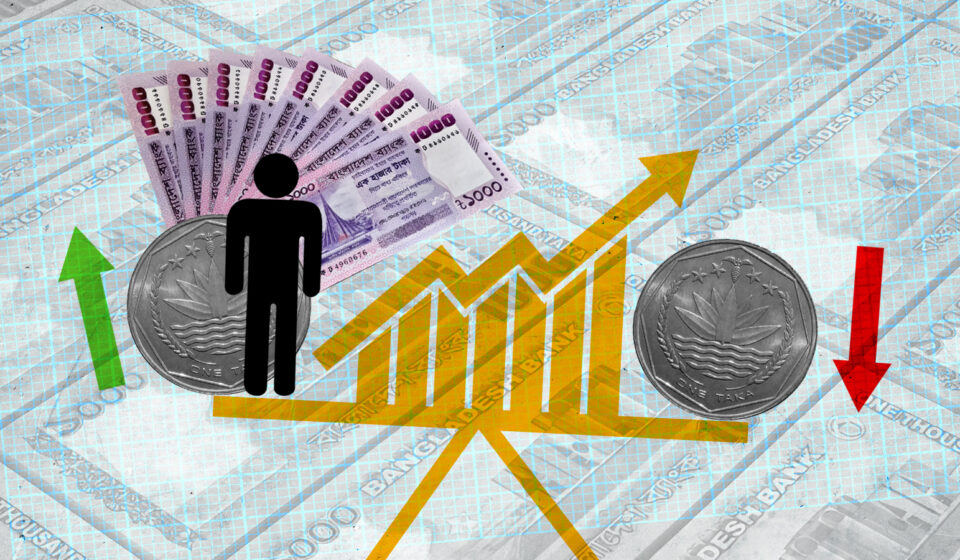
A new report from blockchain data firm , supported by global payments giant , suggests the world may be gradually moving “beyond dollarisation” — a shift that could significantly benefit millions of Bangladeshis who depend on money sent from abroad.

At the centre of this change are so-called stablecoins — digital currencies built on blockchain technology that maintain a fixed value. While most existing stablecoins are pegged to the US dollar, a new generation linked to local currencies such as the euro, Brazilian real and Singapore dollar is gaining traction.

These “local currency stablecoins” could reshape the way money moves across borders. Instead of converting funds into dollars and then back into another currency — a process that adds cost and delay — users can send money directly in the desired currency.

The scale of global payments is vast. Cross-border transactions are currently valued at around $208 trillion annually and are projected to exceed $320 trillion by 2032. Yet for ordinary people, the system remains slow and expensive. Only a third of retail payments are settled within an hour, while remittance fees average about 6.5 per cent, largely due to exchange rate costs.

Local currency stablecoins aim to remove these inefficiencies. By allowing money to remain in its original currency throughout the transaction, they eliminate multiple conversion steps, reduce reliance on intermediaries, and enable near-instant transfers — regardless of banking hours.

For financial institutions, the advantages are equally compelling. They can minimise foreign exchange risks, simplify treasury operations, and even automate compliance processes through programmable payment systems that operate around the clock.

Visa has already begun integrating such technologies into its existing infrastructure, linking stablecoins with its card and payout networks. This means banks and businesses can adopt the system without overhauling their current operations — a transition the report describes as “incremental, practical and institution-friendly”.

The implications for Bangladesh are particularly significant. Remittances from countries such as the United Kingdom and across the Middle East form a vital lifeline for many households. However, these transfers often pass through dollar-based channels, eroding value through fees and exchange rate fluctuations.

A system based on local currency stablecoins could allow senders to transfer funds directly in Bangladeshi taka, potentially reducing costs and ensuring more money reaches families at home.

For individuals like Md Rahman, a London-based Bangladeshi who regularly supports his parents in Dhaka, the change cannot come soon enough. “I pay fees and watch the exchange rate shift before the money arrives,” he says. “If there was a way to send it directly in taka or even euros without losing value, I’d switch immediately.”

While the report stops short of predicting immediate transformation, it acknowledges that regulatory approval and integration with national banking systems remain key challenges. Nevertheless, the direction appears clear: a gradual move away from dollar dominance towards a more flexible, multi-currency digital ecosystem.

As the report concludes, these innovations enable “local money to move on global, programmable rails” — a prospect that could redefine financial access for countries like Bangladesh, where faster and more affordable remittance services are urgently needed.

Related Posts:

  • The invisible system holding the economy together
  • Journalism practices, editorial narratives and…
  • CNN and CBS under one roof: Skydance merger reshapes…
  • Iran’s economic survival strategy faces its hardest test
  • Visa’s China breakthrough opens new front in the…
  • Gold edges higher as weaker dollar, lower oil prices…
Author

TLE DESK

Follow Me
Other Articles
image 375767 1775651668
Previous

Parliament Passes July Mass Uprising Bill Granting Legal Immunity to Participants

image 388038 1779085592
Next

Trump warns ‘won’t be anything left’ of Iran unless it agrees to deal

No Comment! Be the first one.

Leave a Reply Cancel reply

Your email address will not be published. Required fields are marked *

© 2026 The Laborecon. All Rights Reserved. Financed by DPH Agency | Managed by RMRN | Knowledge Partner: ESSB | News Mail: thelaborecon@gmail.com | RMRN Media Diplomacy: mediadiplomacy.rmrn@gmail.com