




















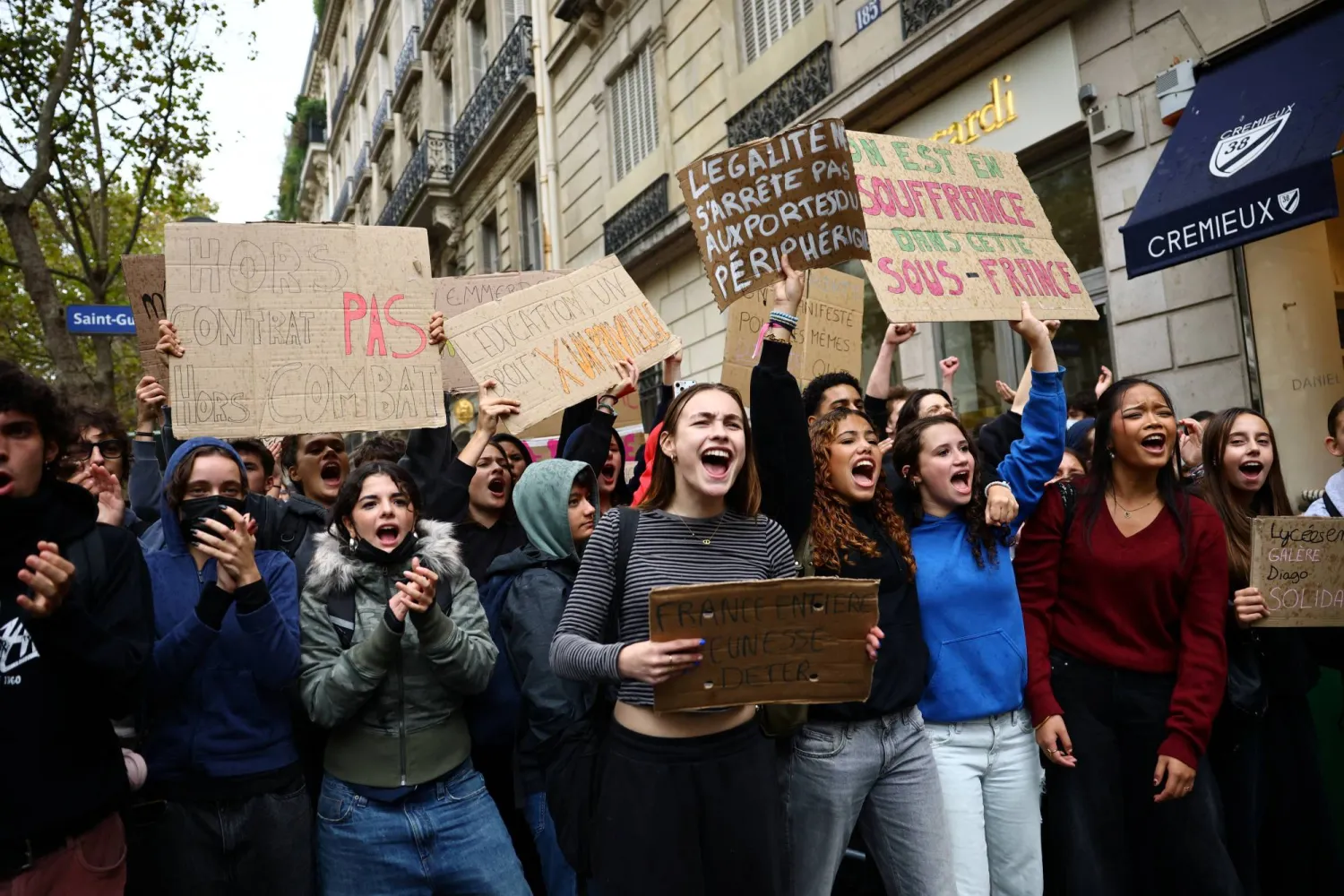
French students renew protests as anger over school conditions
High school students across France staged fresh demonstrations on Thursday, pressing the government to address teacher shortages, overcrowded classrooms and deteriorating school buildings as a nationwide movement entered its third week. The protests continued despite efforts by Prime Minister Sébastien Lecornu to ease tensions and promise a response later this month.
Agence France-Presse (AFP) reported that pupils blocked school entrances and joined rallies in Paris, Nantes, Rennes and other cities, while education unions called for wider mobilisation. Although many demonstrations remained peaceful, some descended into clashes, vandalism and the use of tear gas by police.
The grievances centre on everyday problems inside schools: teachers missing for extended periods, overloaded timetables, poorly maintained facilities and classrooms struggling to cope with rising temperatures. Students say government assurances have yet to translate into concrete improvements. “We don’t want words, we want action,” 17-year-old Camille told AFP during a march in Nantes.
Lecornu said in a televised address on Wednesday that the government would present a plan by the end of October. He denied that security forces had been instructed to confront young protesters, but his statement failed to reassure many students. Education Minister Édouard Geffray separately promised urgent measures to improve the replacement of absent teachers.
The unrest has also brought the conduct of police under scrutiny. Students, unions and rights groups have accused officers of using disproportionate force. The government suspended the use of stun grenades at demonstrations after a 15-year-old was seriously injured and lost a hand during a police operation. Authorities have opened internal investigations into alleged misconduct.
The scale of the disruption is becoming a wider test of France’s public education system. Reuters reported that demonstrations continued amid tension between demands for better-funded public services and the government’s efforts to contain public debt and budget deficits. On Thursday, tens of thousands of people took part in protests across the country, including a large gathering in Paris.
The budget debate complicates the government’s response. France’s draft 2027 budget proposes education spending of €90.9 billion, a 1.4 per cent increase, the second-largest rise after defence. Yet national spending totals do not necessarily resolve local shortages, uneven school conditions or the difficulty of recruiting and retaining teachers.
France’s education record presents a mixed picture. OECD comparisons show that the country spends relatively heavily per pupil at upper-secondary level, but less at earlier stages. Recent international assessment results have also intensified concerns about learning outcomes, adding to pressure for improvements beyond headline spending figures.
The demonstrations come months before France’s 2027 presidential election, giving the dispute wider political significance. However, the movement’s immediate demands remain focused on schools: reliable teaching, safe and properly maintained buildings, manageable timetables and a policing response that does not deepen tensions.
For the government, the challenge is to turn its promised plan into visible changes while restoring confidence among students, families and teachers. Until protesters see progress inside classrooms, official assurances alone may do little to end the mobilisation.
