













Poland’s president holds crisis talks; fight over constitutional court deepens
Poland is in the middle of a political crisis over who controls its top court. On Friday, the head of the Constitutional Tribunal was suspended, riot police surrounded the building, and protesters gathered outside demanding his return. On Saturday, President Karol Nawrocki called urgent talks with political leaders, and Prime Minister Donald Tusk’s party stayed away.
For readers outside Europe, the dispute matters because it is a test of how a European Union country with a divided government handles a contest over judicial independence, and because it comes a year before Poland’s next parliamentary election.
The Constitutional Tribunal is Poland’s top court for constitutional questions, and it has been politically contested for a decade. The former nationalist government of the Law and Justice party (PiS), which ruled from 2015 to 2023, was accused by critics and EU institutions of filling it with loyal judges. Tusk, a centrist and pro-European leader who returned to power in 2023, says restoring the court’s independence is his government’s duty. His camp also complains that the PiS-aligned judges often ruled in favour of Polish law over EU law. Nawrocki, a right-wing figure who took office as president in 2025 and is an ally of the previous government, has blocked nominations of new judges, which Tusk’s side says is part of the problem.
The immediate trigger was the suspension of the tribunal’s president, Bogdan Swieczkowski, on Friday. The government accuses him of using his powers to stop parliament from electing new judges, and says he repeatedly broke the law and jeopardised the court’s work. How the suspension happened is disputed, and the account matters. The tribunal’s own website said its longest-serving judge, Anna Korwin-Piotrowska, had suspended him and taken charge. Nawrocki, however, accuses Tusk of staging a “forced takeover,” and the tribunal’s official X account called it a coup. Legal expert Marcin Matczak said the suspension had no legal basis and warned that the presence of armed police and the government’s reading of the justice minister’s powers could have lasting consequences for the rule of law. The government says the step was painful but necessary after years of erosion under PiS.
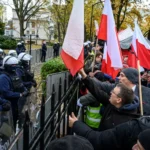
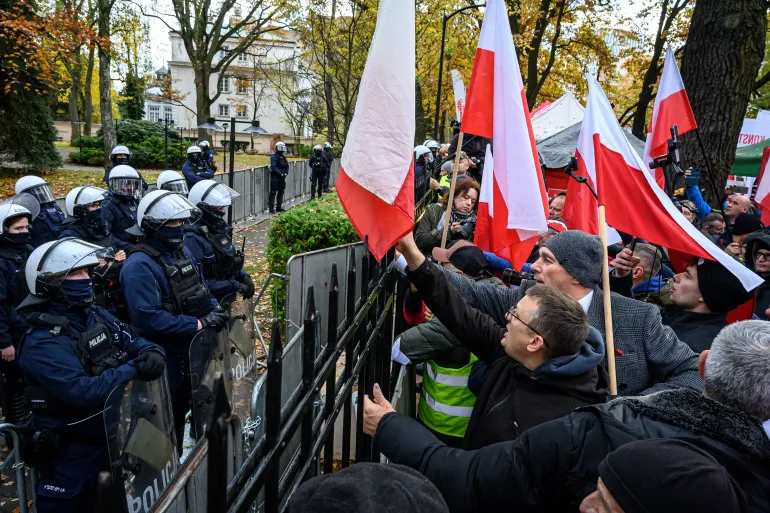
Events moved quickly. Nawrocki cut short a trip to Senegal, turned back in mid-flight, went to the court on Friday night and said he helped Swieczkowski get into the building. Riot police were out in force, several hundred protesters demanded the judge’s reinstatement, and police said they detained three people after objects were thrown. On Saturday, followers of PiS rallied again outside the court, extending protests that have run for weeks. At the presidential palace, representatives of nationalist and far-right parties attended Nawrocki’s talks, along with some members of Tusk’s governing coalition, and no breakthrough had emerged by Saturday afternoon. In a speech that evening, Tusk accused conservative nationalist leaders of wanting to “destroy democracy and rule of law.”
Outside voices are urging calm. The European Commission urged Nawrocki on Saturday to accept the nomination of the new judges at the centre of the crisis, according to AFP. The US ambassador to Poland, Tom Rose, wrote that the last thing Poland needs is a confrontation that spirals into something worse.
There are two readings of what is happening, and each side sees itself as defending the constitution. The government says it is repairing a court that was captured by a former ruling party and has been blocking the election of new judges. Its opponents say a government cannot use police and a disputed suspension to take over an independent court, whatever its past. Some independent legal voices, such as Matczak, doubt the legal basis of the move even though they may share the aim of restoring the court’s independence. That is the difficulty: a court whose independence was damaged can be hard to repair without actions that themselves look political.
What is known and what is not: the suspension, the police deployment, the protests and the talks are reported by several outlets. Whether the suspension is legally valid, who actually holds authority over the court, and whether the standoff ends in a deal or a deeper crisis are not known. This is a news summary of a developing story.
Sources: Al Jazeera, Reuters via Internazionale, Reuters via Internazionale (Senegal trip), AP via News4Jax, AP via WRAL, Times of Israel (AP), Times of Israel (AFP), Outlook India, Devdiscourse, NewsBytes, Republic World, Babel and Tert.am.
