
















AI-generated idols test the limits of K-pop’s fandom economy
The rise of fully synthetic groups such as Seoria and H3ARUS is opening a new commercial frontier for South Korea’s music industry, but questions over fan loyalty, creative ownership and copyright could determine whether the trend lasts
SEOUL – K-pop’s next generation of idols may not need a trainee system, recording studio or even a human performer. Artificial intelligence is increasingly capable of creating the faces, voices, choreography and music of fictional pop stars, raising a new question for South Korea’s entertainment industry: can an artist build a lasting career without actually existing?
The emergence of fully AI-generated groups such as four-member girl group Seoria and five-member boy group H3ARUS suggests that the experiment is moving beyond novelty. Their creators are adopting familiar K-pop strategies, including carefully developed personalities, fictional backstories, music videos, performance content and promotional partnerships, to turn synthetic characters into commercially viable entertainment properties.
Yet the distinction between technological innovation and a sustainable music business remains significant. While AI can reduce production constraints and accelerate content creation, it cannot automatically reproduce the emotional connections, human experiences and sense of authenticity that have traditionally helped K-pop artists build devoted fan communities.
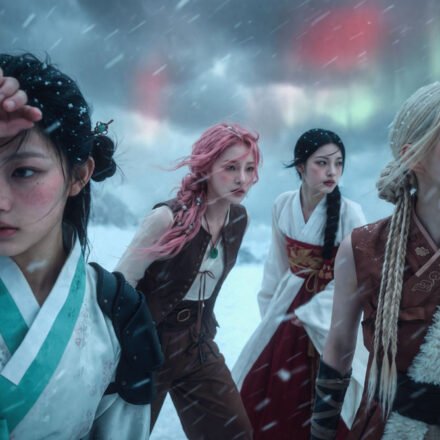
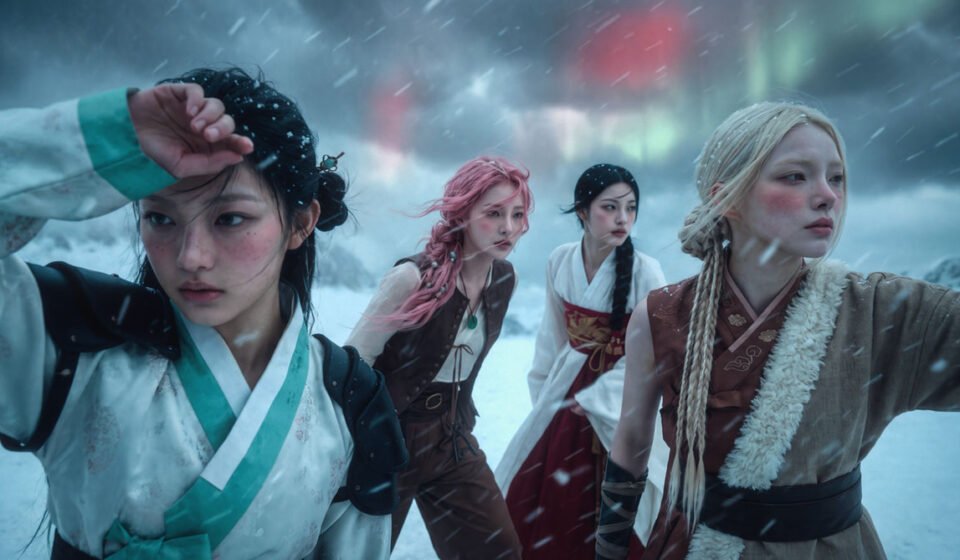
Seoria, developed by South Korean generative AI company Jiro, illustrates the scale of the ambition. The group debuted in August with its single ‘Burning’, with its four members – Riye, Cora, Iseol and Freya – created entirely through artificial intelligence. Their appearances, voices and performances are generated rather than supplied by human performers operating digital avatars.
At a press briefing in Seoul on 24 November, Jiro presented Seoria as its first original AI entertainment property and a demonstration of its Dropshot AI production platform. The company said it spent four months developing the group, generating approximately 5,000 character images and tens of thousands of video clips to maintain consistency across its content.
The production strategy goes beyond music. Seoria has been given individual member identities, a fictional universe inspired by a legendary female warrior group from the Goryeo period (918–1392), album artwork, a custom typeface and promotional material resembling that of conventional K-pop acts.
According to Jiro, Seoria’s video content had accumulated 2.54 million views by early November, including 1.08 million views for its debut music video. The group also secured a promotional collaboration with South Korean athleisure brand Andar in October.
These figures indicate early audience exposure, although video views alone cannot establish the existence of a commercially sustainable fanbase. Repeat engagement, music consumption, merchandise purchases and the ability to retain audiences beyond initial curiosity will offer more meaningful measures of success.
The emergence of Seoria also coincides with a broader expansion of AI-generated music in South Korea. On 13 November, the AI-assisted music project MEOMURU reached the top of Melon’s Top 100 chart with ‘Did You Become the Adult You Dreamed Of?’, becoming the first AI-assisted track to achieve the milestone, according to reports by The Herald Business and Starnews. The song uses AI-generated vocals, while human creators contributed to its lyrics, planning and production direction.
The distinction matters. An AI-assisted song is not necessarily the product of an entirely synthetic creative process, just as a virtual idol is not necessarily an AI-generated performer. Nevertheless, MEOMURU’s chart performance demonstrates that audiences are increasingly willing to consume music made with generative technology, even when the production process differs from conventional recording.
Seoria is now being joined by other projects. H3ARUS, developed by AI entertainment technology company KAIVERSE, released its debut single ‘CRUSH’ on 23 November. The five-member boy group follows a fictional storyline in which secret agents disguise themselves as K-pop idols to carry out undercover missions. Its creators are similarly using distinct member identities, individual voices and narrative-driven content to establish an entertainment brand.
The developments have arrived alongside a busy release period for virtual and AI-based acts. The Korea Times reported on 25 November that four new projects, including H3ARUS, the HYBE-backed VTuber project The Wildcard Club and virtual groups PINKRISE and WINKX, were entering the K-pop release calendar. The mix highlights an increasingly diverse market in which digital performers are no longer a marginal experiment.
However, not all digital performers operate in the same way. The distinction is particularly important when assessing their commercial potential.
Virtual idols have already demonstrated that audiences can connect with performers who do not appear as conventional human celebrities. Plave, one of South Korea’s most successful virtual groups, consists of five real performers who use motion-capture technology to control animated avatars. Its members participate directly in singing, songwriting, composition, choreography and communication with fans.
The model has delivered substantial commercial results. Reuters reported in May 2025 that Plave had attracted more than 470 million YouTube views and sold over one million copies of its latest album within its first week. The group has also built its appeal through concerts and direct fan interaction.
Plave’s success offers an important lesson: a digital appearance does not necessarily weaken the relationship between an artist and an audience. Behind the animated characters are identifiable human creative contributions and performers who can interact with fans.
Fully AI-generated groups remove that human foundation. Their personalities, voices and performances are constructed through technology, leaving their creators responsible for maintaining the characters’ identities and supplying the content that gives them meaning.
That creates both an opportunity and a commercial risk.
For entertainment companies, synthetic performers could reduce the logistical demands associated with conventional idol management. They do not require physical travel, accommodation or conventional performance schedules. Their appearances can be adapted for different markets, languages and advertising campaigns, while their fictional identities can be developed across music, animation, film and digital platforms.
Jiro’s leadership sees these characteristics as an opportunity to expand beyond traditional music releases. Co-CEO Lee Jae-seok has said the company plans to develop Seoria across animation, films, livestreaming and advertising. Co-CEO Hwang Gil-hwan has described the project as a demonstration of the technical challenge involved in generating consistent, convincing human characters.
The business case, however, should not be confused with proof of profitability. Lower production costs do not automatically translate into successful intellectual property. AI-generated acts still need compelling music, distinctive storytelling, effective distribution and sustained audience engagement. They must also compete with established K-pop groups whose agencies have invested years in developing artists and cultivating international fan communities.
Music critic Lim Hee-yun has identified the central uncertainty as whether audiences will develop lasting emotional attachments to characters that have no human performers behind them. K-pop fandoms are built not only around songs and performances but also around artists’ personalities, personal stories and regular interactions with supporters.
AI characters can simulate these interactions through videos, livestreams and scripted content. Whether that simulation can sustain the same level of loyalty over several years remains unproven.
There are also significant questions about who owns the creative work behind these projects and who should receive payment when AI is involved.
The Korea Music Copyright Association (KOMCA) is now confronting the issue as AI-generated music becomes more commercially visible. On 24 November, the association announced plans to hold a public hearing on 30 November to gather members’ views on copyright registration and royalty distribution for AI-assisted music. The discussion will include how much human creative contribution should be required for a work to qualify for registration.
The debate has become more urgent following uncertainty over the association’s earlier approach. KOMCA introduced rules in August allowing certain AI-assisted works with substantial human creative contributions to be registered, but subsequently withdrew them following concerns raised by lawmakers and the Ministry of Culture, Sports and Tourism.
The wider music industry is also pushing for stronger safeguards. According to The Herald Business, a survey of 14 music industry organisations found no support for unrestricted AI training using copyrighted music or a system in which companies use existing works first and compensate rights holders later. The resulting industry proposals emphasise responsible AI training, protection against unauthorised replication of artists’ voices and likenesses, transparent labelling and fair compensation.
These concerns extend beyond fully AI-generated idols. Training models on copyrighted recordings, reproducing recognisable voices and determining ownership of AI-assisted compositions all raise different legal and commercial questions. Without clearer standards, entertainment companies could face disputes over the very material used to build their digital artists.
For South Korea, the challenge is therefore not simply deciding whether AI belongs in K-pop. The technology is already entering music production, marketing and digital entertainment. The more difficult task is establishing rules that protect human creators while allowing responsible technological development.
Fully AI-generated idols could eventually become valuable entertainment properties, particularly if companies successfully develop their characters into recognisable brands across multiple platforms. But their long-term success will depend on more than convincing visuals or technically impressive performances.
K-pop has traditionally sold more than music. It has sold stories, personalities and relationships between performers and their audiences. AI can reproduce many elements of that formula, but whether it can create the emotional investment that turns casual listeners into devoted fans remains the industry’s biggest unanswered question.
Sources: https://www.koreaherald.com/
https://www.koreatimes.co.kr/