
















Kyiv’s underground shelters become a second home as Russian attacks intensify
Families, elderly residents and children are spending increasingly long nights in metro stations as missile strikes disrupt daily life in Ukraine’s capital, exposing the human cost of a war that has made even sleep a matter of survival.
At 10.30pm in Kyiv, the city’s underground metro stations begin to resemble temporary neighbourhoods. Families arrive carrying blankets, inflatable mattresses, tents and sleeping bags, preparing for another night away from their homes as warnings of Russian missile and drone attacks spread across social media.
For 32-year-old Katerina Liubychenko, the journey underground has become part of protecting her two-year-old daughter, Alisa. Living on the tenth floor of an apartment building in Kyiv’s northern suburbs, she and her husband choose to sleep at Akademmistechko metro station whenever the threat of a major attack becomes too serious to ignore.
The family tries to maintain a familiar bedtime routine. Alisa plays, listens to a story and eventually falls asleep on an inflatable mattress. But the normality is fragile. She already understands that an air-raid alert means danger and that she must find shelter, her mother told Agence France-Presse (AFP).
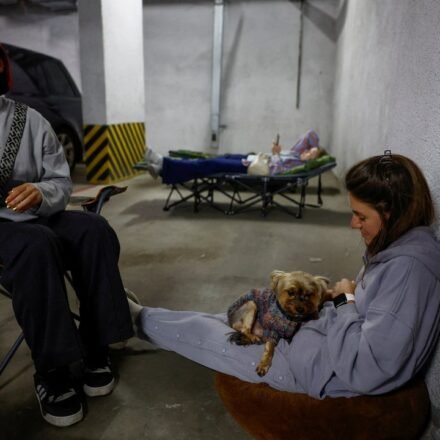
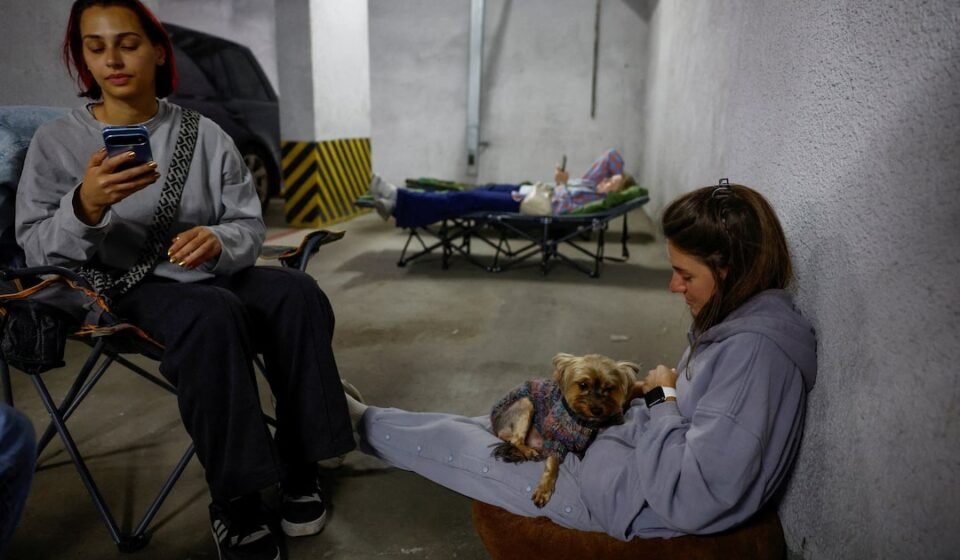
Their experience reflects a wider reality for residents of Kyiv, where underground transport stations have become essential civilian shelters. During major attacks, hundreds of people gather beneath the city, turning platforms and concourses into makeshift sleeping areas. Some bring pets, while others arrive with enough supplies to remain underground for several hours.
The scenes are not simply a temporary response to an emergency. They illustrate how Russia’s sustained aerial campaign has reshaped ordinary life in the Ukrainian capital, forcing families to organise their routines around the possibility of another attack.
The scale of the threat became clear during the night of 19–20 November, when Russia launched one of its largest aerial assaults of the war. Ukrainian officials reported more than 400 attack drones and over 110 missiles, including ballistic missiles, targeting locations across the country. The Ukrainian Air Force said it had intercepted or suppressed hundreds of incoming weapons, although some reached their targets.
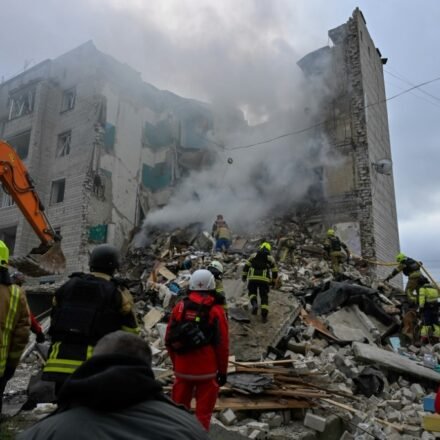
In Kyiv, the attack killed six people and injured at least 15, according to Ukrainian emergency authorities. Three bridges crossing the Dnipro River were also struck, disrupting important transport connections between the city’s eastern and western banks. Across Ukraine, the reported death toll reached eight, with damage to energy facilities, railway infrastructure and residential buildings in several regions.
The attack followed Russian President Vladimir Putin’s threat of retaliation after Ukrainian strikes damaged the bridge connecting Russia with occupied Crimea. Although Moscow presented its actions as a response to Ukrainian operations, the consequences extended well beyond military infrastructure, affecting transport networks and essential services used by civilians.
For residents, the metro offers a degree of protection that many homes cannot provide. Kyiv’s underground stations have served as shelters since the beginning of Russia’s full-scale invasion. According to the city’s metro authorities, all 46 underground stations can operate as public shelters during air-raid alerts, including when normal passenger services are suspended.
Tetiana, a 48-year-old metro employee at Akademmistechko, has witnessed the transformation of the station into a temporary refuge. She records arrivals and helps manage the growing number of people seeking shelter. On particularly dangerous nights, as many as 1,500 people have gathered there.
Yet the shelter cannot remove the psychological and economic consequences of living under repeated bombardment. Katia, a 38-year-old lawyer, told AFP that almost all her friends had moved abroad, with London and Paris among their destinations. She has considered leaving Kyiv but remains reluctant to abandon her professional life and start again elsewhere.
Her uncertainty reflects a difficult choice facing many Ukrainians: whether to remain in a city where daily routines are repeatedly interrupted or seek security in another country at the cost of familiar surroundings, employment and social connections.
The burden is particularly visible among older residents who continue working despite disrupted nights. Arkadi Sahane, 67, carries a thermos of coffee to the metro shelter, knowing that even a few hours of rest may be followed by another working day. His son serves in the Ukrainian military, while his elderly mother also depends on him.
His account of a man arriving at the shelter in his underwear, carrying a newborn child during a freezing night, captures the urgency with which families are forced to respond to sudden attacks. For parents, the immediate priority is not simply finding a safe place but protecting children from the physical and emotional consequences of repeated explosions.
These individual experiences come amid a worsening national picture. The United Nations Human Rights Monitoring Mission in Ukraine reported that at least 372 civilians were killed and 1,981 injured during October 2026. That represented a 95 per cent increase in civilian casualties compared with October 2025. Missiles and long-range drones accounted for 55 per cent of the casualties recorded during the month.
The UN also found that civilian casualties between January and October 2026 had reached 2,957 deaths and 17,218 injuries, substantially exceeding the corresponding period in 2025. Repeated attacks on electricity and heating infrastructure have added another layer of hardship as winter approaches, with power disruptions affecting households and essential services.
The wider challenge for Ukraine is not only intercepting incoming missiles and drones but maintaining the infrastructure and public services that allow millions of people to continue living in their cities. Limited air-defence resources, repeated infrastructure damage and the financial demands of a prolonged war make that task increasingly difficult.
For Kyiv’s residents, however, the consequences are measured in much smaller units of time. A mother tries to get her toddler to sleep, an elderly man prepares for work with a thermos of coffee, and a lawyer wonders whether she can continue building a future in her own city.
When the morning arrives, the metro gradually returns to its usual function. Children head to daycare, employees return to work and commuters board trains. But the night does not simply disappear with the sunrise. For those who spent it underground, the question remains whether the next evening will bring another warning, another journey down the station steps and another interrupted attempt at an ordinary life.
Sources:
- https://www.reuters.com/world/europe/fire-broke-out-ukraines-kyiv-after-missile-strike-mayor-says-2026-11-20/
- https://kyivindependent.com/russia-launches-mass-missile-attack-against-ukraine-after-putin-vows-revenge/
- https://www.euronews.com/2026/11/20/russian-strikes-on-kyiv-kill-three-and-damage-two-bridges
- https://ukraine.ohchr.org/en/Protection-of-Civilians-in-Armed-Conflict-October-2026
- https://ukraine.un.org/en/326337-ukraine-civilians-die-alarming-rates-amid-intensifying-attacks-un-human-rights-officials-say
- https://kyiv.uaway.org/en/news/the-kyiv-metro-municipal-enterprise-has-reiterated-the-procedure-for-station-operations-during-an-air-raid-alert-once-an-alert-is-declared-all-46-underground-stations-operate-as-sh?page=2