










Indonesia’s student protests, politics of democratic accountability
‘If We Burn, You Burn With Us’
By Rosita Miladmahesi
On 20 October 2026, Greenpeace Indonesia activists climbed Jakarta’s Welcome Statue at the Hotel Indonesia Roundabout, unfurling banners calling for climate action and a lower cost of living. The protest coincided with the second anniversary of President Prabowo Subianto and Vice-President Gibran Rakabuming Raka’s administration.
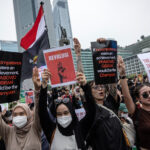
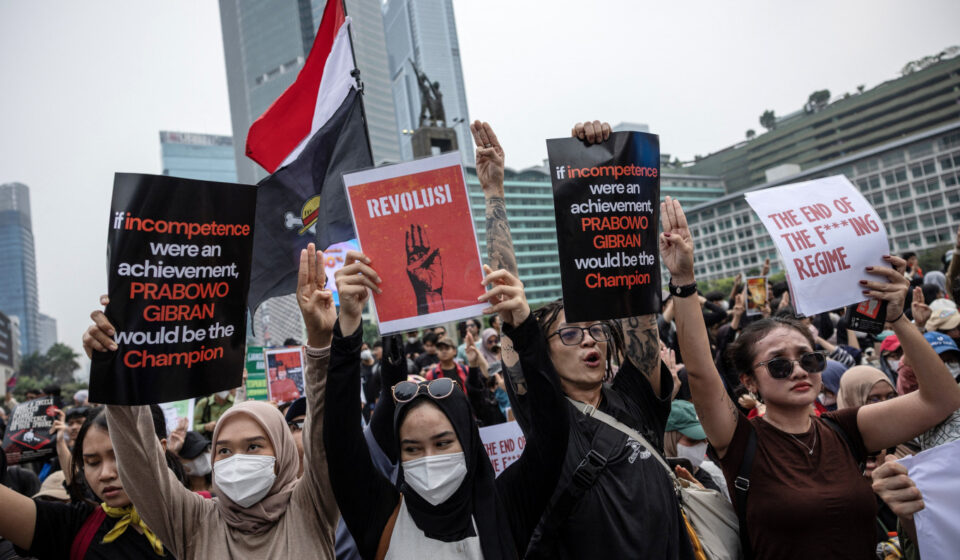
Eight days later, students and civil society groups returned to the streets on Indonesia’s Youth Pledge Day (Hari Sumpah Pemuda), under the banner #IndonesiaSadar. Their demands included declaring the forest fires a national disaster, holding companies responsible for environmental destruction to account, and reforming land governance. They also questioned public spending priorities, including funding for the free school meals programme (Makan Bergizi Gratis, or MBG) and village cooperatives (Koperasi Desa Merah Putih, or KDMP). Other concerns included education costs, access to basic services, employment, corruption, freedom of expression, human rights and the militarisation of civilian spaces.
The demonstrations also featured gas masks, images of orangutans, a red cross and the three-finger salute associated with The Hunger Games. One slogan stood out: “If we burn, you burn with us.” These symbols connected local grievances to a wider language of youth resistance and democratic accountability.
A nation breathing through smoke
Indonesia’s forest and land fires have made environmental degradation a matter of everyday survival. Dry conditions associated with El Niño have intensified fires, producing haze, damaging ecosystems and contributing to respiratory illness. Smoke has also affected neighbouring Malaysia and Singapore.
For demonstrators, the crisis is about the consequences of environmental destruction and the state’s responsibility to address them. They called for the fires to be declared a national disaster and for responsible companies to be held accountable. Images of orangutans extended the message to wildlife and fragile ecosystems. Gas masks and the red cross evoked emergency and vulnerability. Smoke crosses borders and affects people unequally. Environmental degradation is therefore also a question of social justice.
The price of being governed
Environmental concerns were only one part of the mobilisation. Students also raised issues around rising prices, subsidised fuel and the government’s spending priorities. They questioned the scale of funding for MBG while disaster mitigation and other public services remained concerns.
The figures illustrate the debate, although they refer to different categories and periods. The revised allocation for MBG stood at Rp229 trillion in 2026, down from its original budget of Rp335 trillion. The government reported Rp376.8 trillion in energy subsidy and compensation payments by September 2026. For 2027, the approved energy subsidy allocation was Rp261.5 trillion. These figures became part of a wider argument about how public resources should be distributed and which needs should take priority.
The debate is not simply about one programme being funded at another’s expense. It concerns who benefits from public spending, who bears its consequences and whether citizens can question those choices. Economic insecurity and environmental vulnerability can reinforce one another. Citizens are not merely recipients of public programmes; they are entitled to scrutinise how resources are allocated and whose interests they serve.
The right to protest, the duty to listen
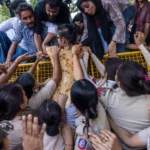
The demonstrations also raised questions about citizens’ space to challenge government policy. On 28 October, protests took place at Jakarta’s Hotel Indonesia Roundabout, the National Monument and the area around the House of Representatives. Police deployments, blockades and minor clashes were reported.
On 29 October, students from Trisakti University brought a renewed version of the Tri Tuntutan Rakyat (Tritura), or Three People’s Demands, to the State Palace. They called for national recovery across the economic, ecological, political, educational and health sectors; an end to public officials’ incompetence and multiple office-holding; and the enforcement of civilian supremacy.
The demands widened the debate to political leadership and the role of security institutions in civilian life. The state must maintain public order without undermining the rights to peaceful assembly and freedom of expression. Accountability is measured not only by the policies a government delivers, but also by its willingness to let citizens question them.
Borrowed symbols, burning realities
The three-finger salute associated with The Hunger Games and the slogan “If we burn, you burn with us” deserve particular attention. Popular-culture references offer a visual language of resistance that crosses national boundaries and helps young people communicate grievances and build solidarity.
In the context of Indonesia’s forest fires, the slogan also evokes ecological interdependence: environmental destruction travels across borders and affects people with little influence over the decisions behind it. The protests are not identical to movements elsewhere; they show how young people adapt shared references to express local experiences. The symbols may be borrowed; the grievances are local.
The streets remember what power forgets
The October demonstrations also recall the nationwide protests of 2025, which followed the police killing of a motorcycle taxi driver and involved deaths and mass detentions. Although the immediate triggers differed, both waves of protest brought questions of state conduct, public accountability and citizens’ rights into the streets.
The October mobilisation revealed how economic insecurity, environmental destruction and restrictions on civic freedoms intersect in people’s lives. Democracy requires more than elections and formal institutions: it needs a state that can be questioned, public resources that can be scrutinised, environmental responsibilities that are taken seriously and civic spaces where dissent is safe.
Some protests end when the streets empty. Others remain in the smoke, in the memories of those who marched and in the questions a government has yet to answer. “If we burn, you burn with us” captures a central challenge of democratic accountability: the consequences of political decisions are shared, even when the power to make them is not.
