







French police officer set on fire in Paris protest
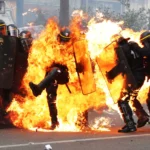
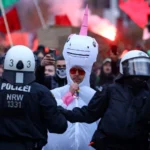
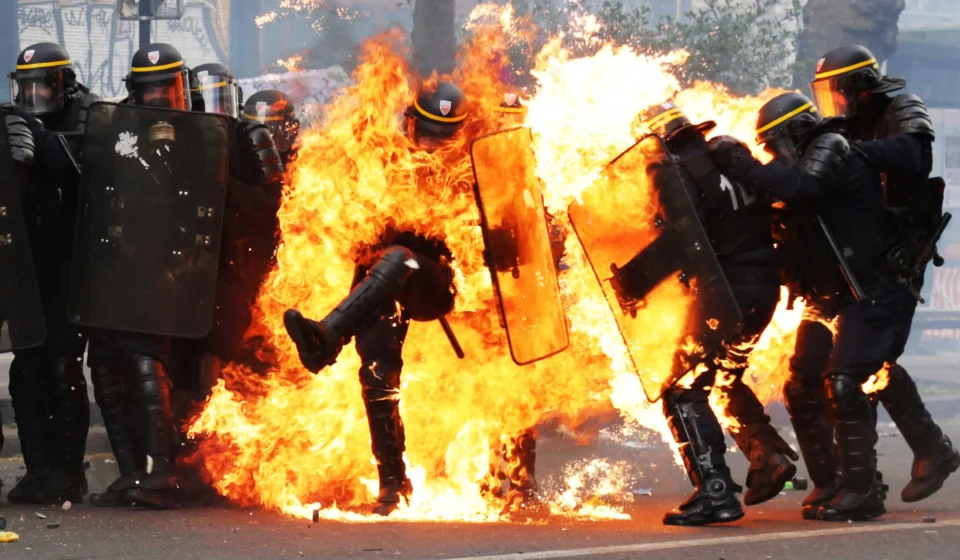
French prosecutors have opened an attempted murder investigation after petrol bombs were thrown at police and gendarmes during Saturday’s cost-of-living protests in Paris. Video of an officer whose leg catches fire when a device explodes at his feet has caused outrage, and it has pushed a protest movement that was mostly peaceful into a debate about violence.
For readers outside France, this is the sharpest turn yet in a wave of youth-led protests over prices, schools and public services that has spread across Europe, and it follows the update to my earlier report on Saturday’s marches.
The investigation was announced on Sunday. Paris prosecutors said it covers the “attempted murder of persons vested with public authority,” and that explosive devices were thrown at around 15 gendarmes, who are military police, as well as police officers. ABC News reports that the officer who was set alight suffered second-degree burns. Al Jazeera reports that no arrests had been made for the attack. Euronews says police singled out three people dressed in black, in the style of “Black Bloc” protesters, as suspects. The Black Bloc is a loose tactic of masked, black-clad protesters, not a single organisation. One outlet describes the attacker as a “leftist protester,” but I found no evidence identifying who threw the device, so that label is unverified. Interior Minister Laurent Nuñez called the attack an attempted murder and described an “extraordinary” level of violence, adding that rallies were largely peaceful until masked and hooded rioters arrived as they ended.
The numbers have moved since my earlier report. I cited more than 560 arrests on Saturday night, from NBC. The French interior ministry has since put the total at more than 770 arrests. The ministry’s turnout estimate for Saturday remains about 320,000 people nationwide, including 70,000 in Paris, though organisers usually give higher figures. Some reports say violence also flared in Germany, Portugal, Albania and Switzerland, but I could only find that in an aggregator summary, so treat it as unconfirmed. Germany’s interior minister has called for harsh penalties after peaceful, mainly youth-led protests across Europe ended in violence, according to the Guardian.
The legal term matters. In France, the charge of attempted murder of someone holding public authority is a serious offence that carries long prison sentences, and the government has said it is determined to prevent further attacks on police, gendarmes and emergency workers. That fits the strategy Nuñez set out before the weekend, with about 70,000 officers deployed and protests banned in city centres. Critics of such measures, including unions and some protesters, say heavy policing and bans can inflame the situation, while the government says the violence of a small minority justifies them. Both arguments are being made in public, and the burned officer’s case will strengthen the government’s hand for now.
The deeper question is what the violence does to the movement. The protests began in early October as student demonstrations over the state of education and widened into a revolt over living costs and social security, joined by unions and the Yellow Vests. Turnout has fallen week by week, from 550,000 on October 17 to 410,000 and then 320,000, according to ministry counts, while the level of disorder has not fallen with it. A movement that loses numbers but keeps a violent fringe risks losing public sympathy, and governments in Germany and Italy are watching the same pattern. The organisers have not, in what I found, condemned the attack in detail, and I could not confirm any link between the people who threw the devices and the groups behind the marches. Unions had planned a nationwide strike for November 5, which I have not re-verified, and that will be the next test of whether the movement holds together.
What is known and what is not: the investigation, the 15 officers targeted, the second-degree burns and the arrest total above 770 are reported by several outlets. Who threw the device, whether they belonged to any group, and whether the violence will change turnout are not known. This is a news summary of a developing story.
Sources: Euronews via Yahoo, Al Jazeera, AFP via LBC Group, AFP via Times of Israel, ABC News Australia, The Guardian via AOL, WION, BGNES, The Local France, Arab News, Breitbart and The Jakarta Post.
