














EU chief hosts Canada’s Carney in push to deepen alliance
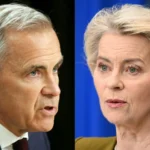
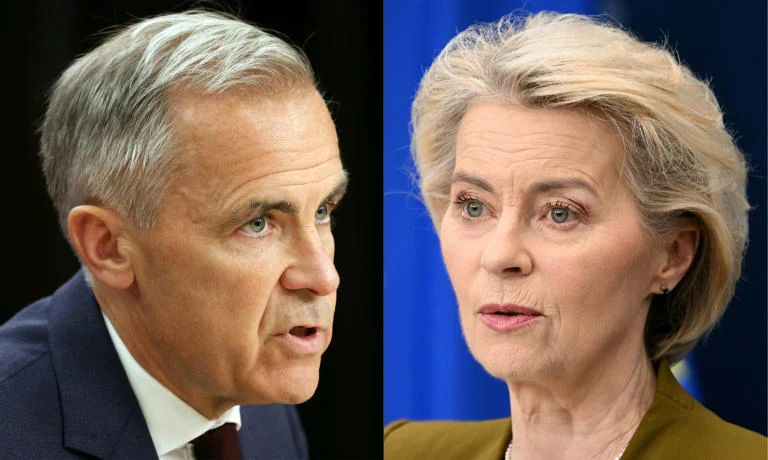
TLE Desk: European Commission President Ursula von der Leyen is set to call for closer ties with Canada on Wednesday as Prime Minister Mark Carney attends the European Union’s annual State of the European Union address as guest of honour.
The visit is aimed at strengthening cooperation between Ottawa and the 27-member bloc in areas including artificial intelligence, energy and critical minerals, while building momentum ahead of an EU-Canada summit in Montreal next month.
Carney, who is pursuing what Canada describes as a “unique alliance” with the EU, will address the European Parliament on Thursday. He is the first foreign head of government to attend the bloc’s annual State of the European Union address.
The two sides are seeking deeper cooperation as both face pressure from US tariffs and growing competition from China. The European Commission said the level of ambition for the relationship was high and that von der Leyen would outline “positive and meaningful” initiatives.
The Comprehensive Economic and Trade Agreement (CETA), which removed almost all tariffs between the two sides, has been credited with increasing trade in goods and services by more than 80 per cent since 2016. Canada also became the first non-EU country to join the bloc’s defence procurement programme this year.
Further cooperation is being explored in strategic sectors. Canadian officials said Ottawa was seeking an agreement allowing the European Investment Bank to finance Canadian critical-minerals projects, potentially helping reduce dependence on China for raw materials used in products such as batteries.
Energy cooperation is also expanding, including a recent agreement to supply Canadian liquefied natural gas to Germany. Canadian artificial intelligence company Cohere’s investments in Germany were cited as another example of growing commercial ties.
However, CETA has yet to be fully implemented. Ten EU member states, including France, Italy and Poland, have not ratified the agreement, partly because of opposition from farmers. Investment-protection and dispute-resolution provisions therefore remain inactive.
The two sides are also discussing labour mobility, student exchanges through the Erasmus programme and possible Canadian participation in the EU’s €90 billion loan package for Ukraine.
“We’re actually looking to go beyond simply a free trading relationship, to deepen that relationship across the board,” Canada’s ambassador to the EU, Jonathan Wilkinson, told AFP.
