


















New Zealand’s major parties lose ground, voters turn to smaller forces
National and Labour secured just 58% of the party vote combined, leaving the country facing weeks of coalition uncertainty as special votes could determine the next government.
New Zealand’s two largest political parties have suffered a historic setback in the 2026 general election, as voters shifted support towards smaller parties and left the formation of the next government uncertain. The National Party and Labour Party received a combined 58% of the party vote on election night, their lowest joint share on record, according to political commentator Claire Robinson in The Guardian.
The result left the two major parties almost level, with Labour securing 29.3% and National 29.2%. However, their combined performance was not enough to produce a straightforward governing majority for either side. Smaller parties recorded gains, while hundreds of thousands of special votes remained to be counted before the final parliamentary balance could be established on 27 November.
The election has exposed voter dissatisfaction with the established parties and increased the influence of smaller political groups in a closely divided parliament.
The election result reflected a shift towards parties offering different policy priorities and political approaches. ACT and the Green Party recorded their strongest results to date, while New Zealand First achieved its best performance since 2002. Te Pāti Māori retained more seats than expected, and the Opportunity party crossed the 5% party-vote threshold for the first time, qualifying for parliamentary representation.
Robinson argues that the major parties failed to present sufficiently compelling policy platforms and that their campaign strategies allowed smaller parties to attract voters from their respective political blocs.
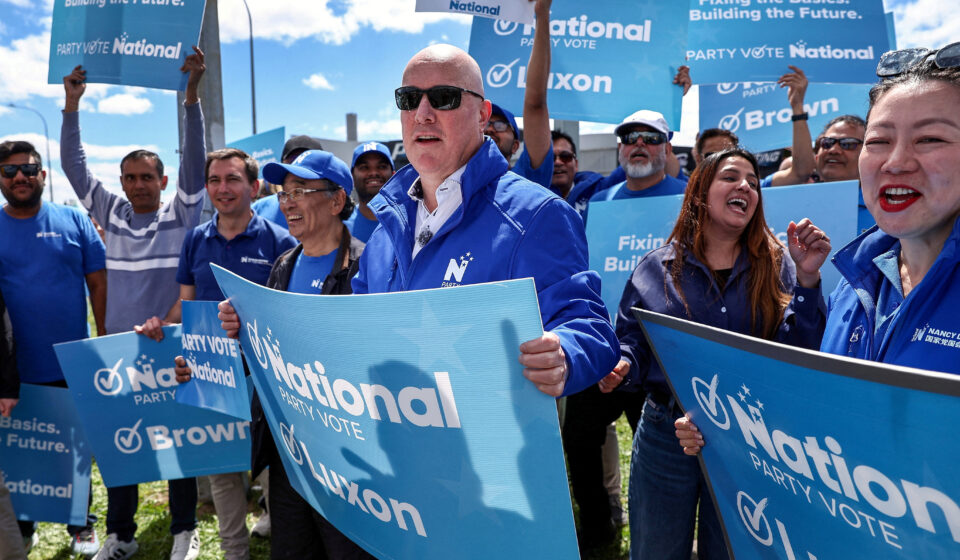
National leader Christopher Luxon and Labour leader Chris Hipkins spent much of the campaign criticising each other. Yet the losses and gains within their broader political camps suggest that competition from smaller parties was also a significant factor in the outcome.
Labour improved its 2023 result by 2.2 percentage points and gained two seats. National, by contrast, lost 8.3 percentage points, a decline that affected the position of several senior figures.
New Zealand’s mixed-member proportional (MMP) electoral system has produced a complicated parliamentary outcome. Under the system, the overall number of seats a party receives is generally linked to its share of the party vote, alongside the seats it wins in individual electorates.
National won more electorate seats than its party-vote share would ordinarily entitle it to receive. This created an overhang, allowing the party to retain those additional seats and increasing the size of parliament.
Instead of its usual 120 members, the House had 131 seats on election night. National received six overhang seats, while Te Pāti Māori received five. The larger parliament also increased the number of seats required for a majority from 61 to 66.
On the provisional election-night count, the governing coalition had a narrow advantage: National’s 42 seats, combined with 25 seats for ACT and New Zealand First, gave it 67 seats. That left the coalition with a margin of just one seat above the threshold.
The result also affected National’s party-list representation. Because the party had won more electorate seats than its proportional entitlement, it received no additional list seats. Several senior politicians who depended on list positions were therefore at risk of losing their parliamentary places, including deputy leader and Finance Minister Nicola Willis, Justice Minister Paul Goldsmith, Speaker Gerry Brownlee and MP Chris Bishop.
The provisional result is not final. Several hundred thousand special votes, including ballots cast by people outside their electorate or overseas, remain to be counted.
In the 2017 and 2023 elections, special votes reduced National’s parliamentary representation by two seats. This time, the overhang means the effect may be different, but even a small shift in party-vote percentages or the loss of a closely contested electorate could eliminate the coalition’s one-seat margin.
The Wairarapa electorate is particularly relevant. National’s election-night majority there was only 139 votes, leaving the seat vulnerable to a change when the remaining ballots are included.
Luxon acknowledged the uncertainty when he addressed the country around midnight. He said National remained the largest party in parliament and had a pathway to forming the next government, but stopped short of declaring victory. Formal negotiations and compromises would wait until the final count on 27 November. Until then, the government would remain in caretaker mode.
Luxon had previously ruled out working with the Opportunity party, led by Qiulae Wong. That position could remain viable if the election-night numbers hold. However, a change of even one seat could force National to reconsider its options.
A coalition with a majority of only one seat would also face significant governing risks. In a closely divided parliament, individual government members could exercise considerable influence over legislation and political decisions. A defection, resignation or by-election could potentially threaten the government’s ability to maintain its majority.
The election therefore leaves Luxon with a difficult task even if the provisional coalition arithmetic survives the final count. Securing the numbers to form a government would be only the first step; maintaining parliamentary support could prove equally challenging.
The decline in combined support for National and Labour raises questions about the relationship between established political parties and an electorate increasingly willing to consider alternatives.
The results do not establish that voters have abandoned the two-party system altogether. Both parties remain the largest individual political forces, and their combined 58% share still represents a majority of the party vote. However, the rise of smaller parties has made coalition-building more complex and reduced the ability of either major party to dominate the political agenda.
The final outcome will depend on the special-vote count and subsequent negotiations. For now, New Zealand faces a period of political uncertainty in which a small number of votes and parliamentary seats could determine the composition of its next government.
Source
