












Workers, students demand higher wages, better services in France
A nationwide strike drew sharply differing crowd estimates, disrupted energy and education services and led to hundreds of arrests, renewing pressure on President Emmanuel Macron’s government ahead of the 2027 election.
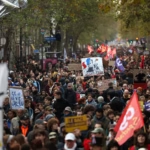
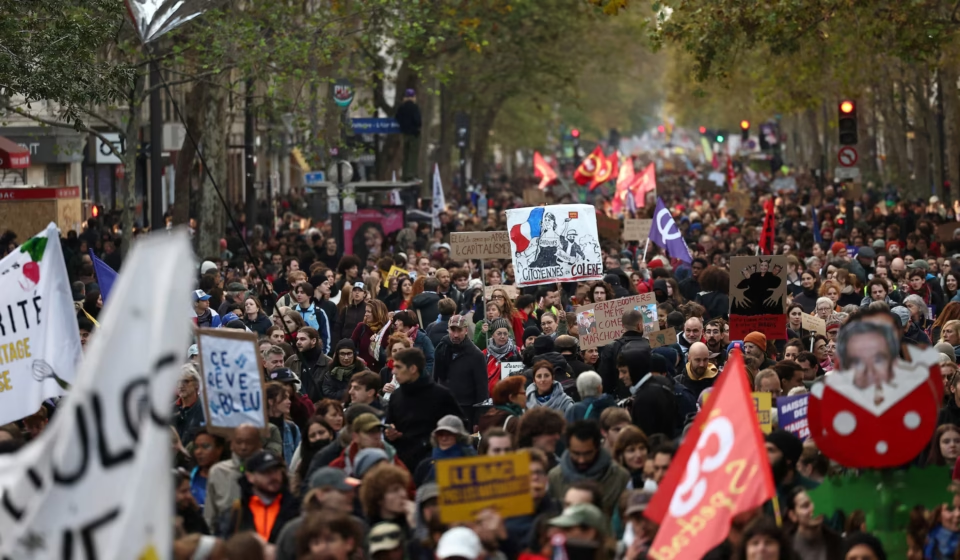
France experienced a largely peaceful nationwide day of demonstrations on Thursday, 5 November, as workers, students and trade unionists mobilised over wages, the cost of living and public services. Although clashes occurred in Paris and Lyon, the protests marked another major challenge to President Emmanuel Macron’s government following weeks of unrest over economic and social grievances.
The French Interior Ministry estimated that 575,000 people took part in demonstrations across the country, while the CGT trade union, one of the organisers, put participation at 1.6 million. The substantial difference reflects competing estimates of the scale of the mobilisation, but both figures indicate a significant nationwide turnout.
The demonstrations brought together public-sector workers, teachers, energy employees, pensioners and students demanding better pay, improved education conditions and stronger public services. The mobilisation also placed Prime Minister Sébastien Lecornu under pressure ahead of a meeting with trade unions and employers scheduled for 9 November to discuss salaries and the cost of living.
The protests reflected concerns extending beyond individual wage disputes. Participants raised questions about purchasing power, inflation, the quality of public services and the future facing younger generations.
In Paris, 18-year-old student Alice Martinovic told Reuters that there was considerable concern about salaries and public services. She said she hoped political candidates would take the movement’s demands into account and listen to young people and students.
A 45-year-old firefighter, Mehdi Dumontroty, said his pay had not kept pace with inflation. His comments illustrated a central concern among public-sector employees: the gap between household expenses and income.
The participation of students alongside established trade unions gave the mobilisation a broader social character. Students demanded better conditions in schools and universities, while workers called for improved wages and public services. Their combined presence suggested that economic insecurity and dissatisfaction with public institutions were connecting different generations and occupational groups.
The strike caused disruption in some sectors without producing a major breakdown in national transport. The Eiffel Tower was closed, some energy workers and teachers joined the stoppage, and France’s nuclear electricity output declined early on Thursday.
The Education Ministry said just over 15% of teaching staff had participated in the strike. Transport services, however, experienced no major disruption.
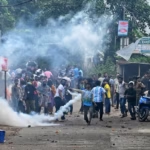
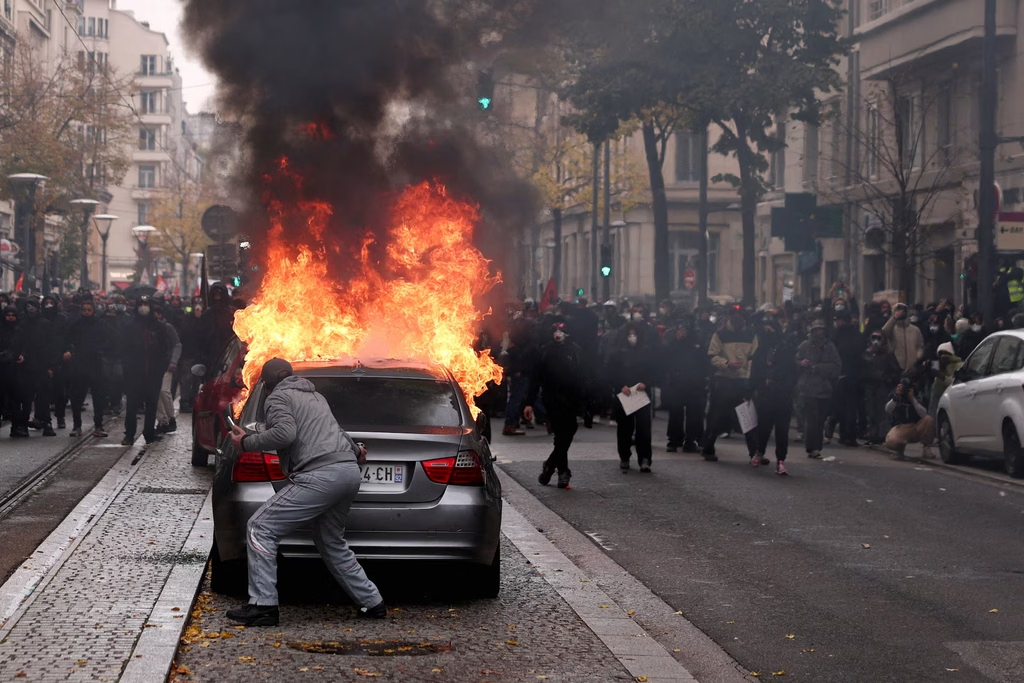
In Paris, the main march began at Place de la République, with a festive atmosphere at the outset. Participants sang the national anthem, while some groups used carnival-style floats. Clashes broke out around two hours into the demonstration when some individuals at the front of the march confronted police. Officers responded with tear gas, while police said hooded individuals had engaged in vandalism.
Further confrontations occurred as the march ended, and authorities extinguished at least one small fire. In Lyon, riot police used tear gas and charged a group of demonstrators, some of whom were dressed in black with their faces covered.
The Interior Ministry subsequently reported 53 injured police officers and 448 arrests. These figures indicate the scale of the security response, although the report did not provide a comprehensive breakdown of injuries among demonstrators.
Violence also affected educational institutions. The Interior Ministry said fireworks were used to start a fire at a high school near Toulouse, forcing an evacuation. People also threw objects at firefighters responding to the incident.
Education Minister Édouard Geffray condemned the behaviour, describing it as criminal. Regional authorities separately reported damage to several high schools in the Paris area, including a school in central Paris that was set on fire.
The authorities had deployed approximately 70,000 police officers nationwide, a level comparable with recent weekends. Security measures had been tightened following the unrest of 17 October, when damaged shops and public buildings drew criticism of the government’s handling of the crisis.
Since then, authorities have imposed curfews in some areas, restricted large gatherings and required demonstrators to use alternative routes away from major boulevards. Trade unions criticised these measures, arguing that the government had attempted to obstruct the demonstrations.
CGT leader Sophie Binet said the protests had grown despite government efforts to restrict them. A banner at the Lyon demonstration carried a similar message of solidarity, declaring that students, pensioners and workers were united.
The demonstrations come approximately five months before France’s next presidential election, expected in 2027. Macron cannot seek another term, leaving the country’s political parties and potential candidates to position themselves around economic concerns, public services and the government’s response to social unrest.
Presidential hopefuls Jean-Luc Mélenchon and Raphaël Glucksmann attended the demonstrations, bringing electoral politics directly into the mobilisation. The prospect of a second-round contest between far-right candidate Marine Le Pen and hard-left rival Mélenchon was also raised in Reuters’ reporting, although the eventual field and outcome remain uncertain.
For Lecornu, the immediate challenge is to respond to demands over wages and living costs while maintaining public order. His scheduled meeting with employers and workers’ representatives on 9 November will provide an opportunity to address the economic issues behind the strike.
Thursday’s demonstrations did not produce the scale of nationwide disruption seen in some previous episodes of French unrest. Nevertheless, the turnout, participation across social groups and continuing clashes indicate that the underlying grievances remain unresolved.
The mobilisation also highlights a recurring challenge for France’s political institutions: economic dissatisfaction can bring together groups with different priorities, creating pressure that extends beyond conventional workplace disputes. Whether the government can translate its upcoming discussions with unions and employers into tangible responses will be important in determining how the current tensions develop.
Sources: Reuters, “Largely peaceful marches take place across France as workers stage strike”, 5 November 2026; Associated Press, “Mass protests sweep France as huge crowds demand higher wages, back students’ demands”, 5 November 2026; Al Jazeera, “Workers strike across France, hundreds of thousands expected to protest”, 5 November 2026; Financial Times, “Nearly 600,000 join latest protests in France”, 5 November 2026; Le Monde, “French students, unions and Yellow Vest protestors bet on common front in new strike”, 5 November 2026; and Agence France-Presse, “France braces for demonstrations as trade unions strike”, 5 November 2026.
