












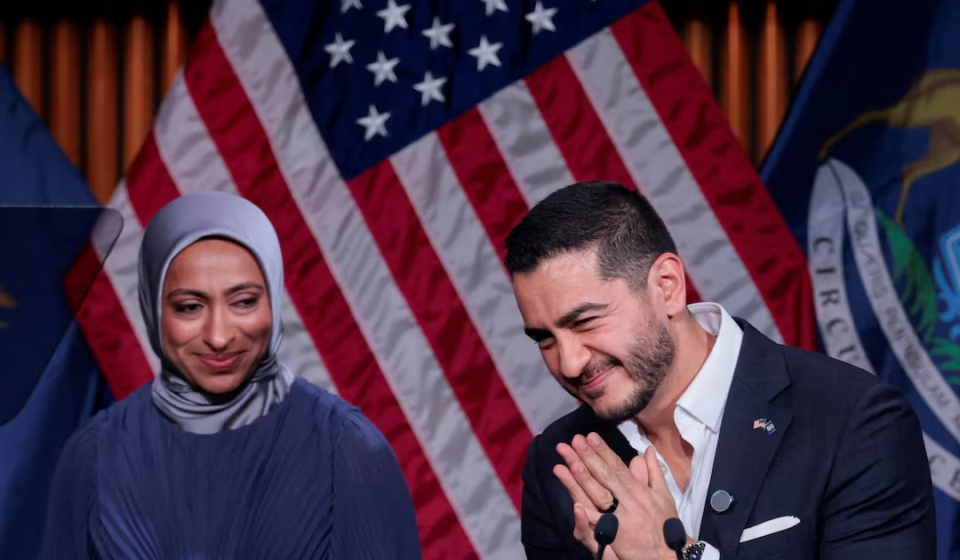
Abdul’s Michigan victory exposes divide over Israel
The first Muslim elected to the US Senate won statewide but trailed Michigan’s Democratic governor-elect in heavily Jewish communities, highlighting tensions over Israel, antisemitism and the future direction of the party.
Abdul El-Sayed’s historic election to the US Senate has exposed a political divide within Michigan’s Democratic electorate, with detailed precinct-level results showing that he performed considerably less strongly than other Democratic candidates in communities with larger Jewish populations. His victory, however, also demonstrated the strength of his support in areas with significant Muslim populations, bringing questions over Israel and political representation into sharper focus for the Democratic Party.
A POLITICO analysis of Michigan’s election results found that El-Sayed received 52.5 per cent of the statewide vote, compared with 54.5 per cent for Democratic governor-elect Jocelyn Benson. The two-point difference was substantially wider in several communities with larger Jewish populations.
In Huntington Woods, a Detroit suburb where approximately two-thirds of residents are Jewish, El-Sayed received 65.3 per cent, compared with Benson’s 80 per cent. In West Bloomfield, where roughly one-quarter of residents are Jewish and the site of a March synagogue attack, El-Sayed trailed Benson by 8.8 percentage points.
The results indicate that his position on Israel was a significant point of political disagreement in parts of the state’s Jewish electorate. During the campaign, El-Sayed faced criticism over his opposition to continued US military assistance to Israel and remarks following the synagogue attack that some Jewish voters considered insensitive. He subsequently apologised for the comments.
El-Sayed nevertheless won the statewide contest, becoming the first Muslim elected to the US Senate.
In an interview with POLITICO on Wednesday, El-Sayed acknowledged that his position on Israel had created disagreements with some Jewish voters. He said he did not intend to change his position but hoped to earn their support through his work on issues shared across communities.
He identified healthcare, workers’ rights, clean air, clean water, religious pluralism and respect for the US Constitution as areas where he believed common ground could be established.
His comments suggest that he intends to maintain his foreign-policy position while attempting to build relationships with constituents who disagree with him. The approach reflects a broader challenge for elected Democrats: managing disagreements over Israel and Palestinian rights without allowing those divisions to undermine relationships across their electoral coalition.
El-Sayed had previously sought to address concerns about antisemitism and Jewish safety. However, some Jewish leaders and activists urged voters to leave their Senate ballots blank or support Republican candidate and former representative Mike Rogers.
His former Democratic primary rival, Representative Haley Stevens, also withdrew her endorsement and backed Rogers shortly before the election. Stevens cited concerns about antisemitism and the rhetoric surrounding Israel within El-Sayed’s political coalition.
A campaign advertisement from a prominent El-Sayed supporter linking high grocery prices to US assistance to Israel also became controversial. El-Sayed and his campaign distanced themselves from the advertisement.
The POLITICO analysis found a contrasting pattern in areas with larger Muslim populations. In Dearborn, for example, El-Sayed received 82.5 per cent of the vote, compared with 78.7 per cent for Benson.
Muslims account for approximately 2.4 per cent of Michigan’s electorate, while Jewish voters represent around 1.4 per cent, according to the figures cited in the report. These relatively small population shares nevertheless carry political significance in closely contested statewide elections, particularly in communities where foreign policy and religious identity are prominent campaign issues.
The comparison with the 2024 election also illustrates the scale of political change in Dearborn. Democratic Senator Elissa Slotkin received 41.4 per cent of the vote in the city that year, while then-Vice President Kamala Harris received 36.3 per cent.
However, precinct-level results should not be interpreted as direct evidence of how every Jewish or Muslim voter voted. Communities are politically diverse, and local election outcomes reflect several factors, including candidate preferences, turnout, campaign organisation and domestic policy concerns.
A poll of Jewish early voters in Michigan cited by POLITICO found that a majority supported El-Sayed, although approximately one-quarter of those who had backed Slotkin in 2024 switched to Rogers. The findings suggest that his position on Israel did not produce a uniform response among Jewish voters.
Lansing Mayor Andy Schor, a Jewish Democrat who supported Stevens during the primary and did not endorse El-Sayed, said he hoped the incoming senator would remain open to concerns raised by Jewish constituents.
The organisation Nonnegotiable Michigan, a group of Jewish activists that had challenged El-Sayed on Israel and Jewish safety, said after the election that it was prepared to work with him while continuing to hold elected officials accountable over antisemitism in political discourse.
These responses indicate that the election has not ended the debate. Instead, it has moved the disagreement from the campaign trail into the relationship between an incoming senator and the communities he will represent.
El-Sayed’s campaign also highlighted an outside analysis suggesting that his performance in predominantly Jewish precincts was only slightly below Slotkin’s 2024 result. His campaign argued that he had faced substantial financial opposition from wealthy donors, corporate interests and organisations including AIPAC. Those assertions reflect the campaign’s interpretation of the election rather than an independent assessment of the causes of voting patterns.
The senator-elect has framed his statewide victory as evidence that voters supported his political position on Israel. He argued that US assistance should be used to advance domestic priorities rather than support actions he considers violations of international law. He also said he hoped future Democratic presidential candidates would take note of the electorate’s position.
Michigan’s results provide a case study in the competing pressures shaping the Democratic coalition. Disagreements over US policy towards Israel have become increasingly prominent alongside debates about antisemitism, Palestinian rights, religious pluralism and the party’s approach to foreign policy.
For some Jewish voters, criticism of Israeli government policy and opposition to military assistance are closely connected to concerns about Israel’s security and antisemitism. For other voters, including many who supported El-Sayed, continued US military assistance raises questions about human rights, accountability and the use of public funds.
Neither position represents an entire religious or ethnic community. The election results demonstrate that voters can share party affiliations while holding substantially different views on international policy.
For El-Sayed, the immediate task will be translating a statewide mandate into representation that includes voters who opposed him. His refusal to change his position on Israel makes that challenge more explicit, but his commitment to engage with constituents across political and religious differences will be central to his Senate tenure.
His election is historic in terms of Muslim representation in the US legislature. Its wider significance, however, may lie in what it reveals about the evolving Democratic coalition: a party capable of delivering a decisive electoral victory while remaining divided over one of the most consequential foreign-policy questions facing the United States.
Sources
