




















Bangladesh’s garment wage deal faces test, protests expose cost of cheap labour
A new wage structure is due to take effect in December, but the wage board has yet to determine the increase. Workers’ demands, factory competitiveness and export reliability are now converging in a critical test for the country’s largest export industry.
Bangladesh’s garment industry is approaching another difficult wage settlement, with the government’s newly formed wage board agreeing to introduce a revised pay structure from December amid a fresh wave of worker protests. The decision offers a timetable for negotiations, but not yet a settlement on how much workers will earn. As factories face production disruptions and international retailers monitor the situation, the dispute is exposing a deeper tension in the country’s export model: the dependence on low labour costs at a time when workers’ living expenses are rising and global buyers continue to demand competitive prices and reliable deliveries.
The six-member wage board held its first meeting on Wednesday, 4 November, and agreed that the revised structure would take effect in December. Workers are expected to receive their first salaries under the new scale in January, according to Babul Akter, the workers’ representative on the board. However, the meeting did not determine the size of the increase. The next stage of negotiations will therefore be decisive, particularly as workers are demanding that the monthly minimum wage rise to Tk 30,000 from the existing Tk 12,500. That would represent an increase of 140 per cent, a demand that reflects the pressure of food, housing and transport costs on low-paid households. Reuters reported the wage board’s decision and the workers’ demands on 4 November.
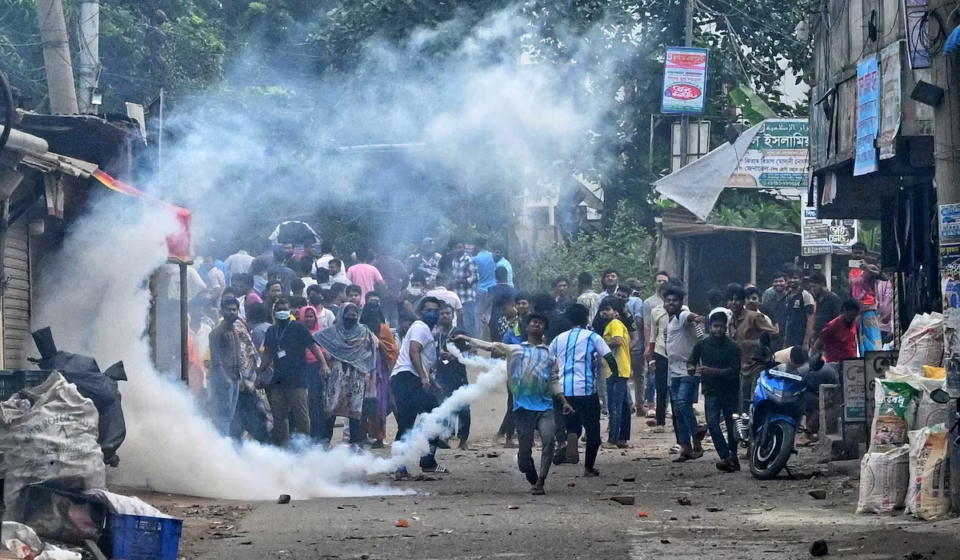
The wage dispute has moved beyond factory negotiations into a wider supply-chain concern. Protests entered their fifth day on Wednesday, with clashes between workers and police reported in Savar and Gazipur, two major manufacturing centres on the outskirts of Dhaka. Demonstrators blocked roads and highways, while police used tear gas and sound grenades. Several factories suspended operations amid fears of further unrest.
Hundreds of factories have reportedly closed during a crucial production period for spring and summer export orders. The timing matters. International apparel supply chains operate on tight production and shipping schedules, and even temporary stoppages can affect delivery commitments, inventory planning and retailers’ ability to prepare for seasonal demand. The immediate commercial risk is not simply the number of factories closed, but whether disruption becomes prolonged enough to force buyers to reconsider sourcing schedules or shift orders elsewhere.
The scale of Bangladesh’s exposure is considerable. The garment industry employs around four million workers and generates more than 80 per cent of the country’s export earnings. It supplies major international retailers, including H&M, Inditex’s Zara and Walmart. H&M told Reuters that some factories had temporarily closed, although it had not experienced major supply-chain disruption at the time of reporting. That distinction is important: temporary closures do not necessarily translate into lost orders, but sustained uncertainty can weaken buyer confidence in delivery reliability.
The current minimum wage of Tk 12,500 was established in 2023. Workers’ demand for Tk 30,000 reflects the gap they say has developed between earnings and the cost of maintaining a household. A nominal wage increase, however, does not automatically translate into an equivalent improvement in living standards. Its real value depends on inflation, the cost of essential goods and services, working hours, employment stability and the extent to which wage gains are absorbed by rising prices.
For manufacturers, the challenge is equally complex. Factory owners face higher operating expenses, energy-market uncertainty and competition from other apparel-producing countries. Weak demand in some major export markets can also limit their ability to pass additional costs on to buyers. Yet treating wages only as a production expense overlooks their role in sustaining the workforce and maintaining industrial stability.
University of Dhaka economics professor Selim Raihan told Reuters that Bangladesh could absorb a significant wage increase without necessarily losing its competitive advantage if factories improved productivity. He argued that wage revision should take into account inflation, living costs and factories’ ability to pay. He also called for international retailers to support better labour standards through fairer purchasing practices and prices. His argument points to a structural question for the industry: whether Bangladesh can compete increasingly through productivity, reliability and higher-value production rather than relying primarily on low wages.
The responsibility for a sustainable wage settlement cannot rest solely with workers or factory owners. International retailers influence the commercial conditions under which suppliers operate through purchasing prices, order volumes, lead times and payment arrangements. If buyers continue to demand lower prices while expecting factories to meet higher labour and compliance standards, the financial pressure is likely to remain concentrated at the manufacturing end of the supply chain.
More predictable purchasing commitments and pricing arrangements could help suppliers plan wage costs and invest in productivity. At the same time, manufacturers need to improve production efficiency, skills, technology and product quality to create room for better remuneration without undermining their ability to compete. The transition requires cooperation across the supply chain rather than a wage decision isolated from the commercial realities of global sourcing.
The wage board’s timetable is therefore only the beginning of the process. Its next task is to establish a pay structure that workers can regard as meaningful and employers can implement without destabilising production. A settlement that fails to address household pressures could leave the causes of unrest unresolved; one that ignores factory viability could create further pressure on employment and investment.
The immediate priority is to restore production and reach a credible agreement before delivery disruptions become more serious. But the longer-term challenge is broader. Bangladesh’s position as the world’s second-largest apparel exporter after China has been built on a combination of labour availability, manufacturing capacity, supplier networks and competitive pricing. Preserving that position will require more than maintaining a low-cost workforce.
Raihan’s warning that prolonged labour unrest may be more damaging than higher wages captures the commercial stakes. Buyers need dependable production, while workers need earnings that keep pace with the cost of living. Those objectives are not inherently incompatible, but achieving them requires improvements in productivity, industrial relations and the distribution of value across the supply chain. The December wage revision will test whether Bangladesh’s garment sector is prepared to move towards a more sustainable model of competitiveness—or whether its dependence on cheap labour will continue to generate recurring conflict.
Sources: Reuters — Bangladesh agrees new garment pay scale from December amid protests; Bangladesh Garment Manufacturers and Exporters Association (BGMEA); International Labour Organization — Bangladesh; Export Promotion Bureau of Bangladesh; H&M Group — Sustainability and supply-chain information.
