

















Airstrikes kill at least 27 near Yemen’s capital, civil war intensifies
Houthi officials blame Saudi Arabia for strikes on a village northeast of Sanaa, while the latest escalation raises fears of renewed mass displacement, hunger and disease.
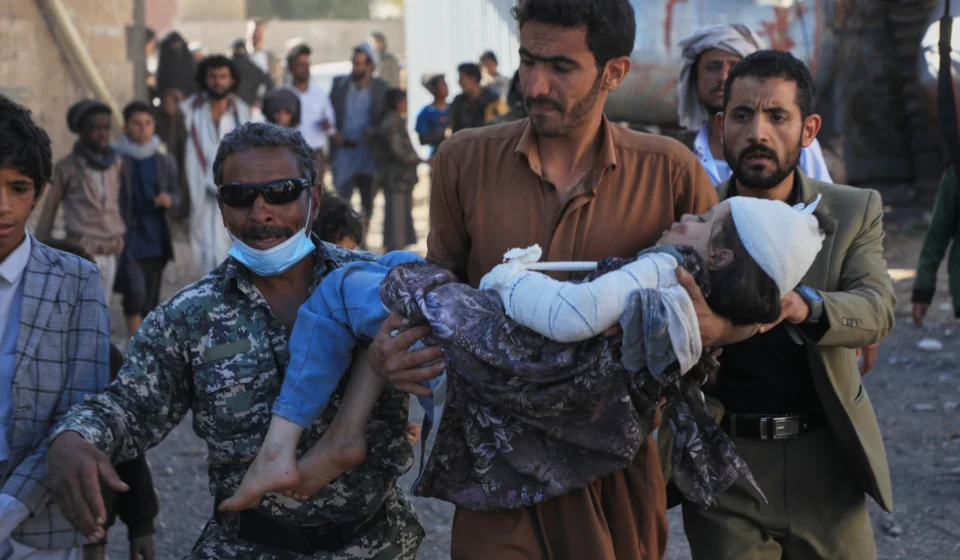
At least 27 people were killed and 36 others wounded when airstrikes hit homes in a farming village near Yemen’s capital, Sanaa, on Saturday, according to the Houthi-run Health Ministry. Most of the reported casualties were women and children, as renewed fighting between the Iran-backed Houthis and forces aligned with Yemen’s internationally recognised government threatens to deepen the country’s humanitarian crisis.
Anees al-Asbahi, a spokesman for the Houthi-run Health Ministry, told The Associated Press (AP) that the strikes hit al-Shariya, around 15 kilometres northeast of Sanaa. He said rescue operations were continuing and warned that the death toll could rise. The Houthis accused Saudi Arabia of carrying out the attack, but AP said it could not independently verify the claim. Saudi Arabia’s Information Ministry did not immediately respond to requests for comment.
The Houthi military spokesperson, Brig. Gen. Yahya Saree, subsequently said the group had launched attacks against Saudi Arabia in response to Saturday’s strikes and an earlier deadly attack on a market in southwestern Yemen. The statement was a claim by the armed group; independent confirmation of the reported attacks was not available in the AP account.
Footage broadcast by Houthi-run Al-Masirah television showed injured children being taken from ambulances to hospitals, while images from the village showed destroyed houses and debris scattered across the area. Residents were reportedly taking shelter in nearby agricultural fields as rescue teams searched the rubble.
Al-Asbahi alleged that civilians remained trapped beneath collapsed buildings and that subsequent strikes had targeted emergency workers attempting to rescue survivors. These allegations have not been independently verified. The reported presence of emergency personnel among those affected, however, adds to concerns about the risks facing civilians and rescue operations in areas exposed to continued bombardment.
The attack followed another deadly incident on Friday, when an airstrike hit a market in southern Yemen. Houthi officials said at least 30 people were killed. Both the Houthis and Yemen’s Saudi-backed military blamed the other side for the attack, leaving responsibility disputed in the absence of independent verification.
The latest violence marks a sharp deterioration after a period of relative calm following the 2022 truce. According to AP, the ceasefire effectively collapsed over the summer as the Houthis resumed offensives, citing Saudi Arabia’s continued blockade of territory under their control.
The Houthis, who seized Sanaa in 2014 and control much of northern and western Yemen, have since expanded their operations along parts of the Red Sea coast and strategic islands near the Bab el-Mandeb Strait. They have also intensified attacks on Saudi oil and military infrastructure and shipping in the Red Sea.
Saudi Arabia and its allies have responded with airstrikes in Houthi-controlled areas, saying they are targeting the group’s military infrastructure. The renewed confrontation has brought the two sides back into direct conflict after years in which front lines changed relatively little.
Ground fighting has been particularly intense around Taiz, a strategically important city in southern Yemen held by government-aligned forces. The Houthis have encircled the city, according to AP, while restrictions on movement have made it harder for residents to obtain drinking water and food.
The deterioration around Taiz illustrates how renewed military operations can compound humanitarian pressures even beyond the immediate areas struck by air raids. Restrictions on access, damaged infrastructure and insecurity can disrupt food supplies, healthcare and the movement of civilians.
Yemen’s conflict has already produced one of the world’s most severe humanitarian emergencies. The war began in 2014 when the Houthis advanced from the north and seized the capital, forcing out the internationally recognised government. Saudi Arabia subsequently assembled a coalition to support that government and launched an extensive air campaign that drew international condemnation over civilian casualties.
The AP report cites the United Nations as estimating that the conflict has killed at least 150,000 people, in addition to widespread deaths associated with hunger and disease outbreaks.
The latest strikes and retaliatory claims point to a conflict increasingly linked to regional security, including Saudi Arabia’s border and energy infrastructure and the strategic shipping routes around the Red Sea and Bab el-Mandeb. The involvement of regional powers has long complicated efforts to secure a durable political settlement.
For civilians, however, the immediate consequences are more direct: deaths, injuries, damaged homes, disrupted markets and reduced access to essential services. The reported attacks on al-Shariya and the market in southern Yemen also underline the difficulty of establishing responsibility during an intensifying conflict, particularly when the parties offer competing accounts.
The latest casualty figures and allegations remain based on statements from Houthi authorities and have not been independently verified by AP. A reliable assessment of responsibility will require further evidence and responses from the parties involved.
As fighting intensifies, the central concern is whether Yemen will be drawn back into a prolonged phase of large-scale warfare after the relative calm that followed the 2022 truce. Without renewed diplomatic engagement and improved humanitarian access, the consequences are likely to extend well beyond the latest attacks, deepening the suffering of communities already affected by more than a decade of conflict.
Sources
