














Egypt backs Saudi Arabia, and Iran hosts regional talks
The Middle East is entering another period of strategic uncertainty as military operations against Yemen’s Houthi movement intensify, Egypt authorises defensive support for Saudi Arabia, and Iran hosts a four-country meeting on regional security involving Saudi Arabia, Pakistan and Türkiye.
The developments, reported on 26 October, reveal competing efforts to contain cross-border threats while keeping diplomatic channels open amid the continuing confrontation involving Iran, Israel and the wider region. Their significance extends beyond military calculations: the security of maritime trade routes, energy infrastructure, humanitarian access and regional investment increasingly depends on whether governments can prevent separate conflicts from becoming more closely connected.
The most immediate military development came from the Saudi-led coalition fighting Yemen’s Houthi movement. Coalition spokesperson Major General Turki al-Malki said an operation in Houthi-controlled territory had destroyed five tunnels used to store ballistic missiles, four missile launchers and an additional missile-storage facility. The coalition also said it had targeted supply lines and military equipment along Yemen’s front lines, presenting the operation as an effort to reduce the Houthis’ capacity to attack Saudi territory. Saudi Arabia’s official news agency published the coalition’s account, but the scale of the claimed damage and its longer-term effect on Houthi military capabilities have not been independently established. Destroying launchers and storage facilities may disrupt operations, but it does not by itself demonstrate that the group has lost the capacity to conduct further attacks.
The operation is taking place amid continuing violence inside Yemen, where rival claims about military targets and civilian casualties remain difficult to verify independently. Yemen’s Houthi-run Health Ministry alleged that Saudi-backed forces struck Mokha General Hospital, a claim the Associated Press said it could not independently confirm. Residents separately reported damage to the hospital and nearby houses following a strike on a residential building, although it was unclear whether the accounts referred to the same incident. The Houthis also claimed to have launched ballistic missiles against military gatherings and weapons depots belonging to Saudi-backed government forces in Aden and Lahj provinces. Those claims were likewise unverified. The competing accounts underline the importance of distinguishing official military statements, allegations by parties to the conflict and independently corroborated evidence when assessing the humanitarian and operational consequences of the fighting.
Egypt’s decision adds a significant regional dimension to the conflict. On 26 October, the Egyptian House of Representatives authorised President Abdel-Fattah el-Sisi to take necessary measures to support Saudi Arabia in defending its territory, sovereignty and holy sites against external aggression. The approval followed closed-door parliamentary deliberations and came after Cairo had considered the implications of a deeper role in the conflict. The authorisation does not, by itself, establish that Egyptian troops will be deployed to Yemen or that Egypt will participate in offensive operations. Al Jazeera, Reuters and Egyptian media reported that Cairo had framed the proposed assistance around Saudi Arabia’s defence. The distinction is consequential: defensive assistance, such as helping intercept missiles and drones, would carry different operational and political risks from sending ground forces into Yemen’s protracted civil war.
For Egypt, the decision involves a balance between strategic partnership and the potential costs of regional military involvement. Saudi Arabia is an important source of investment, financial assistance and economic cooperation for Cairo, while attacks on Saudi territory and critical infrastructure threaten broader regional stability. Supporting the kingdom could reinforce bilateral relations, but a more extensive military commitment could expose Egypt to retaliation, additional expenditure and pressure on an economy already facing substantial financing requirements. The memory of Egypt’s costly military intervention in Yemen during the 1960s also provides historical context for concerns about becoming entangled in a conflict whose political and military outcomes remain uncertain. The parliamentary authorisation therefore establishes room for action rather than confirming the scale, duration or precise form of any future Egyptian contribution.
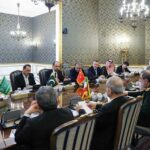
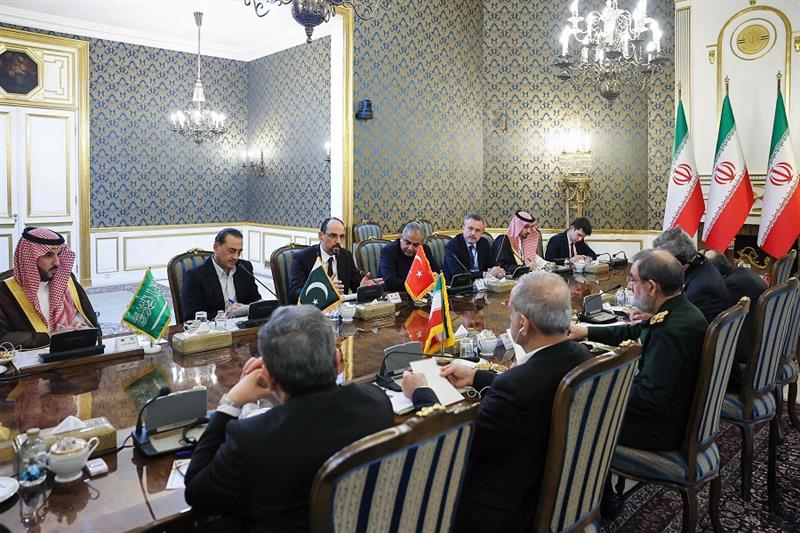
At the same time, Tehran has emerged as a venue for a diplomatic initiative that brings together countries with different security relationships and regional interests. Senior officials from Iran, Saudi Arabia, Pakistan and Türkiye met on 26 October in the first quadrilateral meeting of its kind, hosted by Iran’s Supreme National Security Council Secretary Mohsen Rezaei. Saudi Defence Minister Prince Khalid bin Salman, Pakistan’s army chief Field Marshal Asim Munir and Türkiye’s intelligence chief Ibrahim Kalin attended. According to Iran’s state-run IRNA news agency, the participants agreed to continue dialogue aimed at strengthening cooperation on regional peace and security. Türkiye’s Anadolu Agency also reported that the discussions addressed regional security and developments involving Palestine and Lebanon. The published joint statement did not announce a military alliance, a binding security agreement or a detailed mechanism for resolving existing disputes.
The meeting nevertheless deserves attention because it brings together governments whose interests overlap in some areas but diverge in others. Saudi Arabia and Iran have pursued diplomatic engagement after years of rivalry, while Türkiye maintains its own regional priorities and Pakistan has strategic, economic and security interests across the Gulf. Their willingness to hold discussions in Tehran suggests that regional actors are seeking channels through which to manage shared risks, even as military confrontation continues elsewhere. However, the meeting’s practical significance will depend on whether subsequent discussions produce concrete commitments, crisis-management arrangements or sustained coordination. Diplomatic contact alone cannot be taken as evidence that the participants have resolved their differences over regional influence, armed groups or the role of outside powers.
Energy security provides one of the clearest reasons for such engagement. The Strait of Hormuz is a critical passage for international oil and liquefied natural gas shipments, while the Red Sea and the Bab al-Mandeb Strait connect the Indian Ocean with the Suez Canal and European markets. Disruption in either corridor can increase shipping costs, extend delivery times, raise insurance premiums and complicate energy supply planning. The impact can spread well beyond the immediate conflict zone because oil and freight prices respond to expectations about future supply risks as well as to physical interruptions. Türkiye’s President Recep Tayyip Erdoğan warned on 26 October that renewed attacks on Iran could destabilise the region and hurt countries not directly involved in the conflict. He also linked reports of potential attacks to rising fuel prices. Such warnings illustrate the economic exposure of countries that depend on imported energy and uninterrupted maritime commerce, although the precise effect of any escalation would depend on its duration, geographical scope and impact on shipping.
The diplomatic and military developments are also unfolding against continuing pressure on civilians in Yemen and the occupied Palestinian territories. In Cairo on 26 October, United Nations Secretary-General António Guterres expressed alarm over rising Israeli settler violence and settlement expansion in the West Bank, called for restrictions on humanitarian assistance to Gaza to be lifted, and urged progress on the Security Council-endorsed plan for ending the Gaza conflict. He reiterated that Palestinian self-determination and a two-state solution remained central to a lasting settlement. Separately, Pope Leo expressed concern over the humanitarian situation in Yemen, particularly shortages of food, water and medical care in Taiz. These concerns demonstrate that regional security cannot be assessed solely through the number of missiles intercepted or military installations destroyed. The protection of civilians, access to essential supplies and the ability of humanitarian organisations to operate remain central measures of whether diplomatic and military policies are reducing the consequences of conflict.
Israel’s political and security calculations add another layer of uncertainty. On 26 October, Israeli Defence Minister Israel Katz rejected reports of a confrontation between the political leadership and the military over an alleged instruction from Prime Minister Benjamin Netanyahu to undertake an unspecified action against Iran before Israel’s 27 October national election. Katz said Israel did not intend to strike Iran before the election but would respond forcefully if Iran attacked first. Netanyahu’s office also rejected the reported account, which had been attributed to Israeli Channel 12. The allegation of a dispute between the prime minister and military leadership remains unverified, and the competing statements do not establish that an attack was planned. Nevertheless, the episode illustrates how domestic political events can complicate regional threat assessments, particularly when military decisions could rapidly alter the security environment.
The broader strategic question is whether the latest developments will produce greater containment or further entanglement. The Saudi-led coalition’s strikes may disrupt Houthi missile infrastructure, while Egypt’s authorisation could strengthen Saudi Arabia’s defensive options. Yet additional military involvement could also widen the number of actors exposed to retaliation. Meanwhile, the Tehran meeting offers a diplomatic channel that could help reduce miscalculation, but its initial statement provides little evidence of an operational agreement. For businesses and investors, the immediate concern is not simply which side gains a military advantage; it is whether the region’s transport corridors, energy infrastructure and commercial networks remain reliable enough to support trade and investment. For governments, the challenge is to reconcile national security commitments with the economic and humanitarian costs of prolonged confrontation. The coming days will help establish whether regional diplomacy can keep these competing pressures from converging into a broader crisis.
Sources: The Associated Press’ regional news roundup on Houthi missile facilities, Iran-related tensions and other Middle East developments; Saudi Press Agency’s statement on the coalition’s operation against Houthi missile facilities; IRNA’s joint statement following the Iran–Saudi Arabia–Pakistan–Türkiye meeting in Tehran; Anadolu Agency’s report on the four-country regional security talks; Al Jazeera’s report on Egypt’s parliamentary authorisation of military support for Saudi Arabia; Ahram Online’s coverage of the Egyptian parliamentary decision; the United Nations’ statement by António Guterres in Cairo on Gaza, the West Bank and regional security; and Anadolu Agency’s report on Iran’s position on regional cooperation.
