














Saudi-Pakistani-Turkish defence pact opens a new channel with Iran
The first four-country security meeting in Tehran highlights a dual-track regional strategy: strengthening collective defence while seeking diplomatic engagement to contain a widening conflict. Whether the approach can produce lasting security arrangements remains uncertain.
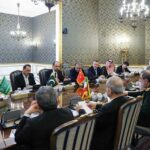
Saudi Arabia, Pakistan and Türkiye have begun combining collective defence commitments with direct diplomatic engagement with Iran, revealing a potentially important shift in how regional powers are responding to escalating Middle Eastern conflicts. Senior officials from the three countries met Iranian leaders in Tehran on 26 October, only weeks after the members of their newly established Makkah Alliance for Defence agreed to accelerate preparations for collective security measures. The meeting concluded with an agreement to continue dialogue on regional cooperation, peace and security, although no detailed roadmap or timetable for further negotiations was announced.
The delegations included Saudi Defence Minister Prince Khalid bin Salman, Pakistani Chief of Army Staff Field Marshal Asim Munir and Turkish intelligence chief Ibrahim Kalin. Iran was represented by senior security officials, including Mohsen Rezaei, secretary of its Supreme National Security Council, alongside President Masoud Pezeshkian and Foreign Minister Abbas Araghchi. The talks took place amid concerns about renewed US-Iran hostilities, expanding fighting in Yemen and threats to regional infrastructure and transport routes. Reporting by Reuters and the Associated Press confirms that the four countries agreed to continue discussions, but the public statement did not establish a binding new regional security mechanism.
The immediate significance lies in the fact that the three members of a mutual-defence arrangement are engaging directly with a country widely associated with several of the security challenges confronting the region. The meeting therefore illustrates that military preparedness and diplomacy are not necessarily competing strategies. For Riyadh, Islamabad and Ankara, engagement with Tehran could provide a channel to communicate security concerns, explore de-escalation and reduce the risk that confrontations involving Iran or aligned armed groups draw additional countries into conflict.
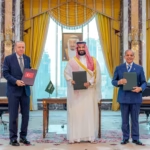
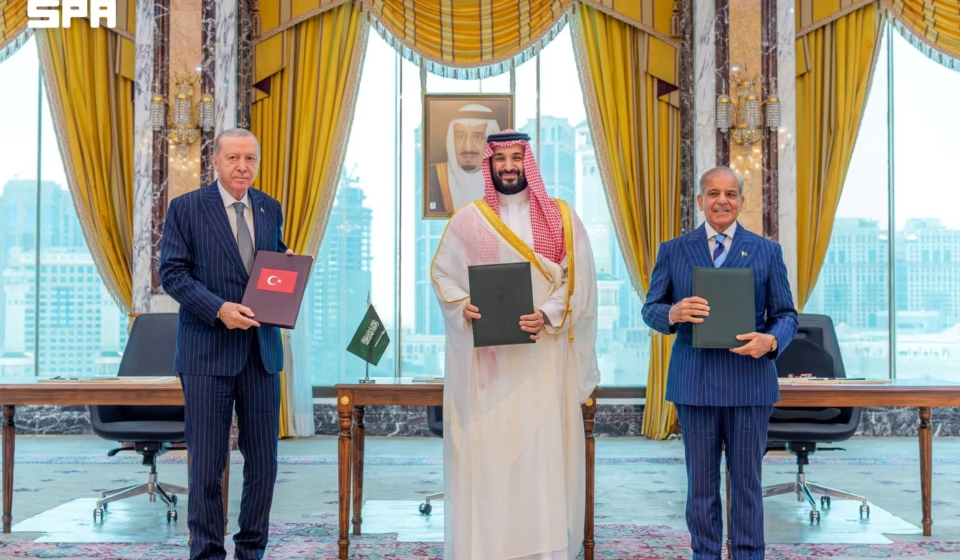
Saudi Arabia, Pakistan and Türkiye signed the Makkah Joint Defence Agreement in August 2026. Its central principle is that an armed attack against one signatory would be treated as an attack against all three, establishing a framework for mutual assistance and closer defence cooperation. The agreement brings together three countries with different but potentially complementary strategic resources: Saudi Arabia’s financial capacity and influence in energy markets, Pakistan’s military capabilities and nuclear-armed status, and Türkiye’s defence industry and membership of NATO.
The pact’s significance, however, depends on how its commitments are implemented. Pakistan has approved the agreement, while Türkiye’s parliamentary ratification process remains under way, according to Reuters reporting published on 26 October. The alliance’s members have also begun developing its institutional structure. At an emergency meeting in Riyadh on 5 October, the three countries appointed a Pakistani former lieutenant general as the alliance’s first secretary-general and agreed to move towards implementing collective-defence commitments, including arrangements for the rapid deployment of agreed military forces and capabilities in Saudi Arabia. These steps indicate movement beyond a political declaration, although they do not by themselves establish how the alliance would respond to every possible military contingency.
The immediate pressure comes from Yemen, where fighting between Houthi forces and Saudi-backed government forces has intensified. The Houthis claimed on 26 October that they had attacked Saudi energy infrastructure and Riyadh airport. Reuters reported that Saudi Arabia had not immediately confirmed those particular claims. Separately, the Saudi-led coalition said it had intercepted and destroyed ballistic missiles and drones directed towards Saudi regions on 27 October. The distinction matters: claims by an armed group, independently verified incidents and official military statements are different categories of evidence and should not be treated as interchangeable.
The deterioration in security nevertheless places practical demands on the new alliance. Saudi Arabia needs to protect its territory, energy facilities and transport infrastructure, while its partners must determine what assistance they are prepared and legally able to provide. The alliance’s credibility will depend not only on statements of solidarity but also on its capacity to coordinate intelligence, air defence, military logistics and crisis communication. The extent of those capabilities, and the conditions under which they would be deployed, has not been fully disclosed.
Türkiye has also sought to distinguish defensive assistance from participation in offensive operations inside Yemen. That distinction could become important if the alliance faces pressure to respond to further attacks. Collective-defence arrangements can deter aggression, but unclear operational boundaries can also increase the risk of escalation, particularly where attacks involve non-state armed groups operating across borders.
The decision to meet Iranian officials while developing a defence alliance reflects the limits of a strategy based exclusively on military deterrence. Even a more closely coordinated Saudi-Pakistani-Turkish security arrangement cannot, by itself, resolve the political and military disputes involving Iran, the United States, Israel and armed groups across the region. Direct communication with Tehran offers an additional route for addressing incidents, conveying red lines and exploring arrangements that might reduce the possibility of further attacks.
Pakistan has a particularly significant diplomatic role in this process. Its relations with Saudi Arabia and its access to Iranian officials give Islamabad an incentive to facilitate dialogue between parties whose interests diverge. Reuters reported that Pakistan and Qatar had led earlier mediation efforts and that the latest discussions were intended to support de-escalation. The meeting also followed a visit by Qatari mediators to Tehran, indicating that diplomatic efforts are being pursued through overlapping channels rather than through a single negotiation process.
Saudi Arabia’s interest is more immediate. Attacks on its territory and infrastructure threaten not only national security but also the economic confidence that underpins its energy exports, investment ambitions and regional commercial position. Persistent insecurity around oil facilities, airports, ports and shipping routes could raise operational costs and increase uncertainty for energy markets. For a major oil exporter, preventing a wider conflict can therefore be both a security priority and an economic necessity.
Türkiye has its own reasons to favour a negotiated regional framework. Its NATO membership and defence partnerships connect it to the wider Western security system, while its geographic position and regional interests require it to manage relations with neighbouring and competing powers. Ankara’s participation in the Tehran meeting suggests that it is willing to pursue direct regional engagement alongside its existing alliances. It does not, however, establish that Türkiye is abandoning NATO commitments or aligning itself strategically with Iran.
For Tehran, the talks offer an opportunity to promote its long-standing argument that regional states should take primary responsibility for their own security rather than rely on outside powers. Iranian officials described the meeting as a step towards security arrangements based on regional cooperation and shared interests. That position overlaps in principle with the alliance’s stated emphasis on regional defence capacity, but the two approaches are not identical. Iran’s relationships with armed groups, its disputes with Washington and Israel, and the security concerns of Gulf states remain major sources of disagreement.
The most important question is whether the four countries can translate their meeting into a framework that manages disputes rather than simply creates another layer of diplomacy. The public statement issued after the Tehran meeting committed the participants to continuing dialogue, but it did not announce a non-aggression agreement, a permanent crisis-management body, a mechanism for investigating attacks or a timetable for future talks. These omissions mean the meeting should be understood as an opening for further engagement, not evidence that a new regional security order has already emerged.
A workable arrangement would require agreement on practical issues: how to communicate during a crisis, how to distinguish an accidental incident from a deliberate attack, how to address threats posed by armed groups, and how to prevent military deployments from being misinterpreted by neighbouring states. The participants would also need to determine whether cooperation could extend to maritime security, protection of critical infrastructure and deconfliction around strategically important routes.
The Strait of Hormuz illustrates the economic stakes. Any renewed confrontation involving Iran and the United States could disrupt shipping through one of the world’s most consequential energy chokepoints. Wider insecurity across the Gulf and the Red Sea could compound pressure on freight, insurance and energy prices. The economic effects would extend beyond the immediate parties, reaching Asian importers, European markets and developing economies exposed to higher fuel and transport costs. For Pakistan and Türkiye, both of which have substantial economic interests tied to regional stability, avoiding a prolonged disruption is an important consideration.
Yet regional cooperation faces structural obstacles. Saudi Arabia maintains extensive security ties with the United States; Türkiye is a NATO member; and Pakistan has defence and diplomatic relationships with several major powers. These partnerships do not prevent the three countries from engaging Iran, but they complicate efforts to establish a common security doctrine independent of external powers. Tehran, meanwhile, may be reluctant to participate in arrangements it believes could constrain its strategic options without addressing sanctions, military pressure and other central grievances.
The conflict in Yemen adds another layer of difficulty. Even if Iran and the three alliance members agree on the value of de-escalation, that understanding would not automatically settle the political, territorial and military disputes involving the Houthis and Yemen’s internationally recognised government. The extent of Iranian influence over Houthi decisions, and the willingness of the different parties to accept limits on military action, will affect whether diplomatic understandings can produce a reduction in violence.
The Tehran meeting is significant because it demonstrates that a collective-defence alliance and diplomatic engagement with a potential adversary can proceed simultaneously. The three countries have reaffirmed their intention to improve their capacity to respond to threats while also opening a direct channel with Iran at a moment of heightened regional insecurity. This dual-track approach may create opportunities to contain crises, but it also places greater demands on the alliance to define its defensive purpose and avoid actions that could be interpreted as preparation for offensive operations.
The next test will be whether the four governments move beyond general commitments to continued dialogue. Follow-up meetings, agreed communication channels, practical confidence-building measures and a clearer understanding of the alliance’s operational commitments would provide stronger evidence of progress than diplomatic statements alone. Without such steps, the talks risk remaining a temporary response to immediate pressure rather than the foundation of a durable regional framework.
For the wider Middle East, the emerging arrangement raises a broader question: can regional powers build enough trust to manage their security disputes collectively, even while maintaining competing alliances and strategic priorities? The answer will depend on whether they can convert shared concerns about escalation into concrete, verifiable measures. For now, the Makkah alliance’s engagement with Tehran represents a notable diplomatic opening—but not yet proof that the region’s underlying rivalries are easing.
Sources: Reuters, “Saudi defence pact countries push for peace in Tehran as Houthis launch more attacks”; Associated Press, “Delegations meet in Iran with Mideast region on edge over potential for renewed fighting”; Türkiye Ministry of Foreign Affairs, joint statement on the Makkah Alliance for Defence meeting, 5 October 2026; Iranian state news agency IRNA, “Tehran summit press statement: Talks on regional peace and security will continue”; Anadolu Agency, “Senior Turkish, Saudi, Pakistani officials to visit Iran for security talks”.
