




















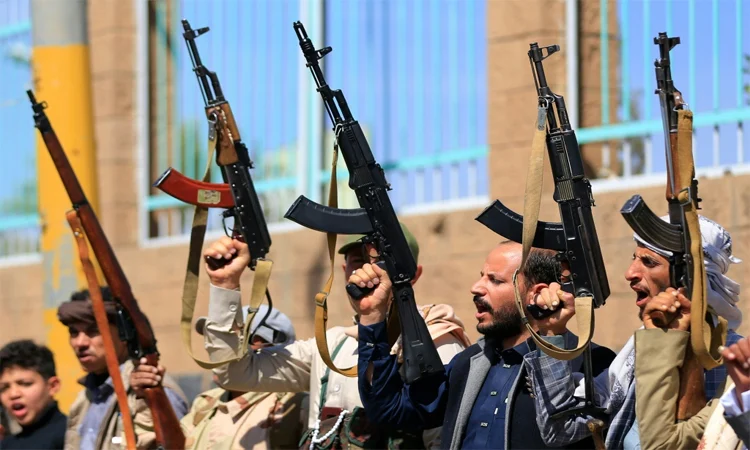
Houthi attacks on Saudi airports kill three, Yemen war widens
Three people were killed and 36 wounded in attacks on two Saudi international airports claimed by Yemen’s Houthi movement, marking a sharp escalation in the renewed war and drawing the Saudi-led coalition deeper into confrontation with the Iran-aligned group.
Saudi Arabia’s General Authority of Civil Aviation said attacks targeted Abha International Airport in the south and King Khalid International Airport in Riyadh on Tuesday and Wednesday. Two women, identified as Moroccan and Algerian nationals, were killed at Abha, while a Sudanese national was killed at the Riyadh airport. Twenty-eight people were wounded in Abha and eight in Riyadh.
The Houthi military spokesman Yahya Saree claimed responsibility for the attacks, saying the group had used missiles and drones against the airports as well as other Saudi military targets. The Houthis said a ballistic missile attack on King Khalid airport disrupted air traffic.
Saudi authorities said the Riyadh-bound missile was intercepted, while the Saudi-led coalition said it had destroyed the launch platform used in the attack. The coalition subsequently warned that attacks on civilian facilities would not go unanswered and announced a major retaliatory operation inside Yemen.
The coalition said it destroyed 82 Houthi military targets across four Yemeni provinces — Saada, Hodeidah, Al-Jawf and Marib. According to coalition spokesman Turki al-Maliki, the targets included 11 ballistic-missile storage facilities in mountainous areas of Saada, as well as command-and-control centres, communications systems, weapons depots and Houthi gathering sites. The figures are based on the coalition’s own account and have not been independently verified.
The airport attacks came as Saudi-backed Yemeni government forces launched a major counter-offensive against the Houthis after months of relative calm. The government says it has retaken strategic positions along the Red Sea coast and around the port of Mocha, while the Houthis maintain that they continue to hold their positions. AFP reported that military sources from both sides had not independently confirmed major changes on the ground, illustrating the difficulty of verifying battlefield claims as fighting accelerates.
The conflict has also spread beyond Saudi airports. The Houthis claimed attacks on Aden airport, the temporary seat of Yemen’s internationally recognised government. A missile reportedly landed near the runway shortly before a Cairo flight was due to arrive, forcing the aircraft to divert to Jeddah. Reuters separately reported that Houthi missiles and drones targeted Aden airport on Wednesday, narrowly missing an arriving flight.
The renewed fighting represents a significant reversal from the relative calm that followed the four-year truce. The Houthis have expanded their control along parts of Yemen’s Red Sea coastline, including areas near the strategically important Bab el-Mandeb Strait, while Saudi-backed forces are now attempting to reverse those gains.
The geography makes the latest escalation particularly important beyond Yemen itself. Bab el-Mandeb connects the Red Sea with the Gulf of Aden and is a major corridor for international shipping and energy flows. Fighting around the waterway therefore carries potential consequences for commercial shipping, insurance costs and regional energy security.
For Saudi Arabia, the attacks also expose the difficulty of separating the Yemeni battlefield from its own security environment. Riyadh is backing the internationally recognised Yemeni government and providing air support for its counter-offensive, but Houthi missile and drone capabilities allow the group to extend the conflict hundreds of kilometres into Saudi territory.
The human cost inside Yemen is meanwhile rising rapidly. The United Nations said more than 200,000 people have been displaced within the country by the renewed fighting. Reuters reported that the escalation has also worsened an already severe humanitarian situation, with civilians caught between intensified ground operations and airstrikes.
The latest exchange has therefore created a potentially dangerous cycle. Houthi attacks on Saudi infrastructure are prompting wider coalition strikes inside Yemen, while the Saudi-backed offensive is simultaneously increasing the Houthis’ incentive to demonstrate that they can retaliate beyond the battlefield.
What began as a renewed struggle over territory on Yemen’s western coast is consequently developing into a broader security confrontation involving airports, military installations and the strategic Red Sea corridor. The immediate concern is not only whether either side can change the military balance, but whether continued attacks on civilian infrastructure will turn Yemen’s renewed war into a wider regional crisis.
