
















Journalism practices, editorial narratives and perspectives in S Asia
Regional Media Research Network (RMRN)
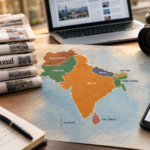
South Asia’s media landscape is extensive, multilingual and politically diverse. Newspapers, television broadcasters and digital news platforms influence how citizens understand elections, public policy, economic challenges, social change and relations between neighbouring countries. Yet the region does not have a single model of journalism. News organisations operate under different legal frameworks, ownership arrangements, commercial pressures and levels of access to information.
The International Federation of Journalists (IFJ), in its South Asia Press Freedom Report 2024–2025, recorded 250 media-rights violations across the region between 1 May 2024 and 30 April 2025. These included the targeted killings of 20 journalists and media workers, as well as arrests, detentions, assaults, threats and harassment. The report also highlighted financial insecurity in newsrooms and dependence on government advertising as challenges to editorial independence. These findings provide important regional context, although they do not establish that every outlet operates in the same way.
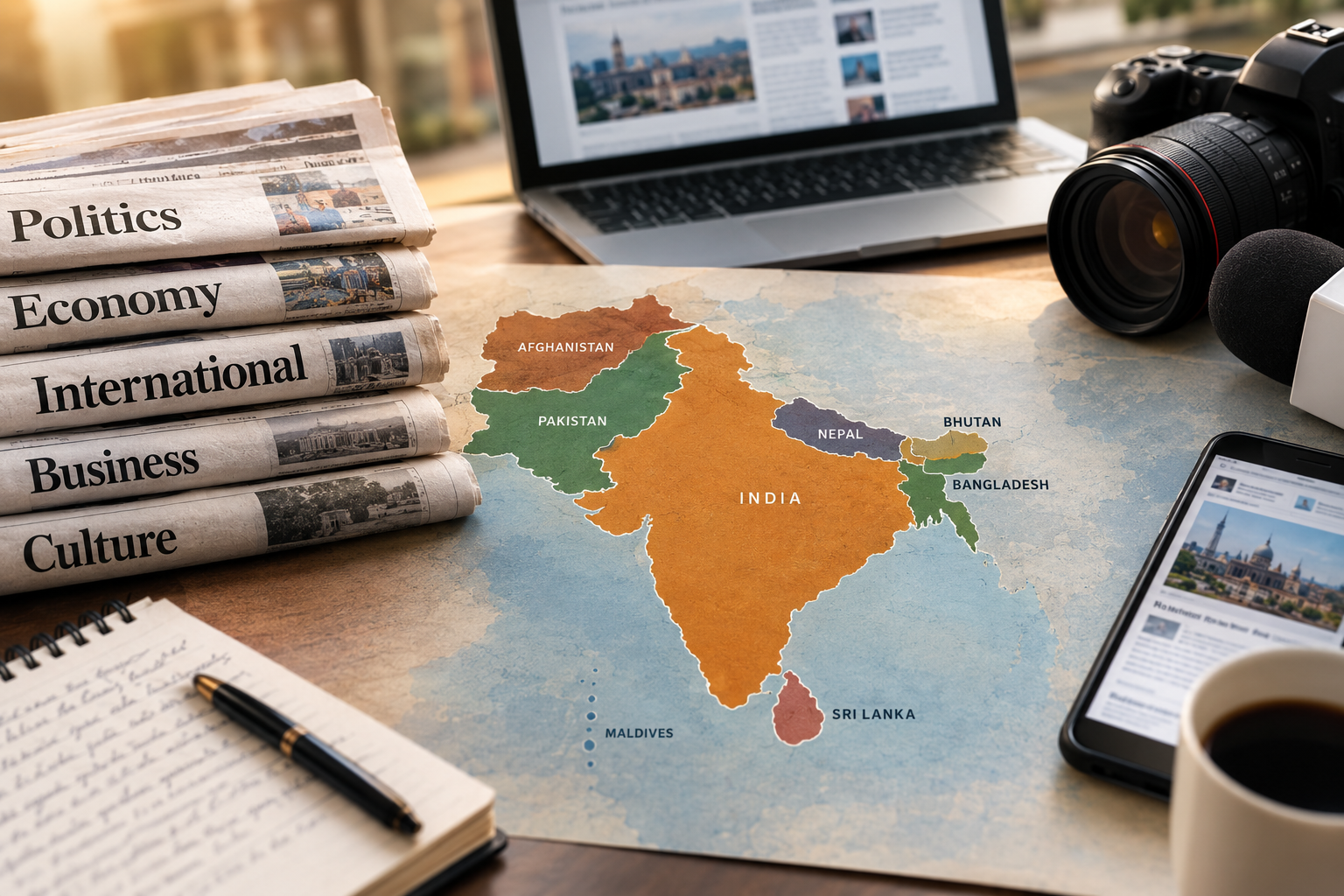
This report examines 24 established or significant news organisations, selecting three from each of the eight South Asian countries: Afghanistan, Bangladesh, Bhutan, India, the Maldives, Nepal, Pakistan and Sri Lanka. It considers their online presence, principal areas of coverage and the editorial questions their reporting raises for comparative media research. The selection is intended as a working sample for RMRN, not a definitive ranking of the region’s news media.
India: A large, competitive and increasingly digital media environment
India has one of the world’s largest and most diverse media markets, with national newspapers, regional-language publications, commercial television networks and digital-first newsrooms competing for audiences. The Reuters Institute’s 2026 Digital News Report describes an environment in which online and social-media platforms are important news sources, while established television brands continue to reach substantial audiences. It also identifies the expansion of video-led news and the uneven adoption of artificial intelligence in newsrooms.
The Hindu is a useful outlet for examining national policy, diplomacy, public affairs and explanatory reporting. Its coverage can be compared with The Indian Express, which publishes political reporting, investigations and accountability journalism, and Scroll.in, a digital publication covering politics, society, culture and public-interest issues.
For RMRN, the relevant question is not whether these publications share the same editorial position. It is how they construct stories about elections, constitutional questions, religious and social tensions, economic policy and India’s relations with neighbouring states. A comparative study should record whose explanations dominate a report, whether opposing claims are checked against evidence, and how much space is given to the effects of policy on ordinary people.
India’s media environment also illustrates the difference between the reach of a news organisation and the independence of its journalism. The Reuters Institute’s 2025 country analysis raised concerns about concentrated ownership and pressure on critical reporting, while also documenting collaborative work by digital news organisations. These are structural issues that should be assessed alongside the content of individual articles rather than used to prejudge every report.
Pakistan: Political reporting, security and the challenge of verification
Pakistan’s media landscape includes influential English-language newspapers, Urdu-language publications, television networks and digital outlets. Dawn provides extensive coverage of national affairs, politics, business and international developments. Geo News offers television-led breaking news and current-affairs coverage, while The Express Tribune reports on politics, society, business and international issues.
A key area for RMRN’s analysis is the treatment of civil–military relations, political competition, security operations and Pakistan’s relationships with India and Afghanistan. These subjects often involve competing official accounts and claims that may be difficult to verify independently. Researchers should examine whether reports distinguish confirmed events from allegations, whether sources are named and whether affected communities are represented alongside political and security officials.
The IFJ’s regional report describes legal and digital restrictions as part of the challenges facing journalists in Pakistan. It also discusses the use of online platforms by independent journalists to reach audiences when traditional reporting channels face obstacles. Such conditions make source verification and transparent attribution particularly important.
Bangladesh: Political transition, public accountability and media safety
Bangladesh’s media landscape combines influential Bengali-language newspapers, English-language publications, television broadcasters and digital news services. Prothom Alo covers national politics, society, public affairs and a broad range of public-interest issues. The Daily Star publishes reporting and analysis on governance, business, human rights and international relations, while bdnews24.com operates as a digital news service covering domestic and international developments.
The country’s political transition following the July–August 2024 mass uprising created significant questions for journalism: how to scrutinise a changing political order, how to report allegations against powerful actors, and how to protect journalists while covering polarised public debate. A United Nations Development Programme assessment, developed with UNESCO and published in July 2025, identified legal, institutional, financial and professional challenges facing Bangladesh’s media sector, including working conditions, safety risks and gender inequality.
The physical safety of newsrooms remains an important part of this assessment. Reuters reported that mobs attacked the offices of Prothom Alo and The Daily Star in December 2025, interrupting publication and raising renewed concerns about the protection of journalists and media institutions.
For RMRN, the central analytical question is how Bangladeshi outlets report political accountability and social conflict while maintaining a distinction between verified evidence, political accusation and public sentiment. Comparisons between Bengali- and English-language coverage could also reveal differences in source selection, terminology and the audiences each publication addresses.
Nepal: Political accountability and the regional balance
Nepal’s media landscape includes national newspapers, online news services and broadcasters. The Kathmandu Post reports on politics, governance, society and international affairs. Onlinekhabar provides digital coverage of national developments and current affairs, while The Himalayan Times covers politics, business, society and regional news.
Nepal offers a useful case for studying how media organisations cover government accountability, federalism, corruption allegations, youth participation, migration and relations with India and China. Its geographical position and economic links mean that regional diplomacy can have direct domestic consequences, from trade and infrastructure to energy and employment.
A comparative assessment should examine whether reports explain the interests of different stakeholders, including communities outside Kathmandu, and whether stories about neighbouring powers are grounded in documents, attributable statements and independently verifiable evidence. Differences in national perspective should not automatically be interpreted as bias; the research task is to identify how those perspectives are supported and communicated.
Bhutan: Development journalism and the limits of a small media market
Bhutan has a smaller media market than its neighbours, making the sustainability of news organisations and the range of available perspectives important subjects for research. Kuensel covers national affairs, development, public policy and society. Bhutan Broadcasting Service provides public broadcasting and national news, while The Bhutanese reports on politics, governance and public issues.
RMRN could examine how these outlets cover development policy, tourism, employment, migration, environmental questions and Bhutan’s relationships with India and China. Particular attention should be given to the range of sources available to journalists, the distinction between official announcements and independent assessment, and the space provided for public criticism.
The structure of a small media market does not, by itself, determine the quality of journalism. A more useful assessment would examine the practical conditions under which reporting is produced, including newsroom resources, access to public information and the diversity of voices appearing in published stories.
Maldives: Domestic politics, tourism and strategic relationships
The Maldives has a relatively small media market in which domestic politics, tourism, climate vulnerability and international partnerships are central public concerns. Sun Online publishes domestic news and current-affairs coverage, Mihaaru is a prominent Dhivehi-language news platform, and The Edition publishes English-language reporting on politics, society and the economy.
For RMRN, the Maldives provides an opportunity to compare local-language and English-language news coverage. Researchers could examine how stories about political competition, tourism revenue, climate adaptation and relationships with India and China are framed for different audiences. The comparison should account for language and audience rather than assume that differences in emphasis necessarily indicate different standards of journalism.
The key questions concern the sources used, the evidence offered for policy claims and the degree to which reporting explains how decisions affect local communities. This is particularly relevant when national debates about foreign policy overlap with livelihoods, public services and environmental risks.
Afghanistan: Reporting under severe constraints
Afghanistan presents a distinct case because journalists and news organisations operate under significant restrictions on media freedom and public expression. TOLOnews covers Afghan politics and current affairs, Amu TV reports on Afghanistan and regional developments, and Pajhwok Afghan News provides reporting on national, provincial and humanitarian issues.
The IFJ’s South Asia press-freedom research describes severe obstacles facing independent journalism in Afghanistan. The situation makes it especially important to distinguish between what a newsroom can independently verify, what it can report only through official sources, and what remains inaccessible because of restrictions or safety concerns.
For RMRN, relevant themes include governance, humanitarian conditions, women’s access to education and public life, displacement, security and Afghanistan’s relationships with Pakistan and other neighbouring countries. The analysis should also recognise that reporting from inside the country and reporting from outside it may have different access to people, documents and official institutions. Those differences should be recorded as methodological limitations, not treated as automatic proof that one account is more accurate.
Sri Lanka: Economic recovery, governance and reconciliation
Sri Lanka’s news organisations report within a media environment shaped by economic recovery, political change, public services and the legacy of ethnic conflict. Daily Mirror covers politics, society and current affairs. Daily FT focuses on business, investment, finance and economic policy, while News 1st provides broadcast-led news and public-affairs coverage.
RMRN could compare how these outlets explain economic reform, public debt, corruption investigations, employment, reconciliation and relations with India and China. Business reporting is especially useful for examining whether macroeconomic indicators are connected to their effects on households, workers and smaller businesses.
A report about economic recovery, for example, may emphasise growth forecasts, investment or government targets. A fuller account would also examine the evidence behind those claims, identify uncertainty and explain how costs and benefits are distributed. The purpose is not to demand identical coverage from a business publication and a general news broadcaster, but to understand how their different editorial priorities shape the public’s understanding of the same issue.
Comparative findings: What the regional picture reveals
Across these eight countries, the selected outlets operate in different political, linguistic and commercial environments. Their formats also vary: some are newspaper-led, others are broadcasters, and some are digital-first publications. For that reason, the presence of an outlet in this report should be understood as a starting point for research rather than an endorsement or a judgement of its editorial independence.
A common concern identified in regional press-freedom research is the pressure placed on journalism by political interference, threats to journalist safety and unstable finances. The IFJ’s report also highlights changes in how journalism is produced and distributed, including the growth of precarious work and the use of digital platforms. These pressures can affect a newsroom’s capacity to invest in investigations, maintain specialist correspondents and correct errors transparently.
The digital environment creates opportunities as well as risks. The Reuters Institute’s 2026 Digital News Report describes a global shift in which platforms have become more popular than television and news websites or apps as sources of news. Its findings concern the markets surveyed globally and should not be treated as a direct measurement of every South Asian country. Nevertheless, they underline the importance of examining how news organisations adapt their reporting for video and social media, where context can be reduced and unverified claims can circulate rapidly.
For RMRN, a meaningful assessment of journalism practice must therefore go beyond political labels. An outlet’s coverage should be assessed through the quality of its evidence, its sourcing, the accuracy of its headlines, its treatment of competing claims and its willingness to correct mistakes. A publication can produce rigorous reporting on one subject and weaker coverage on another. Conclusions about its practices should be based on examples and recurring patterns, not assumptions about its identity.
How RMRN should assess journalism practice
A reliable comparative study should begin with a shared event or issue covered by outlets in several countries. Researchers could select reporting on a regional trade agreement, a political protest, a border dispute, climate-related displacement or a major diplomatic meeting. The same period should be used for each outlet so that the comparison does not mistake differences in publication timing for differences in editorial judgement.
The analysis should record the original headline, publication date, article link, author, format and principal sources. Researchers should then examine how the event is framed, which voices are included, whether claims are independently verified and what relevant context is supplied. Where an allegation is disputed, the report should identify who made it, what evidence is available and whether the outlet sought a response from the party concerned.
It is equally important to distinguish news reporting from opinion, editorials, commentary and sponsored content. These formats have different purposes and should not be judged by precisely the same criteria. Researchers should also record corrections and updates where available, since transparency after publication is an important part of professional practice.
The resulting analysis should describe observable differences before offering an interpretation. If one outlet foregrounds security while another emphasises the economic impact of the same event, the report should first establish that difference and examine the sources and editorial context behind it. It should not immediately conclude that one outlet is propagandistic or that the other is independent. Such conclusions require stronger evidence than a headline comparison alone.
Implications for regional media diplomacy
South Asia’s countries are connected by trade, migration, shared environmental challenges, cultural ties and security concerns. Yet their news audiences may encounter the same regional event through substantially different national perspectives. Understanding those differences is an important part of media diplomacy because public perceptions of neighbouring countries can be influenced by the way events are selected, explained and repeated.
RMRN can contribute by creating a space in which journalists and researchers compare coverage across borders without requiring them to agree on a single political interpretation. A journalist in Bangladesh may bring local context to a story about India; a researcher in Pakistan may identify relevant background to coverage of Afghanistan; and a contributor in Nepal or Sri Lanka may highlight economic or diplomatic dimensions that are less visible in another country’s reporting.
The objective should be informed disagreement grounded in evidence. Regional media collaboration becomes valuable when it helps participants identify missing context, question unverified claims and understand how different audiences experience the same event.
The 24 news organisations examined here provide RMRN with an initial map of South Asia’s media landscape. They offer different formats, audiences and editorial priorities, and they operate under different institutional and economic conditions. No single outlet can represent the full diversity of journalism within its country, and no short overview can establish the overall quality or political independence of an entire newsroom.
The next stage should be a systematic review of dated articles from these organisations, using common indicators and transparent selection criteria. That would allow RMRN to move from a general landscape assessment to evidence-based findings about how particular stories are reported, which narratives receive prominence and how those narratives differ across national boundaries.
The purpose is not to decide in advance which newsroom is right. It is to understand how reporting is produced, test its claims against evidence and make regional media analysis more transparent and useful to the public.
References and online sources
The main regional reference for this report is the International Federation of Journalists’ South Asia Press Freedom Report 2024–2025, published on 4 May 2025. It covers press-freedom developments across Afghanistan, Bangladesh, Bhutan, India, the Maldives, Nepal, Pakistan and Sri Lanka, and documents media-rights violations recorded between 1 May 2024 and 30 April 2025. The report is available at IFJ — South Asia Press Freedom Report and as a full report PDF.
The Reuters Institute for the Study of Journalism’s Digital News Report 2026 provides wider evidence on changes in news consumption, digital platforms and the future of journalism. Its India country analysis is particularly relevant to India’s mix of established media, regional-language news and digital-first reporting.
For Bangladesh, the UNDP assessment of the country’s media landscape, published in July 2025, examines the legal, institutional, financial and professional conditions affecting independent and pluralistic media.
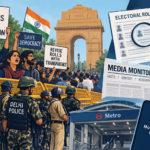
For a contemporary example of journalist safety concerns, Reuters’ 12 October 2026 report on journalists detained during protests in Delhi documents allegations by journalists and media-rights groups, along with the disputed circumstances surrounding the protests.
Research limitation: The outlet descriptions in this report identify organisations and propose areas for further comparison. They do not constitute a completed systematic content analysis of all 24 outlets. Specific conclusions about an outlet’s narrative, verification standards or editorial independence should be supported by dated examples from its published work.
Prepared for: Regional Media Research Network (RMRN) Category: RMRN — Research and Analysis Title: South Asia’s News Media: Journalism Practices, Editorial Narratives and Regional Perspectives
