


















Fire devastates Hitler’s Eagle’s Nest, questions over Nazi-era remembrance
The destruction of a landmark associated with Adolf Hitler has placed Germany’s preservation of its Nazi-era history back in focus, as investigators examine suspected arson and a possible political motive.
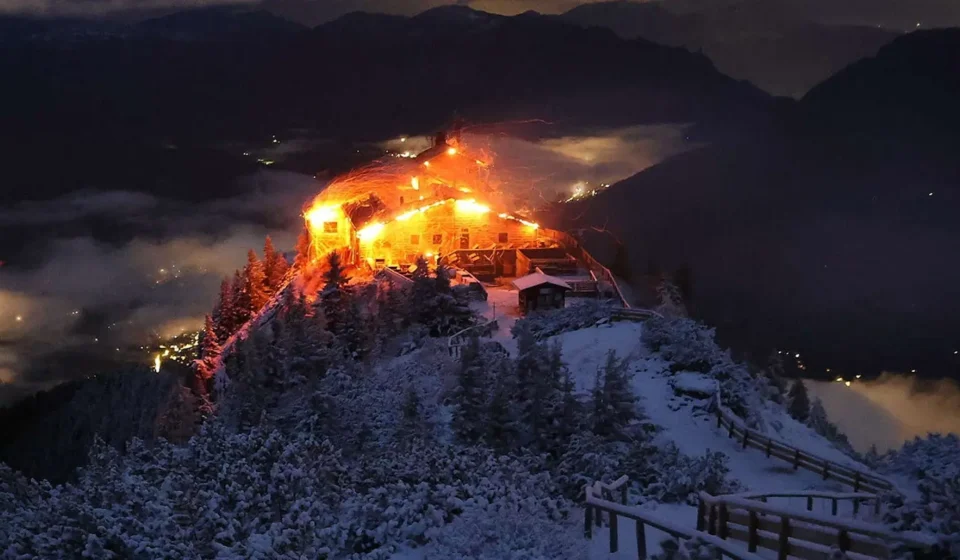
A fire has severely damaged the Eagle’s Nest, Adolf Hitler’s former mountain retreat in the Bavarian Alps, prompting an investigation into suspected arson and renewed attention to the preservation of Germany’s Nazi-era heritage. A 33-year-old German man was detained after the blaze on Friday evening, 23 October, but investigators have yet to establish a motive or confirm whether the fire was politically motivated.
The building, known in German as the Kehlsteinhaus, stands at an altitude of 1,834 metres near Berchtesgaden in southeastern Germany. According to the Associated Press, emergency services were alerted on Friday night, but snow, strong winds and difficult access complicated efforts to control the fire. Around 200 firefighters and emergency personnel were involved in the response. No injuries were reported, and firefighters initially faced difficulties entering the building because of the risk of falling debris.
The suspect was reportedly travelling down the mountain on a motorcycle when he encountered emergency personnel approaching the scene. Authorities detained him on suspicion of arson. German prosecutors said he showed signs of mental illness, while investigators continued examining whether a political motive was involved. The investigation remains ongoing, and suspicion does not establish guilt.
Constructed between 1937 and 1938, the Eagle’s Nest was developed during the Nazi dictatorship as a mountain retreat for Hitler and a venue for receiving prominent guests. Its location, imposing architecture and panoramic views formed part of the spectacle surrounding the Nazi leadership. Although Hitler visited the site, he used it less frequently than his nearby residence at the Berghof.
The building survived the Second World War and became a tourist destination after the conflict. Since 1952, it has operated as a restaurant and hosted an exhibition addressing its historical background. Its transformation from a site associated with Nazi power into a public attraction illustrates the challenges of preserving places connected to authoritarianism and mass violence.
The Nazi regime was responsible for the Holocaust and other systematic persecution, forced labour, occupation and mass killing across Europe. The historical significance of sites associated with Hitler therefore extends beyond architecture or tourism. They can help explain how the regime presented itself, cultivated political authority and used monumental settings to reinforce its image.
The Eagle’s Nest is not, however, interchangeable with every other site associated with Nazi crimes. Its principal significance lies in its role as a retreat and representational venue, while other locations were directly connected to imprisonment, forced labour, extermination and the administration of mass murder. Preserving historical distinctions is essential to an accurate account of the period.
Bavarian Interior Minister Joachim Herrmann said the building would not be left as a ruin and emphasised the importance of continuing Germany’s work of historical remembrance. His remarks indicate that authorities intend to consider the future of the damaged structure, although the final restoration approach and the extent of the destruction will require further assessment.
The decision will involve more than rebuilding a tourist attraction. Restoration could preserve a historically significant structure, but it would also require decisions about how its Nazi associations should be interpreted and presented. Any reconstruction would need to retain the distinction between preserving evidence of history and celebrating the regime responsible for immense human suffering.
Germany’s approach to Nazi-era remembrance has involved documentation centres, memorials, education and the preservation of selected historical sites. These institutions serve different purposes: some commemorate victims, while others explain the machinery of dictatorship and the circumstances in which persecution and genocide became possible. A site such as the Eagle’s Nest presents a particular challenge because its scenic setting and popularity as a tourist destination can obscure the political purpose behind its original construction.
The nearby Obersalzberg Documentation Centre, which examines the history of the Nazi leadership and its presence in the region, was reported to have escaped damage from the fire. Its continued operation could remain important to understanding the wider historical context of the mountain complex.
The investigation must establish how the fire began, whether it was deliberately set and what role, if any, the detained suspect played. Authorities are also examining a possible political motive, but the available reporting does not establish an ideological connection or show that the fire was intended as a political statement.
That distinction matters in a case involving a site with such a charged history. Premature conclusions could turn an unresolved criminal investigation into a vehicle for speculation about contemporary political movements. The suspect’s reported mental health condition also should not be treated as proof of motive or as an explanation for the incident before the evidence is established.
The fire has already raised practical questions about the building’s structural condition, the feasibility of restoration and the future of the site as a historical attraction. The answers will depend on assessments by investigators, conservation specialists and the authorities responsible for the property.
The destruction of a historic building associated with Hitler does not erase the history it represents. But the loss of physical heritage can make the work of documentation, education and interpretation more difficult, particularly when a site provides evidence of how the Nazi leadership presented its power to visitors and the public.
For Germany, the immediate priority is to establish the cause of the fire and determine the building’s condition. The longer-term task is to ensure that decisions about reconstruction preserve historical accuracy and do not detach the site from the crimes and ideology with which it is associated.
The Eagle’s Nest became a tourist attraction decades after the fall of the Nazi regime, but its significance has always depended on more than its location in the Alps. Its history connects architecture, political propaganda and the responsibility to confront the past. How authorities preserve and interpret the damaged site will determine how effectively that history continues to be communicated to future visitors.
Sources: Associated Press — A fire devastates the Eagle’s Nest retreat built for Hitler in Germany, AFP — Suspect detained after fire wrecks Hitler’s mountain retreat, Deutsche Welle — Hitler’s Eagle’s Nest retreat catches fire, Al Jazeera — German police detain suspect after fire engulfs Hitler’s Eagle’s Nest.
