




















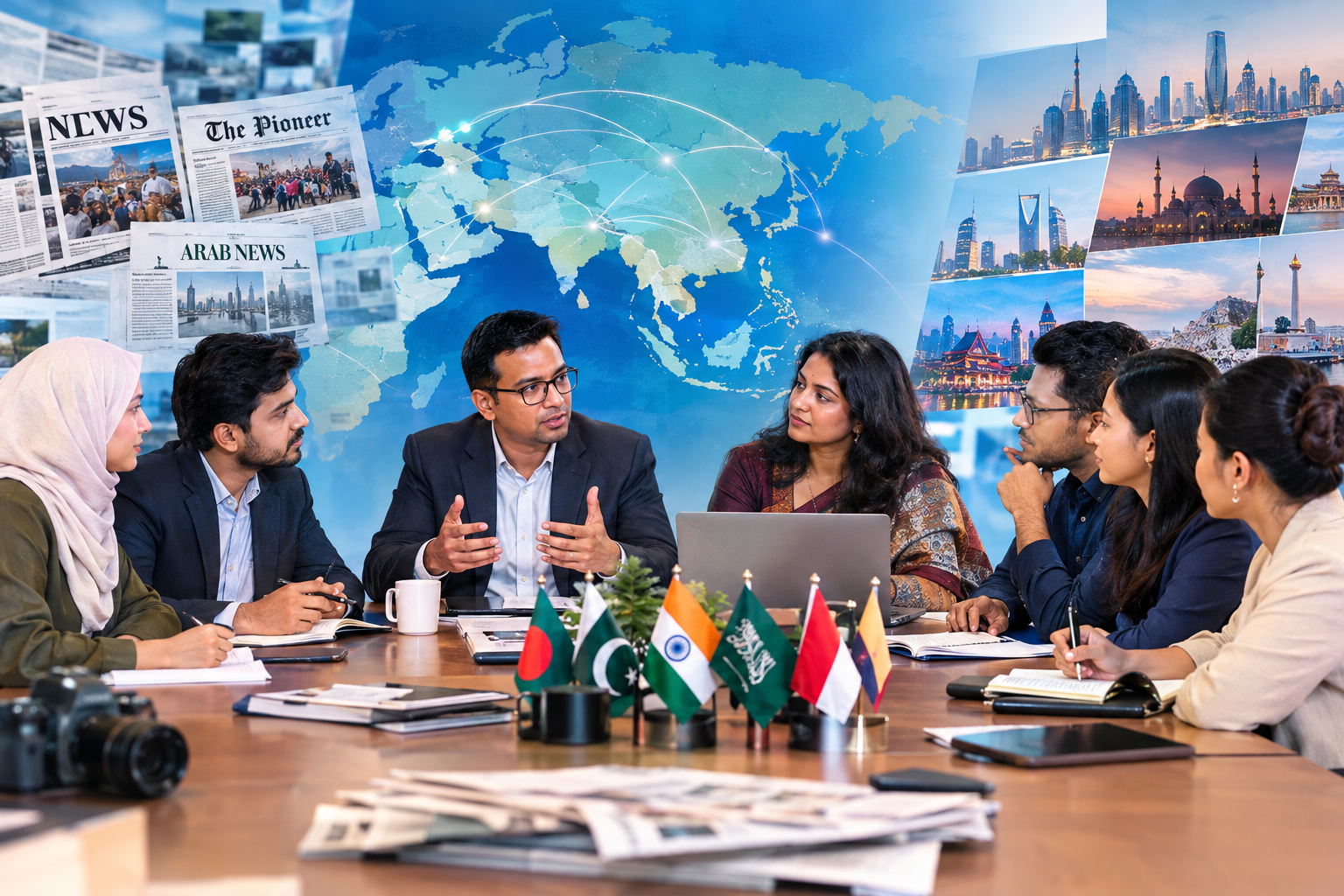
TLE DESK: A new cross-border media initiative is taking shape with an ambition that is both simple and challenging: to bring journalists, researchers and media professionals from different parts of Asia into the same conversation about how their countries report the world around them.
The Regional Media Research Network (RMRN), led by Bangladeshi media professional Md Tarek Hossain, is being developed as a regional platform connecting professionals across South Asia, Southeast Asia and the Middle East. Rather than functioning simply as another journalists’ network or an academic research forum, RMRN is designed around regular media monitoring, comparative discussion, media diplomacy and regional dialogue.
At the heart of the initiative is an observation familiar to anyone who follows international news closely: the same event can acquire very different meanings depending on which country’s newspaper is being read. A diplomatic meeting, conflict, election, economic agreement or regional crisis may be placed under entirely different headlines, given different levels of prominence and explained through different national perspectives.
RMRN intends to examine those differences rather than simply choosing between them.
The network’s proposed approach is to monitor major mainstream media outlets, identify significant stories and narratives, examine the sources and framing behind them, verify important claims and then bring members from different countries together to discuss what they have found. The intention, according to the network’s organisers, is not to reduce the exercise to “debunking” one country’s media, but to understand why narratives differ and what information may be missing from any single perspective.
That approach will be put into practice when RMRN holds its first Focus Group Discussions on Friday, 2 October 2026. Two sessions are planned to accommodate the network’s different regional blocks: the South and Southeast Asia session will begin at 10am Bangladesh time, followed by a Middle East session at 10pm Bangladesh time.
For the first discussions, members will examine developments from the preceding five days. The Middle East session will use Arab News as one of its principal media references, while the South and Southeast Asia session will look particularly at The Pioneer, alongside other relevant mainstream sources. Members will be encouraged to bring news links, explain why a particular story matters and discuss how it has been presented in their respective media environments.
The organisers envisage the process as a continuing cycle: monitoring a story, researching it, discussing different accounts, verifying relevant information, analysing the narrative and eventually documenting and sharing the findings.
The network is being built by a Core Team whose members bring different professional backgrounds and regional perspectives. Hossain, the Convenor, will provide overall strategic direction and coordinate the team. Rumaisa A Mohimeen of Saudi Arabia will lead media monitoring and regional coordination, while Sikandar Khan Khalil of Pakistan will oversee research, verification and narrative analysis. Poornima Naik of India will lead research and geopolitical analysis, and Muhammad Azfar Shehzad of Pakistan will take responsibility for editorial and communications work.
The digital side of the project will be led by Rama Daru Jati of Indonesia, whose responsibilities include developing the network’s digital platform, data systems and outreach. Rama is also associated with The Laborecon, which is expected to provide a potential publishing platform for selected RMRN work. Shamorita Barua of Bangladesh will lead partnerships, outreach and programmes, helping build connections with regional organisations, media professionals and experts and supporting future programmes and collaborative activities.
The organisers stress that these designations are intended to establish areas of primary responsibility rather than create rigid divisions. Members of the Core Team are expected to understand the wider RMRN mission and contribute beyond their individual portfolios.
That collective approach is particularly important to the network’s longer-term ambition. RMRN is considering a permanent membership structure through which journalists, researchers, academics and other media professionals can participate in regular discussions. The organisers also envisage a digital platform where selected FGD discussions could develop into media-monitoring briefs, research observations, articles, opinion pieces and other forms of regional analysis.
The first writing exercise has already been set for the Core Team. Members have been asked to examine why Europe was able to develop deeper structures of regional integration, including the European Union and the Schengen system, while countries in South Asia, Southeast Asia and the Middle East have followed different and, in many cases, less integrated paths.
The subject is deliberately wider than a comparison of institutions. Members are being encouraged to consider the influence of history, political differences, economic interests, security concerns, sovereignty and regional conflicts, while asking whether lessons from Europe’s experience can meaningfully inform other regions.
Selected articles will be considered for publication through The Laborecon, subject to editorial evaluation led by Rama Daru Jati.
For RMRN, however, publication is not the only objective. The larger idea is to create a habit of looking beyond national media boundaries.
A reader in Dhaka may encounter an international story through one set of assumptions. A journalist in Riyadh, Islamabad, Delhi or Jakarta may encounter the same development through another. Bringing those perspectives together does not necessarily produce a single answer; instead, it can reveal the complexity that is often lost when a regional issue is viewed from only one side.
That is where the organisers believe a regional media network can have a role.
RMRN’s first FGD on 2 October will therefore be more than an introductory meeting. It will be an early test of whether journalists and researchers separated by geography, language, professional routines and national media cultures can develop a shared method for examining the news — and, eventually, build a regional conversation that extends beyond the news cycle itself.
