



















Merz vows to fight antisemitism as Germany marks October 7 anniversary
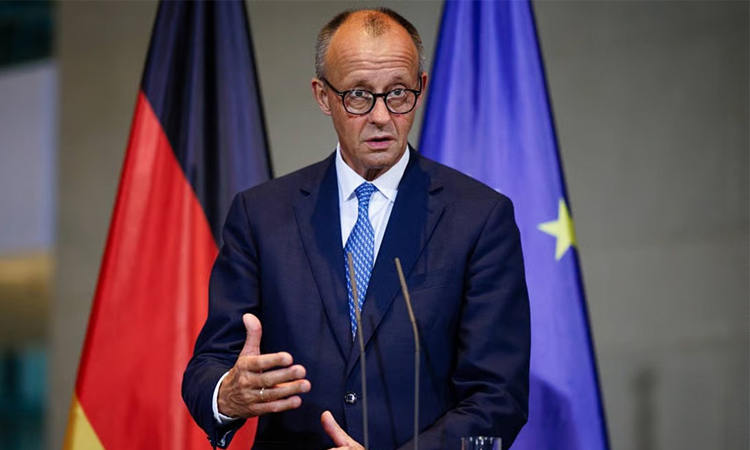
German Chancellor Friedrich Merz has pledged to step up the fight against antisemitism as Germany marked the third anniversary of the October 7, 2023 Hamas attack on Israel, while also backing the creation of a Palestinian state alongside Israel.
In a statement marking the anniversary, Merz said Germany was witnessing rising antisemitism that was “far too often” going unchallenged. He said his government would combat antisemitism “in all its forms”, stressing that Jewish people must be able to live without fear across Germany.
Merz also reaffirmed Germany’s longstanding commitment to Israel, saying the country’s security and existence were part of the lessons Germany had drawn from the Holocaust. At the same time, he argued that a new political order in the Middle East should allow Israelis, Palestinians and neighbouring countries to live in peace and security.
“The best way” to achieve that goal, he said, was through the establishment of a Palestinian state alongside Israel. The position puts Berlin behind the two-state framework even as Israeli Prime Minister Benjamin Netanyahu has continued to reject Palestinian statehood.
The anniversary has also exposed the increasingly difficult domestic political debate surrounding Israel, Gaza and antisemitism in Germany. Merz used his statement to criticise the far-left Die Linke, which emerged as the strongest party in Berlin’s September regional election and is seeking to form a left-wing government.
The chancellor argued that the Social Democrats and Greens should not enter a coalition with Die Linke, invoking the October 7 attack and what he described as the “non-negotiable principles” of German society.
Die Linke, however, has publicly condemned the Hamas attack and said it stands against antisemitism while simultaneously calling for Palestinian rights and criticising Israel’s conduct in Gaza. In a statement issued for the anniversary, the party described the October 7 attack as a systematic assault on civilians and said the killing, torture, sexual violence and hostage-taking were war crimes. It also said a secure Israel required a free and secure Palestine.
The party’s position illustrates the fault line running through Germany’s current debate: criticism of Israeli government policy and support for Palestinian rights increasingly intersect with disputes over where political criticism ends and antisemitism begins. Die Linke has argued that criticism of Israel should not automatically be treated as antisemitic, while also explicitly rejecting antisemitism and the ideology of Hamas.
The issue has become particularly sensitive in Berlin, where Die Linke’s election victory has placed the question of its role in government at the centre of national political debate. At the same time, Germany’s far-right Alternative for Germany has expanded its influence in several regional elections and has faced accusations of links to extremist and neo-Nazi circles.
Germany’s political establishment is therefore confronting pressure from both ends of the political spectrum. Merz has warned against cooperation with the AfD, while simultaneously using the debate over antisemitism and Israel to challenge the legitimacy of cooperation with Die Linke. The broader political dispute comes as Germany faces growing concerns over polarisation and the influence of extremist movements.
The October 7 attack killed about 1,200 people in Israel and triggered the war in Gaza. Palestinian health authorities in Hamas-run Gaza have reported more than 74,000 deaths since the start of the Israeli military campaign, while the United Nations has described the figures as credible.
Three years later, Germany remains particularly sensitive to the conflict because of its historical responsibility for the Holocaust. Support for Israel has long been regarded by successive German governments as a central element of the country’s foreign policy and post-war identity.
But the political landscape is becoming more complicated. Germany is now attempting to combine its commitment to Israel’s security and the fight against antisemitism with support for Palestinian statehood and a political settlement.
That tension was visible on Berlin’s streets on Wednesday, when hundreds of pro-Palestinian demonstrators marched wearing keffiyehs and carrying signs condemning Israel’s actions in Gaza. Counter-protesters confronted them with Israeli flags and accusations of left-wing antisemitism. Police ended the demonstration earlier than planned, citing several violations.
For Merz, the anniversary was therefore not only a moment of remembrance. It also became a statement about what Germany considers its historical responsibility, how it defines antisemitism and how far that responsibility should shape its approach to the Israeli-Palestinian conflict.
The challenge for Berlin is increasingly to hold those positions together: defending Jewish life and Israel’s security, opposing antisemitism in all political forms, protecting legitimate debate over Palestinian rights, and maintaining support for a two-state settlement in a conflict that continues to divide German society.
