















India’s voter-roll dispute exposes fault lines in electoral accountability
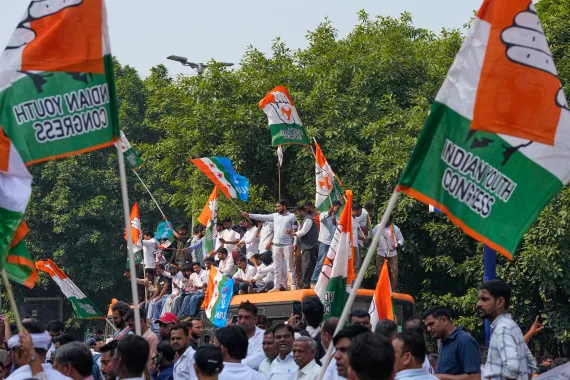
India’s voter-registration controversy has escalated into a broader confrontation over electoral accountability, institutional independence and the right to peaceful protest. The Congress-led opposition’s march towards the Supreme Court on 12 October brought together established political parties, student organisations and youth activists demanding the resignation of Chief Election Commissioner Gyanesh Kumar. The immediate dispute concerns the Special Intensive Revision (SIR) of electoral rolls, but the political stakes extend to public confidence in the institutions responsible for administering elections.
The scale of the revision is central to the controversy. Reuters reported that approximately 130 million entries had been removed from electoral rolls, including around 28 million entries associated with deceased people, 63 million with people who had relocated, 30 million with people officials could not trace and 10 million duplicate entries. These categories explain much of the administrative rationale presented for the deletions, but they do not establish that every removal was accurate or that the process was free from errors. The opposition alleges that eligible voters have been excluded and that the impact disproportionately affects Muslims and other minorities. The Bharatiya Janata Party (BJP) and the Election Commission of India reject allegations of politically motivated manipulation.
The distinction between administrative deletion and wrongful disenfranchisement is fundamental. A voter-list revision may legitimately remove duplicate, deceased or invalid entries, but its legitimacy also depends on whether eligible citizens can verify their registration, challenge mistakes and regain their place on the rolls without unreasonable obstacles. The Indian Express reported that the Election Commission had ordered special enrolment drives in states and union territories where the revision had been completed, providing a route for people who may have been left out to apply for registration. The existence of such a corrective process is relevant, but its effectiveness must be assessed through evidence of applications, successful re-enrolment and unresolved cases.
Media coverage reveals different dimensions of the dispute. Al Jazeera’s live reporting foregrounds the protest itself: opposition demands, student participation, police detentions, restrictions on movement and the Supreme Court’s response. Its coverage captures the changing relationship between established opposition parties and youth-led mobilisation. Reuters gives greater prominence to the scale of the deletions, the political dispute surrounding the Election Commission and the operational measures used to control demonstrations in New Delhi. The Indian Express provides more detailed reporting on the administrative process, including the Election Commission’s corrective measures and reported internal objections to decisions concerning the revision. These approaches are complementary rather than inherently contradictory: one documents political mobilisation, another establishes the wider context, and the third helps readers investigate the administrative basis of the allegations.
The controversy has acquired an additional institutional dimension following The Indian Express’s reporting that two election commissioners raised objections to decisions concerning voter-list revisions and other procedures. Reuters subsequently incorporated the reported disagreements into its account of the protests. Internal objections do not independently prove electoral fraud; they may concern procedure, interpretation or implementation. Their significance lies in the need for transparent explanations of how decisions were reached, whether objections were addressed and what safeguards protected eligible voters. The Election Commission’s denial of wrongdoing must be considered alongside the reported concerns, rather than treated as a substitute for examining the underlying evidence.
The Supreme Court’s position introduces a further distinction between political pressure and judicial review. Opposition leaders sought a meeting with Chief Justice Surya Kant, but the court indicated that the dispute should be pursued through formal legal proceedings because related matters were already pending. That response does not determine the merits of the opposition’s allegations. It places responsibility on the parties to present their claims through evidence and legal arguments that the court can examine. The next significant indicator will be the substance of any formal petition, the Election Commission’s response and any judicial directions concerning voter registration or procedural safeguards.
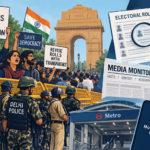
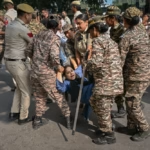
The police response has widened the debate from electoral administration to civil liberties. Reuters reported that authorities closed six metro stations and restricted traffic along more than 20 routes ahead of the march. Earlier reporting by Reuters described mass detentions during attempts by the youth-led Cockroach Janta Party to demonstrate, while Al Jazeera and The Indian Express documented further arrests and allegations that protesters and journalists were handled aggressively. The Indian Express also reported that the Supreme Court had urged the authorities to prevent unlawful detention and preserve freedom of movement while maintaining public order. These accounts raise questions about proportionality and the practical ability to assemble peacefully, but allegations concerning individual incidents require corroboration and a response from the relevant authorities.
The decision to remove Jantar Mantar from its status as a designated protest site adds another layer to this debate. Delhi Police announced three alternative venues: Ramlila Ground, Burari Ground and CBD Ground. Authorities can regulate demonstrations for public-order reasons, but the practical consequences depend on accessibility, capacity and whether alternative locations allow citizens to communicate their demands effectively. The change has been criticised by youth activists and protest organisers, who regard Jantar Mantar as a historically significant venue. The available reporting establishes the change and the competing positions; it does not, by itself, settle whether the new arrangements comply with all applicable legal requirements.
The involvement of youth organisations also matters to the evolution of the protest. The Congress-led march has created a point of convergence for parliamentary opposition, student activists and the CJP movement, but their participation should not be taken to mean that all groups have identical objectives. Reuters and Al Jazeera describe the youth movement’s earlier demonstrations and the arrests of its leaders. Their reporting suggests that the voter-roll controversy is interacting with wider grievances, including dissatisfaction with public institutions and the treatment of demonstrators. Whether this coalition sustains its mobilisation will depend on developments that cannot yet be inferred from a single day’s protest.
For regional media monitoring, the key question is how each outlet distinguishes verified administrative facts from political interpretation. The reported number of deleted entries is a measurable feature of the revision. The allegation that the exercise was designed to benefit the BJP is a contested claim. The claim that eligible voters have been wrongly excluded requires case-level or statistically robust evidence. Similarly, the existence of arrests is distinct from the allegation that particular detentions were unlawful. Coverage that collapses these categories risks presenting a political accusation as an established finding—or treating an official denial as conclusive proof that no irregularity occurred.
The evidence needed to resolve the controversy is therefore concrete: a transparent breakdown of deleted entries; comparable information on re-enrolment and appeals; documented cases of eligible voters being excluded; clear explanations of the Election Commission’s decision-making; and judicial scrutiny of any properly filed challenges. Continued reporting should also compare the experiences of different states and communities without inferring discriminatory intent from aggregate figures alone.
India’s voter-roll dispute is no longer confined to a technical revision of electoral records. It has become a test of whether the country’s electoral administration can demonstrate accuracy, fairness and effective remedies while maintaining public confidence during intense political contestation. The protests show the strength of public concern, but protest size cannot establish the truth of the allegations. Official assurances are equally insufficient without transparent evidence. The central measure of accountability will be whether eligible voters can exercise their rights, errors can be corrected, and contested decisions can withstand independent legal and public scrutiny.
