











Dubai’s non-oil economy drives trade and finance, but 2026 growth is uneven
Dubai’s economy reached AED232 billion in the first quarter of 2026, while UAE non-oil foreign trade approached AED2 trillion in the first half. However, subsequent GDP data reveal slower real growth, highlighting the difference between trade expansion and broader economic performance.
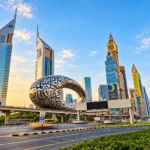
Dubai’s economic model increasingly relies on trade, financial services, logistics, tourism, real estate, construction and technology rather than direct dependence on oil revenues. Its geographic position between Asia, Europe and Africa, combined with international transport infrastructure and business-oriented policies, has helped establish the emirate as a major commercial and financial centre.
The diversification strategy is no longer simply a long-term ambition. Official Dubai government information states that more than 95% of the emirate’s gross domestic product is non-oil based. That figure illustrates the limited direct role of oil in Dubai’s present economic structure, although it should not be confused with the UAE’s national economic composition, which includes the hydrocarbon-producing emirates.
Dubai’s official economic profile reported that real GDP reached AED442.942 billion in 2024, representing 3.2% growth, while GDP at current prices reached AED540.677 billion. The emirate’s development model has combined trade infrastructure, aviation, financial services, tourism, property development and specialised free zones to attract companies, investment and international talent.
However, the strength of this model should be assessed through several indicators rather than a single growth figure. GDP measures economic output, trade statistics record cross-border commercial activity, and sectoral data reveal where expansion or contraction is taking place. These measures are related, but they are not interchangeable.
Dubai’s GDP reached AED232 billion in the first quarter of 2026, increasing by 2.4% compared with the same period a year earlier. The figure was announced by the Dubai government in July, following revisions to the emirate’s GDP series to incorporate updated economic surveys and administrative records.
The first-quarter results showed substantial contributions from several non-oil industries. Wholesale and retail trade remained the largest sector, accounting for almost 22% of GDP, with gross value added of AED50.9 billion. Financial and insurance activities generated AED32.4 billion, equivalent to 14% of GDP, and grew by 6.5%. Real estate activities contributed approximately AED26 billion and expanded by 3.1%, while construction grew by 8.2%.
These results indicated that the emirate’s economic base extended well beyond a single industry. But they did not establish that all major sectors would continue growing at the same rate throughout the year.
Figures released on 18 October offered a more complex picture. Dubai’s real GDP reached approximately AED473 billion in the first half of 2026, compared with around AED484 billion in the corresponding period of 2025—a decline of 2.3%. GDP at current prices, by contrast, reached approximately AED505 billion, up 0.2%.
The distinction matters. Real GDP adjusts for price changes, while GDP at current prices reflects prevailing prices. The two indicators can move in different directions when inflation and changes in economic activity affect sectoral output.
The first-half results showed that financial and insurance activities continued to expand, recording real growth of 8.8%. Health and social work grew by 14.3%, information and communication by 2.7%, and construction by 2.4%. Yet the performance of other large sectors was weaker. Wholesale and retail trade declined by 6% in real terms, while transportation and storage contracted by 7.4%. Real estate activity declined by 2.5% in real terms, despite growing by 5.4% at current prices.
These figures qualify the more positive first-quarter narrative. They suggest that Dubai’s diversified economy can sustain growth in particular sectors even when other major activities face pressure. They also demonstrate why a positive quarterly result should not be treated as evidence of uniformly strong performance across the wider economy.
Trade remains one of the strongest pillars of the UAE’s economic strategy. In the first half of 2026, the country’s non-oil foreign trade reached AED1.937 trillion, representing an annual increase of 13.1%, according to figures released by the Government of Dubai Media Office on 19 July.
Non-oil exports reached a record AED452.8 billion, up 23.9% from the same period a year earlier. Their share of the country’s non-oil foreign trade rose to 23.4%, compared with 21.3% in the first half of 2025.
The figures indicate that exports contributed significantly to the expansion of non-oil commerce. They also show that the UAE’s trading relationships extend across a broad range of international markets.
China was the UAE’s largest non-oil trading partner during the period, with trade valued at AED180.7 billion. Switzerland followed at AED138.4 billion, while India accounted for AED107.5 billion. Non-oil trade with the country’s ten largest trading partners grew by 12.6%, while trade with the rest of the world expanded by 13.6%.
The UAE’s Comprehensive Economic Partnership Agreements (CEPAs) also formed part of this expansion. Non-oil trade with countries covered by fully implemented agreements reached AED304.3 billion in the first six months of 2026. The government’s figures suggest that these arrangements are contributing to the country’s efforts to widen market access and strengthen commercial ties.
Nevertheless, non-oil foreign trade should not be interpreted as a direct measure of domestic production. Trade totals include goods crossing borders, including imports and re-exports, and therefore do not represent the value added generated within the UAE. A rise in trade can benefit logistics, ports, finance and other services, but the scale of those domestic benefits must be assessed separately.
Dubai’s role in the UAE’s trading system rests on its ports, airports, transport links, logistics facilities and free zones. These assets enable businesses to move goods between international markets and support activities including warehousing, insurance, freight forwarding, customs services and trade finance.
The economic significance of this network extends beyond the direct value of merchandise moving through the emirate. International trade creates demand for transport, distribution, professional services and financial transactions. It can also support the development of regional headquarters and commercial operations serving multiple markets.
The UAE’s strong first-half trade figures are consistent with the continued importance of this infrastructure. But the national trade total cannot be attributed exclusively to Dubai: it reflects activity across the federation, whose emirates have different industrial and commercial structures.
Dubai’s economic performance is therefore best understood as part of a wider UAE system. The emirate is a major gateway for international commerce, while national export, industrial and investment policies also involve activities and assets located elsewhere in the country.
Financial services are a central part of Dubai’s non-oil economy, supporting investment, trade finance, insurance, asset management and business expansion. The emirate’s financial ecosystem also helps international companies manage transactions and connect with regional and global markets.
First-half 2026 data show the sector’s growing weight. Financial and insurance activities generated approximately AED65.9 billion in real value added, representing 14% of Dubai’s real GDP and growth of 8.8% from the corresponding period of 2025.
The national picture was also positive for the sector. UAE financial and insurance activities recorded 14.8% growth during the first half of 2026, according to preliminary estimates from the Federal Competitiveness and Statistics Centre. Financial services ranked among the strongest-performing major activities in the country.
The growth suggests that finance is contributing to economic activity beyond the traditional movement of goods. However, growth in financial services alone does not demonstrate that every part of the economy is equally resilient. Its contribution depends on the continued performance of businesses, investment, credit markets and the wider regional environment.
Tourism, hospitality, construction and property development remain important to Dubai’s economic ecosystem. Visitors generate spending across accommodation, food, retail, entertainment and transport. Construction supports housing, commercial buildings, hotels, transport infrastructure and logistics facilities, while real estate activity is linked to business expansion and population growth.
The first-half figures, however, show why these sectors should not be grouped as if they were moving in the same direction.
Construction recorded real growth of 2.4% in Dubai during the first half of 2026. Real estate activity declined by 2.5% in real terms, although its value at current prices increased. Transportation and storage, meanwhile, contracted by 7.4% in real terms. These differences suggest that the overall performance of connected industries can diverge even within a diversified economy.
At the national level, non-oil economic activity also faced pressure during the second quarter. The Federal Competitiveness and Statistics Centre reported that UAE real GDP contracted by 2.1% year on year in that quarter, while non-oil activity declined by 1.1%. The agency cited regional developments and disruptions to travel as factors affecting tourism, transport and trade.
This national result does not mean that every emirate or sector contracted at the same rate. It does, however, underline the importance of examining regional risks when evaluating the performance of tourism and transport-related industries.
The UAE’s 2025 performance provides important context for the first-half results of 2026. According to the Federal Competitiveness and Statistics Centre, real GDP grew by 6.2% in 2025 to reach AED1.9 trillion, while non-oil GDP increased by 6.8% to AED1.5 trillion.
Trade accounted for the largest share of non-oil GDP at 16.9%, followed by financial and insurance activities at 13.2%, construction at 12.9% and manufacturing at 12.8%. Construction grew by 11.1% in 2025, financial and insurance activities by 10.4%, real estate by 7.9%, and transport and storage by 7.8%.
Those figures demonstrate the scale of non-oil activity in the national economy. But the latest first-half data show a different pace of growth. Real GDP reached AED961.9 billion in the first half of 2026, an increase of 0.4% year on year, while non-oil GDP grew by 1.8%. Non-oil activities accounted for 79.2% of national real GDP, compared with 78.1% in the same period of 2025.
The figures are not contradictory: they cover different periods. Instead, they show that the economy entered 2026 after a strong year but subsequently experienced slower real growth. The increasing share of non-oil output is evidence of structural diversification, while the slowdown demonstrates that diversification does not prevent exposure to regional and global shocks.
The national statistics are also preliminary. The Federal Competitiveness and Statistics Centre has stated that a comprehensive revision of the UAE’s GDP time series is under way, with updated figures expected after approval in the first quarter of 2027. Future revisions may therefore change some estimates.
A diversified economy can be better positioned to absorb shocks because its activity is spread across multiple industries. A decline in one sector may be partly offset by growth elsewhere. In Dubai, for example, strong financial services and health-sector performance helped broaden the base of expanding activities during the first half of 2026, even as trade, transport and real estate faced real-term declines.
Yet diversification is not a guarantee of stable growth. Several non-oil sectors can be affected by the same external event. Regional instability may disrupt shipping routes, reduce travel, delay investment and raise business costs at the same time. In such circumstances, a broad economic base can provide a buffer without preventing a slowdown.
The distinction is particularly relevant for Dubai because its international connectivity is both a strength and a source of exposure. Its position as a hub allows it to benefit from global trade and investment, but it also links economic activity to developments in markets and transport networks beyond its borders.
The first-half figures indicate that Dubai and the wider UAE continue to have significant sources of non-oil economic activity. They also show that resilience should be measured by how effectively the economy sustains real output, employment, productivity and investment through periods of uncertainty—not simply by the size of trade flows.
Dubai’s long-term economic agenda places emphasis on strengthening the business environment, attracting investment and talent, improving market access and expanding high-value activities. Technology, artificial intelligence and digital services are expected to play a larger role in sectors such as finance, logistics, retail and property management.
These priorities matter because diversification is not only about increasing the number of industries in an economy. It is also about improving productivity, generating domestic value and developing activities that can sustain growth over time.
Trade expansion can support that objective when it creates stronger links with local suppliers, logistics providers, service firms and exporters. Financial services can contribute by directing capital towards productive investment. Technology can improve efficiency across established sectors. But the extent of these benefits depends on implementation and on whether productivity gains translate into broader economic value.
For policymakers, the challenge is to maintain the UAE’s international competitiveness while addressing uneven sectoral performance and external risks. For businesses, the changing figures reinforce the need to distinguish between nominal growth, real output and commercial activity when making investment decisions.
Dubai’s transition towards a non-oil economy is supported by a substantial commercial and services base. Its first-quarter 2026 GDP growth and the UAE’s record first-half non-oil foreign trade demonstrate the continuing importance of diversification, international connectivity and export activity.
The more recent first-half GDP figures, however, offer a necessary qualification. Dubai’s real GDP was lower than a year earlier, while the UAE recorded only modest real growth and a contraction in the second quarter. Some high-value sectors continued expanding, but trade, transport and property-related activities faced significant pressure.
The evidence therefore supports a balanced conclusion: diversification has changed the structure of Dubai’s economy and reduced its direct dependence on oil, but it has not insulated the emirate or the UAE from economic shocks. Sustained progress will depend on productivity, innovation, resilient trade relationships and the ability to turn international connectivity into lasting domestic economic value.
Sources: Dubai Government — Official Economic Fact Sheet, Dubai Media Office — Dubai’s Q1 2026 GDP Results, Emirates News Agency (WAM) — Dubai’s First-Half 2026 GDP and Sectoral Performance, Dubai Media Office — UAE Non-Oil Foreign Trade Reaches AED 1.937 Trillion in H1 2026, Emirates News Agency (WAM) — UAE GDP and Non-Oil Growth in H1 2026, Federal Competitiveness and Statistics Centre — UAE GDP Growth in 2025
