



















France pledges university admissions overhaul
France’s government has pledged to replace its national university admissions platform by 2028 and expand education funding after weeks of student-led demonstrations escalated into violent unrest, mass arrests and a wider movement against rising living costs.
The concessions announced on 26 October include 15,000 additional higher-education places, inflation-linked student grants, smaller secondary-school classes, additional education-sector jobs and billions of euros in financing for building renovations. The measures represent a substantial policy response to mounting pressure on public education, but their capacity to restore confidence remains uncertain. Student representatives have criticised the proposals as insufficient, while the government faces the more difficult task of addressing grievances that extend beyond admissions to overcrowded classrooms, unequal access to educational opportunities and the affordability of everyday life.
The immediate focus of the reforms is Parcoursup, France’s national online platform for applications to universities and other higher-education programmes. According to the French government, a record 1.05 million people applied through the system in 2026. Although the platform provides a central mechanism for processing applications, critics have challenged the transparency of selection criteria and questioned whether applicants from less advantaged backgrounds have an equal opportunity to secure places on their preferred courses. For the 2027 admissions cycle, institutions are expected to publish clearer selection criteria, provide explanations for rejected applications and give applicants access to the reasons for their decisions when requested. A committee involving students and teachers is expected to submit initial recommendations for a replacement system by the end of November, ahead of the planned transition in 2028. The reform therefore has two stages: immediate changes intended to improve transparency and a longer-term redesign whose precise structure has yet to be determined.
The distinction between improving an admissions platform and expanding access to education is central to understanding the dispute. More transparent decisions could help applicants understand why they were rejected, but transparency alone cannot create additional university places, reduce overcrowding or ensure that students can afford to continue studying. Student representatives have highlighted this gap, with one group calling for 250,000 additional university places compared with the government’s commitment to create 15,000. The proposed expansion is concentrated largely in vocational and technical education, including additional places in higher technician programmes and university technology courses. These measures may help relieve pressure in areas where demand is particularly strong, but their eventual impact will depend on staffing, facilities, course availability and whether the new places match students’ qualifications and career ambitions.
The financial package also extends beyond admissions reform. The government has pledged up to €4 billion in low-interest loans for local and regional authorities to renovate secondary schools by 2030, alongside a separate €1 billion state investment programme for university buildings through 2029. It has also committed to cancelling planned reductions in secondary-school teaching positions and creating 500 additional jobs. Under the proposed class-size changes, first-year general and technological secondary-school classes would initially be capped at 28 pupils in less advantaged schools from the 2027 academic year, with the policy due to extend more widely in 2028. Student grants are also due to be linked to inflation from the start of the 2027 academic year. Taken together, the commitments address several structural complaints raised during the protests, including deteriorating buildings, insufficient teaching capacity and financial pressures on students.
However, the scale of the commitments needs to be assessed against France’s wider public-finance constraints. The country is dealing with elevated public debt, pressure to contain budget deficits and competing demands for funding across education, social protection, defence and public services. Low-interest loans can accelerate school renovations by allowing local authorities to spread costs over time, but they are not equivalent to direct government grants and may still leave financially constrained authorities with difficult investment decisions. Similarly, creating additional university places requires recurring expenditure on teaching staff, student support and campus operations, not simply a one-off commitment to expand capacity. The government’s challenge is therefore to turn headline funding announcements into durable improvements without undermining its broader fiscal objectives. The official announcements establish the proposed financing envelopes, but their ultimate delivery will depend on budgetary decisions, implementation schedules and the capacity of public institutions to execute the programmes.
The protests have also become a broader expression of economic dissatisfaction. What began around school funding, university admissions and learning conditions has increasingly incorporated workers’ concerns about the cost of living. This expansion complicates the government’s response because education reforms cannot resolve all the pressures driving public discontent. Students may benefit from improved grants and additional university places, but housing, transport, food and other living expenses also influence whether higher education remains financially accessible. For lower-income households, the cost of studying includes both direct educational expenses and the income that students or family members forgo while pursuing qualifications. Without broader improvements in affordability, even a more transparent admissions system could leave many young people unable to take full advantage of available opportunities.
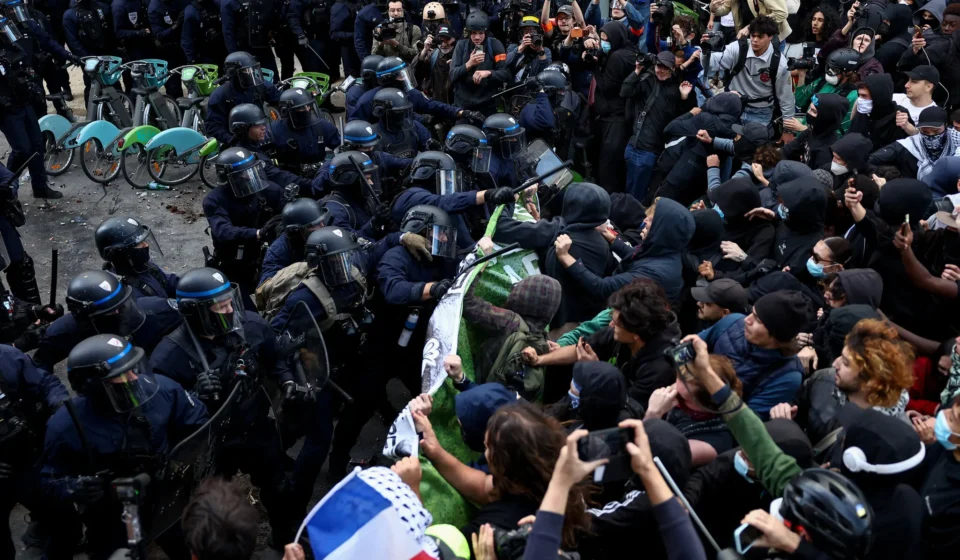
The scale of the unrest has raised the political stakes for President Emmanuel Macron’s centrist government. Demonstrations on 17 October were followed by reports of fires, looting and attacks on public buildings, including damage to municipal buildings in Marseille and Limoges. The Associated Press reported approximately 2,400 arrests connected with the demonstrations, while authorities recorded another 1,435 arrests during the latest protest weekend. These figures should be interpreted as arrests associated with the unrest, rather than convictions or proof that every person detained participated in violence. The government has faced pressure to restore public order while addressing the grievances of students who have protested peacefully. Reports of serious injuries linked to police crowd-control weapons have also intensified scrutiny of the authorities’ handling of demonstrations. The parallel challenges of maintaining public safety and protecting the right to peaceful protest are likely to remain important as further demonstrations are planned.
The timing is especially consequential because France is approaching its 2027 presidential election. Macron cannot seek a third consecutive term, and the next administration will inherit responsibility for implementing the planned replacement of Parcoursup in 2028. This creates a political and administrative vulnerability: the current government can announce the framework, but the system’s final design, legislative requirements and implementation will extend into the next presidency. Opposition parties have sought to capitalise on public frustration, with Marine Le Pen’s National Rally presenting itself as a party of law and order. Yet the protests should not be interpreted as evidence of uniform support for any particular political movement. Dissatisfaction over education and living costs can bring together groups with different priorities, and the extent to which it translates into electoral support will depend on the wider campaign, competing policy proposals and voters’ assessments of the government’s response.
For France’s education system, the central test is whether the proposed changes address the underlying mismatch between student demand, institutional capacity and household resources. A more transparent admissions process could improve accountability, while new places in vocational and technical programmes could strengthen pathways into employment. Better-maintained buildings, additional staff and grants adjusted for inflation could also improve learning conditions and reduce financial barriers. But implementation will determine whether these commitments produce measurable results. The government will need to demonstrate that selection decisions become easier to understand, that additional places are available where demand is strongest and that funding reaches institutions with the greatest needs. If the reforms are delayed or fail to address persistent inequalities, replacing the admissions platform may be seen as a procedural change rather than a substantive response to the movement’s demands.
France’s confrontation over education ultimately reflects a broader policy dilemma facing advanced economies: governments are expected to widen access to skills and qualifications while operating under fiscal constraints and responding to households struggling with living costs. The proposed package acknowledges that admissions procedures cannot be separated from the quality, capacity and affordability of the institutions receiving students. Yet the gap between the government’s commitments and protesters’ demands remains substantial, and the most consequential reform will not be complete before the next presidential administration takes office. The immediate question is whether the concessions can reduce tensions in the short term; the longer-term question is whether France can translate them into a more accessible and adequately resourced education system. The outcome will matter not only for students and teachers, but also for the country’s future workforce, productivity and social mobility.
Sources: The Associated Press’ report on France’s planned university admissions overhaul and education concessions; the French Ministry of Higher Education’s official announcement of the Parcoursup replacement, additional university places, student grants and renovation funding; the French Ministry of Education’s details on class-size limits, staffing and school renovation measures; The Guardian’s report on student leaders urging further protests despite the government’s concessions; and Le Monde’s coverage of the growing high-school protest movement and its demands for better educational conditions.
