













Israeli strike on Gaza’s hospital kills six, including surgeon
At least 28 people were wounded in the attack on the surgical department in Khan Younis, according to Gaza’s Health Ministry; Israel says it targeted a senior Hamas commander and other fighters inside the hospital complex.
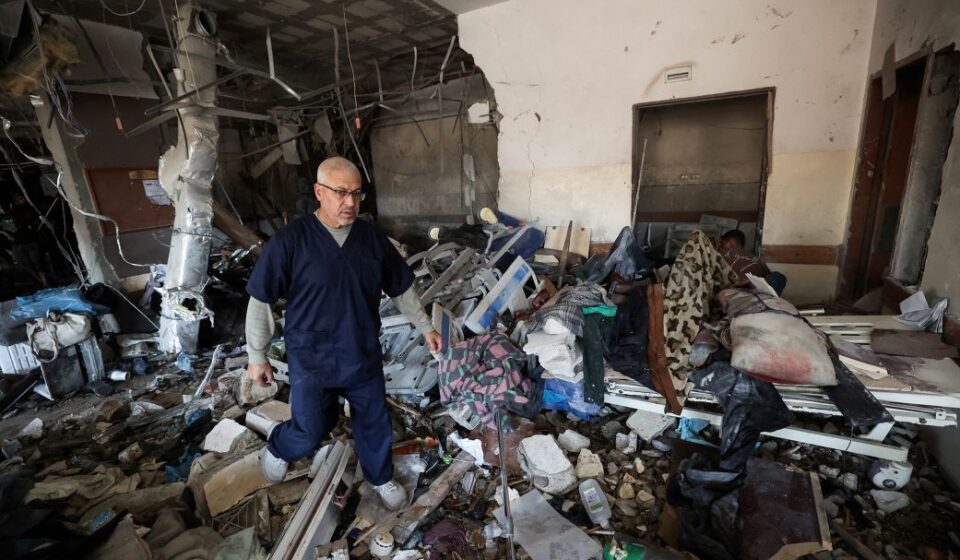
An Israeli airstrike hit the surgical wing of Nasser Hospital in southern Gaza early on Thursday, killing six people, including a surgeon, and injuring at least 28 others, according to Gaza’s Health Ministry. The attack damaged several floors of one of the territory’s remaining functioning medical facilities, disrupting surgery and other essential services as the healthcare system continues to struggle with the consequences of years of war.
The Associated Press reported that the strike occurred shortly after midnight at the hospital in Khan Younis. Those killed included general surgeon Rizk Abu Shaira and a 13-year-old patient, according to the latest AP account. The Israeli military said it had targeted a senior Hamas commander and other militants, alleging that the group had established a presence inside the hospital complex. It did not provide publicly available evidence in its initial explanation.
The casualty figures were reported by Gaza’s Health Ministry, while the Israeli military’s account of the intended target and alleged Hamas presence represents its stated justification for the operation. These claims require separate examination and should not be treated as independently established findings.
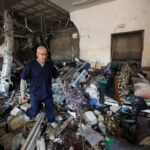
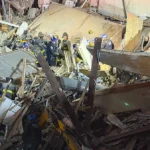
The strike caused extensive damage to the hospital’s surgical department, with parts of several floors severely damaged or destroyed. Debris was scattered across beds and medical equipment, while exposed reinforcement bars and damaged ceilings were visible inside the building.
British surgeon Goher Rahbour, who was volunteering at Nasser Hospital, told AP that the explosion occurred while he was on the fourth floor of the surgical department. He said the building shook and smoke spread through the area. Rahbour had worked alongside Abu Shaira only hours before the attack.
Ahmed al-Farra, a doctor and the hospital’s general director, said there had been no warning before the strike. Operations were suspended in several areas, including surgery, radiology and laboratory services, because of the damage.
The disruption carries consequences beyond the immediate casualties. Nasser Hospital had been providing specialised surgical treatment that other nearby facilities were not equipped to offer, according to al-Farra. Patients requiring such procedures now face uncertainty over where they can receive treatment.
The Israeli military said the operation targeted a senior Hamas commander and additional fighters. In a statement, it alleged that Hamas had established a presence within the hospital complex and that the commander had turned the facility into a headquarters.
A subsequent statement reported by The Times of Israel identified the intended target as Muhammad Abu Ismail, described by the Israeli military as the commander of Hamas’s Khan Younis Brigade. The military said the outcome of the strike remained under review.
The allegation that Hamas was using the hospital for military purposes has not been independently established in the reporting available. The military’s account of its target does not, by itself, resolve whether the attack complied with the legal requirements governing the protection of medical facilities and civilians.
Hospitals and medical personnel receive specific protection under international humanitarian law. The International Committee of the Red Cross explains that medical facilities must be respected and protected during armed conflict and that their protection does not automatically disappear because wounded combatants or armed guards are present.
A medical facility can lose its special protection if it is used, outside its humanitarian function, to commit acts harmful to the enemy. However, the ICRC says that a warning must be given before an attack in circumstances where the law requires it, and that the attacking party remains bound by the principles of proportionality and precaution. Patients and medical workers who are not responsible for any alleged misuse must continue to be protected.
The distinction is central to assessing the Nasser Hospital strike. Israel’s allegation of a Hamas military presence requires scrutiny, while the consequences for patients, medical staff and the hospital’s ability to provide care must also be considered. Establishing whether the attack was lawful would require evidence about the alleged military activity, the information available to the Israeli forces, the precautions taken and the expected civilian harm.
Nasser Hospital has previously been affected by Israeli military operations. In 2025, an Israeli strike on a gathering point for journalists at the hospital complex killed five journalists, including Associated Press photojournalist Mariam Dagga.
The latest attack comes after more than three years of war that have devastated Gaza’s healthcare infrastructure. The territory’s Health Ministry reported that more than 74,600 Palestinians had been killed since the conflict began in October 2023. The ministry is part of the Hamas-run administration and does not distinguish between civilian and combatant deaths in its overall toll. AP noted that United Nations agencies and independent experts generally regard its casualty records as reliable.
The strike also took place despite a US-backed ceasefire that came into effect in October 2025. Gaza’s health authorities said Israeli strikes and gunfire had killed 1,622 people since the truce began. Those figures underline the continuing insecurity facing civilians and medical facilities despite the ceasefire framework.
The damage to Nasser Hospital illustrates how attacks on medical facilities can affect an entire network of care. When surgery, radiology and laboratory services are interrupted, patients who were not directly injured in an attack can also face delays, cancelled procedures and reduced access to diagnosis and treatment.
The loss of specialised capacity is particularly consequential in a territory where years of conflict have already damaged hospitals, depleted supplies and placed medical workers under extreme pressure. Restoring a damaged department requires more than repairing a building: equipment, medicines, electricity, staffing and safe access must also be available.
The immediate questions concern the condition of the injured, the restoration of suspended services and the circumstances of the strike. Beyond those questions lies a broader challenge: ensuring that medical facilities can continue treating patients without becoming casualties of the conflict.
Sources: The Associated Press’s report on the Nasser Hospital strike provides the updated casualty toll, accounts from medical personnel and details of the damage. Reuters published an earlier report on the strike and the initial casualty figures, while Agence France-Presse’s coverage was carried by Ahram Online. The Israeli military’s stated explanation and identification of the intended target were reported by The Times of Israel and in a subsequent military update. The Palestinian official news agency WAFA also reported the six deaths and damage to the hospital. For the applicable legal framework, the International Committee of the Red Cross explains the protection of hospitals during armed conflict, including the conditions under which that protection may be lost and the obligations that continue to apply during an attack.
