










Mass protest in Czechia puts public-media independence
Hundreds of thousands rally against plans to replace broadcasting licence fees with state funding, amid concerns that a proposed 15% budget reduction could weaken public broadcasters and expose them to political pressure.
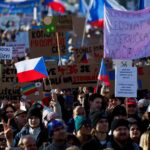
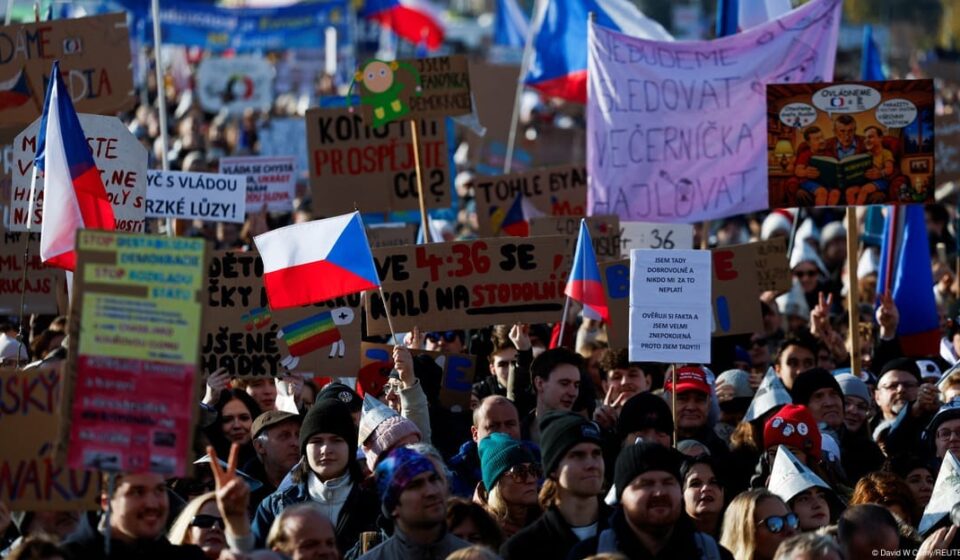
Hundreds of thousands of people gathered in Prague on 15 November to oppose the Czech government’s proposed overhaul of public-media funding, turning a dispute over broadcasting fees into a wider debate about press freedom, institutional independence and the relationship between government and publicly funded journalism.
The demonstration followed the government’s move to replace household and business licence fees for Czech Television and Czech Radio with direct financing from the state budget. Organisers estimated that between 350,000 and 450,000 people attended, while Reuters reported an estimate of approximately 400,000. The differing figures are organisers’ and media estimates rather than an independently verified attendance count.
The reform has been promoted by Prime Minister Andrej Babiš’s coalition as a way to reduce household costs and require broadcasters to cut expenditure. However, critics argue that moving funding under the state budget, alongside a proposed reduction in resources, could make public-service media more vulnerable to political pressure. The government rejects the allegation that it intends to take control of editorial operations.
Under the existing system, Czech Television and Czech Radio receive revenue through compulsory broadcasting fees paid by households and businesses. The government wants to abolish those payments and replace them with allocations from the national budget.
The European Broadcasting Union (EBU) and other media organisations estimate that the proposed changes would reduce the broadcasters’ combined annual funding by approximately 1.4 billion Czech koruna, or around 15%, bringing it to roughly 7.8 billion koruna. The organisations warned that a reduction of this scale could affect journalism, programming, public-service obligations and investment in new services.
The financial impact is central to the controversy. Licence fees provide a dedicated revenue stream, whereas state-budget financing places annual allocations within the wider government budget process. The latter arrangement is not inherently incompatible with editorial independence, but its safeguards depend on how funding is determined, whether allocations are predictable and whether political authorities can influence resources in response to editorial decisions.
The government argues that the reform will not compromise editorial independence and that public broadcasters should operate more efficiently. Critics question whether the proposed funding level and institutional arrangements provide sufficient protection against political interference.
Babiš has denied that his government intends to nationalise public broadcasting or interfere with editorial decisions. In remarks cited by Deutsche Welle, he dismissed the protesters’ accusations and defended the proposed changes as a legitimate funding reform.
Foreign Minister Petr Macinka also criticised the protest organisers, accusing them of turning demonstrations into a business model. The government’s position is that replacing licence fees with state financing will not determine what journalists can report or how broadcasters make editorial decisions.
The governing coalition comprises Babiš’s ANO movement, the far-right Freedom and Direct Democracy party (SPD) and the Eurosceptic Motorists. The political composition of the coalition has added to concerns among opponents of the reform, although its membership alone does not establish that the funding proposal is intended to secure editorial control.
The controversy has also become a test of public confidence in the government’s assurances. According to the 2026 Reuters Institute Digital News Report, trust in news in Czechia remains relatively low, at approximately 30–33%. Public broadcasters nevertheless continue to be regarded as among the country’s most trusted media institutions.
The proposed reform has attracted criticism from organisations representing public broadcasters and journalists. The EBU, European Federation of Journalists, Reporters Without Borders and other groups have raised concerns about the proposed reduction in funding and the speed at which the legislation has been advanced.
In an October statement, the EBU and its partner organisations said the proposed funding reduction could undermine the ability of Czech Television and Czech Radio to fulfil their public-service responsibilities. They also questioned whether the parliamentary process allowed sufficient time for scrutiny and public consultation.
The European Federation of Journalists and other organisations have separately called for sustainable and independent funding arrangements, arguing that public-service media must be accountable to citizens rather than become financially dependent on the political priorities of the government of the day.
The debate is also being viewed against developments elsewhere in Central Europe. Critics have drawn comparisons with changes to public broadcasting in Hungary and Slovakia, where international media organisations have raised concerns about political influence over public media institutions. These comparisons indicate the broader concerns surrounding the Czech proposal, but do not establish that the same institutional outcome will necessarily occur in Czechia.
The legislation has not completed its parliamentary passage. The Chamber of Deputies advanced the bill through its first reading on 24 October, after a contentious overnight debate that opposition parties criticised as rushed. The proposed changes have therefore moved beyond an initial government announcement but have not yet become a fully implemented funding system.
The European Commission has been monitoring the issue in relation to European media-freedom requirements. In a 3 November briefing, a Commission spokesperson said the institution was assessing the Czech authorities’ response concerning the proposed reform. The Commission had not announced a finding that the proposal violated European Union law or opened infringement proceedings at that point.
The European Media Freedom Act provides a framework for protecting public-service media, including requirements concerning transparent, objective, sustainable and predictable funding arrangements. The practical question is whether the Czech proposal, as ultimately adopted, would meet those standards and provide sufficient safeguards against political interference.
Culture Minister Oto Klempíř proposed on 16 November that parliamentary consideration of the funding reform be delayed until lawmakers begin examining national legislation implementing the European Media Freedom Act. The suggestion could create an opportunity for further discussion, although it does not itself mean that the government has withdrawn the proposal.
The Prague demonstration reflects a wider European debate over how public broadcasters should be financed and protected. Governments have legitimate responsibilities to oversee public expenditure and ensure that publicly funded institutions use resources efficiently. At the same time, public-service journalism requires funding arrangements that prevent political authorities from using financial decisions to influence editorial priorities.
Moving from licence fees to general taxation is not, by itself, proof of political interference. Several European countries finance public broadcasters through taxation. The decisive factors include the independence of funding decisions, the predictability of allocations, the adequacy of resources and the legal safeguards governing appointments and editorial operations.
For Czechia, the immediate challenge is to establish whether the proposed reform can deliver the government’s stated cost-saving objectives without weakening the financial and institutional independence of public broadcasting. The scale of the Prague demonstration shows that the issue has become a major public concern, but the outcome will ultimately depend on the legislation, parliamentary scrutiny and the safeguards adopted.
The dispute is therefore about more than how Czech households pay for television and radio. It concerns whether public broadcasters can continue to serve audiences independently while receiving money through a system ultimately controlled by elected political institutions.
Sources: Deutsche Welle — Czechia: Thousands protest against public media reform, 15 November 2026; Reuters — Hundreds of thousands of Czechs rally against government media funding plan, 15 November 2026; Associated Press — Czechs gather in big numbers to reject government’s plan to overhaul funding of public media, 15 November 2026; European Broadcasting Union — Concern over fast-tracked debate on Czech public service media funding, 23 October 2026; European Commission Audiovisual Service — Commission assesses Czech reply on public television and radio funding reform, 3 November 2026; The Guardian — Public media freedom has been eroded across central Europe. Now Czechs are rallying to protect theirs, 14 November 2026; Euronews — Hundreds of thousands in Prague protest Czech government’s public media funding plans, 15 November 2026.
