
















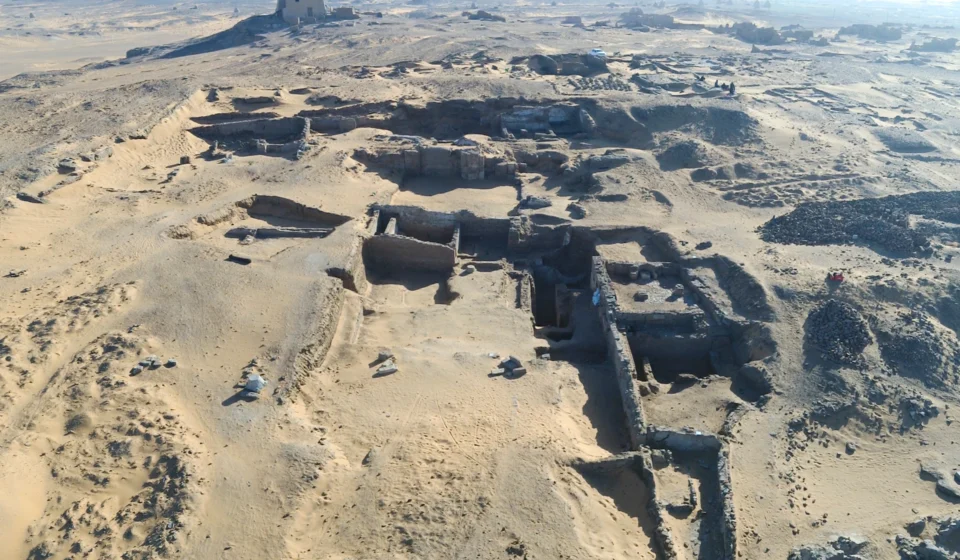
Archaeologists uncover original floor of monumental medieval cathedral
The discovery at Old Dongola offers new evidence of the scale and architectural influence of the Great Church of Jesus, believed to have been one of medieval Nubia’s most important Christian buildings.
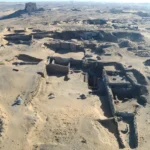
Archaeologists have reached the original floor of a monumental medieval cathedral in northern Sudan for the first time, revealing further details about a major centre of Christian worship in the ancient Nubian kingdom of Makuria. The discovery was made at Old Dongola by a joint Sudanese-Polish archaeological mission, which uncovered a massive staircase leading into the Great Church of Jesus.
The Associated Press reported on 16 November that the staircase had walls standing approximately 11 metres high and provided the first access to the church’s original floor level. Although the structure was identified in 2021, most of it remains buried. Archaeologists have so far reached the floor only in the area around the staircase.
The expedition estimates that the church measured approximately 47 metres wide and 57 metres long. Its scale could make it larger than the White House in Washington, according to Artur Obłuski, director of the Polish Centre of Mediterranean Archaeology at the University of Warsaw and head of the mission.
The Great Church of Jesus is located in Old Dongola, on the eastern bank of the Nile in northern Sudan. The ancient city was a major centre of the Christian kingdom of Makuria, one of the Nubian kingdoms that developed along the middle Nile following the arrival of Christian missionaries in the sixth century.
Obłuski described the building as the largest and most important church in medieval Makuria. He compared its potential architectural influence to that of Hagia Sophia in Istanbul, suggesting that its spatial organisation and construction techniques may have shaped religious architecture in Nubia and neighbouring parts of Africa.
The comparison is significant because Hagia Sophia became an influential model of Byzantine architecture after its construction under Emperor Justinian in the sixth century. Obłuski believes the Great Church of Jesus may have played a comparable role in its own regional context.
The archaeological findings could also lead historians to reconsider the religious geography of Old Dongola. A different church outside the city’s walls had previously been regarded as its cathedral. The newly uncovered structure has raised questions about that interpretation and the actual function of the other building.
The excavation has revealed more than the original floor and staircase. Researchers have identified structural supports around the cathedral’s apse, providing additional evidence of the building’s construction.
The mission has also discovered remains of a second church on an upper floor of an adjoining structure. Although its surviving walls are relatively low, archaeologists have recovered fragments of painted plaster and material bearing Greek inscriptions.
According to the University of Warsaw’s archaeological team, epigraphist Agata Deptuła identified some of the Greek texts as biblical odes, or liturgical songs associated with the Psalter. One fragment contains material from the Prayer of Hannah, a biblical passage connected with the mother of the prophet Samuel.
These discoveries offer evidence of the religious practices, artistic traditions and cultural connections of medieval Nubian Christianity. The surviving decorations and inscriptions may also help researchers reconstruct the appearance and liturgical use of the buildings.
Despite the scale of the discovery, only a small portion of the Great Church of Jesus has been excavated. The unusually well-preserved walls create technical challenges because archaeologists must remove deep layers of accumulated material while protecting the standing structures.
The site has also faced environmental pressures. The University of Warsaw reported that severe flooding in autumn 2024, the worst at Old Dongola since 1988, damaged some protective roofs covering archaeological remains. Conservation and structural protection have therefore been important parts of the mission’s work.
The excavation is being conducted by the University of Warsaw’s Polish Centre of Mediterranean Archaeology in partnership with Sudan’s National Corporation for Antiquities and Museums. Researchers hope that future work will establish the cathedral’s full dimensions and reveal more of its internal layout.
The mission has also supported local heritage protection and infrastructure initiatives. A solar-powered installation funded through Poland’s development assistance programme has been used to operate water pumps serving nearby communities, demonstrating how archaeological projects can contribute to local needs as well as historical research.
The Great Church of Jesus provides a rare opportunity to understand the architectural and religious achievements of medieval Nubia, a region whose Christian kingdoms maintained political, cultural and religious connections with the wider Mediterranean and northeastern Africa.
Its excavation may change existing interpretations of Old Dongola’s urban and religious history. The building’s dimensions, surviving architectural features and newly identified inscriptions could provide evidence about the organisation of Christian institutions and the movement of artistic and construction practices across the region.
The discovery also carries significance for Sudan’s cultural heritage at a time when the country faces serious challenges in protecting historical sites and archaeological collections. Further excavation and conservation will require resources, technical expertise and cooperation with local institutions and communities.
For now, the original floor has been reached in only one section of the cathedral. The full structure remains largely underground, leaving substantial questions about its construction, internal design and historical development. As excavation continues, the Great Church of Jesus could offer a much clearer picture of Nubia’s place in the history of African and Christian architecture.
Sources: Associated Press — A hidden cathedral floor emerges in Sudan, revealing one of the biggest medieval churches, 16 November 2026; University of Warsaw — The largest church in medieval Nubia; Radio Tamazuj — Archaeologists uncover original floor of medieval cathedral in Sudan, 11 November 2026; Archaeology Magazine — Archaeologists uncover original floor of Nubia’s largest medieval cathedral, 9 November 2026; Polskie Radio — Polish and Sudanese archaeologists uncover further parts of medieval church in Sudan, 5 November 2026.
