



















SpaceX Starship faces defining test, reusable rockets
SpaceX is preparing for one of the most ambitious tests in its history, as its Starship programme moves towards an attempt to recover both stages of its enormous launch vehicle following a mission into space. Scheduled for Friday, the Flight 15 mission could mark a significant development in the economics of space transportation, although the engineering risks remain considerable.
The company plans to launch Starship from its Starbase facility in South Texas during a 75-minute window beginning at 5.45pm Eastern Time (2245 GMT). For the first time, SpaceX intends to bring both the Super Heavy booster and the upper-stage Starship spacecraft back to its launch site, using mechanical arms attached to its launch tower to catch the returning vehicles. The attempt remains conditional on operational and regulatory requirements, and success is far from guaranteed. Space.com.
The significance of the mission extends beyond another experimental rocket launch. SpaceX is attempting to establish a system in which an entire orbital launch vehicle can be recovered, refurbished and flown again, potentially changing the cost structure of the global space industry. Conventional launch systems often discard substantial hardware after each mission. Reusability, if achieved at scale, could reduce the amount of new hardware required for every launch and allow operators to increase flight frequency.
The challenge, however, is considerably more complex than recovering a conventional rocket booster.
From booster recovery to complete vehicle reuse
The Starship system consists of two major components: the Super Heavy first-stage booster and the upper-stage spacecraft, also called Starship. After liftoff, the two vehicles separate, with Super Heavy expected to turn back towards Starbase for a controlled descent and capture by the launch tower’s mechanical arms, commonly known as Mechazilla.
SpaceX has already demonstrated booster recovery and tower capture on previous missions. Flight 15 introduces a different level of difficulty by attempting to recover the upper spacecraft after it has travelled through orbit.
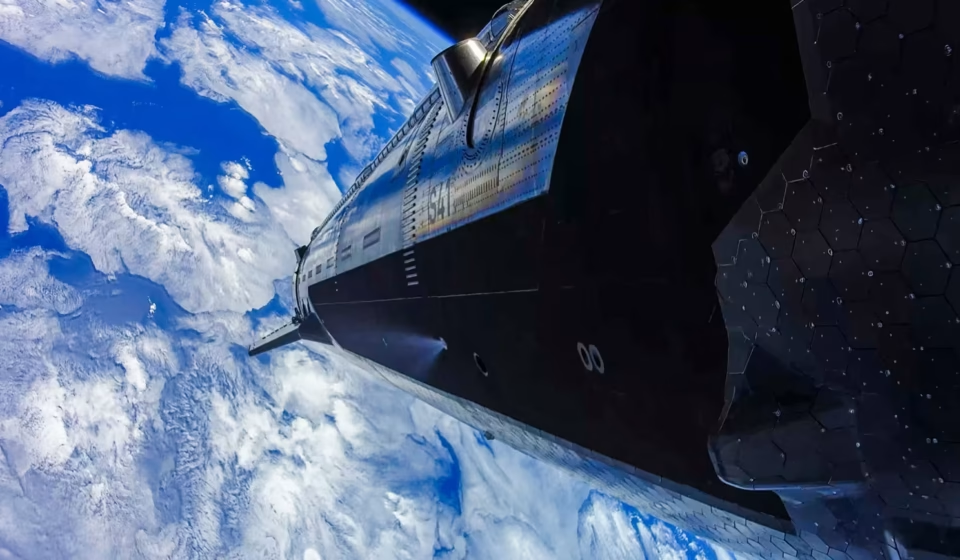
Following separation, Starship is expected to ignite its engines and accelerate towards orbital velocity, exceeding 27,000 kilometres per hour. If the mission proceeds according to plan, the spacecraft will complete approximately 14 revolutions around Earth over roughly 22 hours before beginning its return.
The flight also includes the planned deployment of 26 next-generation Starlink V3 satellites, designed to expand the capacity of SpaceX’s satellite internet network. This combination of vehicle testing and commercial payload deployment illustrates how the company is seeking to turn Starship into an operational platform rather than simply an experimental rocket. Space.com.
The most difficult part begins on the way home
The return journey presents a separate set of engineering problems. As Starship enters Earth’s atmosphere, friction and atmospheric compression generate extreme temperatures, placing enormous demands on its thermal protection system. The spacecraft must maintain structural integrity while travelling at orbital speeds and making controlled adjustments to its flight path.
Unlike conventional spacecraft that rely on parachutes or runway landings, Starship is designed to perform a controlled descent, manoeuvre towards its launch site and use its engines to position itself for capture by the tower.
The risks are not limited to the spacecraft itself. A failed manoeuvre or uncontrolled descent could create hazards for populated areas and surrounding infrastructure. SpaceX has therefore developed contingency procedures that allow mission controllers to abandon the planned tower recovery and direct the spacecraft towards a designated ocean splashdown if conditions require it.
The safety dimension is particularly important because the proposed return trajectory involves airspace over parts of northern Mexico and southern Texas. The Federal Aviation Administration’s oversight of commercial launches and re-entry operations remains a central part of the regulatory framework governing the mission.
Previous progress has not removed the technical uncertainty
Flight 14, conducted on 28 September 2026, provided an important demonstration of Starship’s developing capabilities. The spacecraft reached orbit for the first time on the mission profile, deployed its planned Starlink V3 satellites and completed a controlled splashdown in the Indian Ocean.
However, the flight also exposed continuing concerns about engine reliability. One of the spacecraft’s engines shut down prematurely during ascent, raising questions about the system’s ability to maintain performance under demanding flight conditions.
SpaceX continued the mission after assessing the situation, with the company subsequently explaining that the decision was within its approved flight criteria. The Federal Aviation Administration confirmed that it monitored the licensed launch and re-entry activities.
These developments illustrate an important distinction between reaching orbit and demonstrating a dependable reusable transportation system. A vehicle may complete a successful flight while still requiring substantial engineering improvements before it can operate regularly and economically. Reuters.
The economics behind the ambition
SpaceX’s strategy reflects a wider transformation in the global space economy. For decades, the high cost of launching payloads into orbit has limited access to space, concentrating much of the industry around government agencies and a relatively small number of commercial operators.
The company’s Falcon 9 programme has already demonstrated how recovering and reusing first-stage boosters can change launch operations. Starship seeks to extend that model to the entire launch vehicle, including the upper stage, which encounters much greater thermal and mechanical stresses during its return from orbit.
If SpaceX can achieve reliable recovery and rapid refurbishment, the implications could extend across satellite communications, commercial space stations, scientific missions and deep-space exploration. Lower launch costs could also increase competition by making larger payloads and more frequent missions economically viable.
However, lower costs remain a long-term objective rather than an established outcome. Recovery alone does not guarantee affordability. The spacecraft must also demonstrate consistent performance, manageable maintenance requirements and a sufficiently short turnaround between missions. NASA’s Space Shuttle programme offers a historical reminder that reusable spacecraft can still involve extensive inspection, maintenance and operating costs.
A strategic asset for the next phase of space exploration
Starship is also closely connected to the future of American lunar exploration. NASA has selected SpaceX to develop a human landing system for its Artemis programme, which aims to return astronauts to the Moon and establish a longer-term framework for lunar exploration.
The vehicle’s potential capacity to transport large payloads could support future lunar infrastructure, satellite networks and other space-based activities. Elon Musk has also repeatedly presented Starship as central to his ambition of making human settlement beyond Earth possible, particularly on Mars.
Yet these ambitions depend on overcoming a series of engineering and operational obstacles. The ability to launch a large vehicle into orbit is only one part of the challenge. Returning it safely, recovering it, preparing it for another flight and maintaining predictable operations will determine whether the system can fulfil its commercial and exploration objectives.
Flight 15 should therefore be understood as a test of an emerging transportation model rather than a declaration that reusable orbital flight has already been solved. Even a successful recovery would need to be followed by repeated demonstrations before the system could be considered operationally mature.
The broader significance lies in what the technology could mean for the relationship between economic power, industrial capacity and access to space. As governments and private companies compete to build satellite infrastructure, develop lunar capabilities and secure a greater role in the emerging space economy, reusable launch systems could become a decisive source of strategic and commercial advantage. SpaceX’s latest attempt is consequently about more than bringing a rocket back to Earth: it is an effort to establish whether access to space can become a repeatable industrial activity rather than an exceptionally expensive undertaking. The outcome of Flight 15 will not settle that question, but it could provide an important indication of how close the industry is to answering it.
