



















Eric Trump-backed robotics start-up misses payroll
Foundation Future Industries faces a cash crisis as employees await overdue wages, investors question its governance and the origins of its reported Pentagon contracts come under renewed scrutiny.
A US robotics start-up backed by Eric Trump, son of US President Donald Trump, has failed to pay employees following a missed payroll at the end of October, raising questions about its financial position and corporate governance. The company, Foundation Future Industries, is developing humanoid robots for military and industrial applications and has attracted attention through its claims about future defence capabilities.
In an investigation published on 14 November, CNBC reported that employees had not received their wages since the San Francisco-based company missed its 30 October payroll. Citing people with direct knowledge of the matter, the report said the company’s cash reserves had dwindled and that workers were increasingly concerned about its financial position.
The situation has drawn particular criticism because chief executive and co-founder Sankaet Pathak borrowed $4.6 million from the company in 2025, reportedly to purchase a luxury property in Sausalito, California. Public records cited by CNBC show that a limited liability company naming Pathak as its sole principal acquired a property at that price in October 2025. Pathak’s spokesman acknowledged receiving questions from CNBC but did not respond to its requests for comment.
Foundation’s cash difficulties appear to extend beyond the latest missed payroll. CNBC reported that the company had also run short of money to pay employees in August, although wages were delayed by only about two days after an existing investor provided a bridge loan.
Pathak reportedly described the $4.6 million transaction as a short-term loan. Existing investors were aware of it through the company’s financial disclosures, according to people familiar with the matter. However, the arrangement has raised concerns among prospective investors because Pathak is both the company’s majority shareholder and its sole board member.
A board with only one member concentrates corporate oversight and decision-making authority in a single individual. That structure can make independent scrutiny of executive decisions more difficult, particularly when a transaction involves the chief executive personally. CNBC reported that prospective investors had raised governance concerns about the arrangement.
Pathak has reportedly been seeking hundreds of millions of dollars in fresh funding at a proposed valuation of $3 billion since at least January. People familiar with the company’s finances told CNBC they feared it could collapse without additional capital. In a message to employees during the week of 14 November, Pathak said he was working to secure funds to pay outstanding wages. The report did not establish that the overdue salaries had subsequently been paid.
Foundation has also attracted attention through claims about its defence business. Its public profile grew after Eric Trump became an investor and chief strategy adviser, appearing alongside Pathak in a televised interview in April 2026.
The company has been widely described in media coverage as having secured approximately $24 million in Pentagon contracts. However, CNBC’s investigation challenged the attribution of that funding. A person familiar with the matter told the network that the figure related to existing government research contracts held by Boardwalk Robotics, a Florida-based company acquired by Foundation in late 2024, rather than contracts independently won by Foundation.
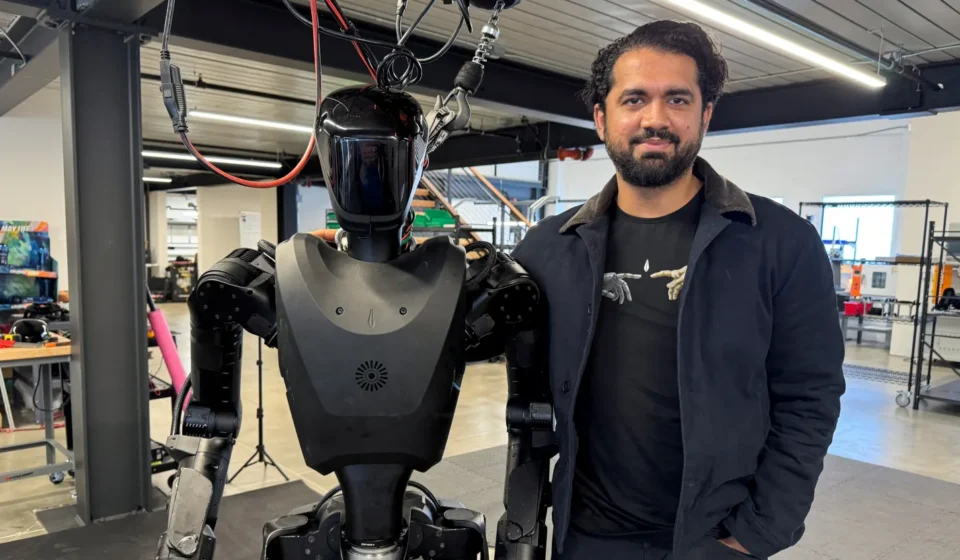
Boardwalk’s Alex robot reportedly provided the technological basis for Foundation’s first humanoid model, the Phantom MK-1. A separate person with knowledge of the acquisition told CNBC that the deal included performance milestones that had not been achieved.
The distinction is important for assessing the start-up’s commercial position. Government contracts held by an acquired company are not necessarily equivalent to new contracts secured by the acquiring business, and inherited research agreements do not automatically demonstrate demand for a new generation of military robots.
The issue has also attracted political attention. In April, Democratic Senator Elizabeth Warren questioned whether Eric Trump’s involvement had influenced the company’s access to government business. She described the circumstances as appearing to be “corruption in plain sight”. These were political concerns, not a finding that Foundation had received contracts through improper influence.
Eric Trump did not respond to CNBC’s requests for comment. His spokesperson previously told the Financial Times that he had no involvement in Foundation’s management, operations, strategic decisions or commercial activities, including the solicitation, negotiation, procurement or execution of government contracts. The size of his investment has not been publicly established in the report.
Foundation’s financial difficulties have renewed attention on Pathak’s previous venture, Synapse, a financial technology company that connected non-bank fintech platforms with traditional banks to provide services such as savings accounts and payment facilities.
Synapse filed for Chapter 11 bankruptcy protection in April 2024. Its collapse left customers unable to access funds held through fintech platforms, while discrepancies between the company’s records and those of its partner banks complicated the process of reconciling customer balances.
The Consumer Financial Protection Bureau (CFPB) subsequently brought an enforcement proceeding against Synapse. According to the regulator, partner banks found that the funds they held for customers were between $60 million and $90 million below the amounts recorded in Synapse’s records. The bureau said customers were unable to access their money for weeks or months and that many had not received their full account balances.
CNBC separately reported that more than 100,000 Americans were affected and that the bankruptcy trustee had estimated that as much as $96 million in customer funds was missing. The CFPB’s documented shortfall estimate and the trustee figure cited by CNBC should be treated as distinct reported assessments, rather than interchangeable measures.
Pathak also reportedly withdrew $320,000 in loans from Synapse as the company approached bankruptcy, according to independent journalist Jason Mikula, whom CNBC cited. The report said federal prosecutors convened a grand jury to investigate possible criminal misconduct at Synapse, citing an earlier Wall Street Journal report. That reporting did not specifically implicate Pathak in the investigation, and the existence of an inquiry does not establish criminal wrongdoing.
The Synapse episode is relevant to the scrutiny of Foundation because it raises questions about financial controls, executive borrowing and the management of companies handling other people’s money. However, the circumstances of the two businesses are different, and the earlier company’s collapse does not itself establish misconduct at Foundation.
Foundation has sought to position itself as a US competitor in the development of advanced humanoid robots, with applications ranging from industrial work to military operations. Pathak has publicly described plans for a more advanced, weapons-ready robot and argued that the technology could support US defence capabilities.
The company has recruited robotics engineers and artificial intelligence specialists, including personnel from major technology and autonomous-vehicle businesses. Its ambitions have also attracted prominent investors and political attention.
Yet the current payroll crisis highlights the financial demands of turning advanced robotics research into a commercially sustainable operation. Hardware development requires substantial investment in engineering, manufacturing, testing and supply chains. Defence applications also involve procurement requirements, performance validation and lengthy commercial processes.
A high proposed valuation cannot substitute for evidence of recurring revenue, completed contracts, reliable production capacity or sufficient working capital. For investors, the immediate questions concern the company’s ability to meet its payroll obligations, the terms and prospects of its proposed fundraising and the governance arrangements surrounding transactions involving senior management.
Foundation’s situation therefore illustrates a wider challenge facing capital-intensive technology start-ups: ambitious claims about future capabilities must ultimately be supported by financial discipline, transparent governance and demonstrable commercial performance. Until the company secures fresh funding and restores its ability to pay employees, its robotics ambitions will remain overshadowed by questions about its financial stability.
Sources: CNBC — Eric Trump-backed robot soldier startup can’t pay staff after founder borrowed $4.6 million from company to buy home, Hugh Son, 14 November 2026; Consumer Financial Protection Bureau — Synapse Financial Technologies enforcement action, including the regulator’s findings on customer-fund discrepancies; CFPB — Synapse complaint filed in August 2025; San Francisco Standard — A SoMa startup is building humanoid robots for war, reporting on Foundation’s defence-contract claims and federal records; Financial Times — Humanoid robot start-up backed by Eric Trump in talks with Israel’s military, reporting on the company’s proposed military applications and Eric Trump’s role.
