


















OpenAI disbands standalone robotics team, AI takes centre stage
The company is moving robotics researchers into its main research and Applied organisations, betting that increasingly capable foundation models can control physical machines without requiring a separate AI division.
OpenAI has disbanded its standalone robotics team and redistributed its researchers across the company’s broader research and product organisations, signalling a strategic shift towards using general-purpose artificial intelligence models to control robots. The restructuring reflects the company’s belief that advances in language, vision and reasoning models can increasingly be applied to machines operating in the physical world.
In an exclusive report published on 13 November, Fortune‘s Wen Shao reported that OpenAI confirmed the reorganisation, describing it as an effort to accelerate robotics development rather than abandon the field. The company’s robotics research team has moved under Chief Research Officer Mark Chen, while its applied robotics and hardware teams have joined the larger Applied organisation led by President Greg Brockman. Fortune’s investigation also reported that the company had registered a booth at the Conference on Robot Learning (CoRL) in Austin, but the space was empty when the journalist visited.
The development comes as the AI industry increasingly explores whether foundation models can serve as the intelligence behind robots, autonomous vehicles and other physical systems. Rather than building separate specialised models for each category of machine, companies are investigating whether general-purpose models can interpret visual information, understand instructions, plan actions and control physical devices.
OpenAI’s robotics strategy has undergone several changes. The company initially developed a robotics team but discontinued the effort in 2020. Its co-founder Wojciech Zaremba subsequently cited limitations in available robot-training data and the greater efficiency of pursuing artificial general intelligence through other approaches, particularly large language models trained on extensive collections of text.
OpenAI revived its robotics work in 2024, when it announced a collaboration with humanoid robotics company Figure to develop AI models for robots. The partnership ended in February 2025, after Figure announced that it would concentrate on developing its own AI systems. The development was reported by TechCrunch, while the original collaboration had been announced through Figure’s February 2024 funding and partnership statement.
The latest restructuring reflects a different approach. According to OpenAI’s explanation to Fortune, researchers initially expected that advances in models such as Sora, the company’s video-generation system, would help provide the physical-world understanding required for robotics. However, the company now believes its general-purpose frontier models, including GPT-6 Astra, can be applied more directly to robotic tasks.
This approach could reduce the need to develop entirely separate AI systems for every robotic application. It also places greater importance on the capabilities of foundational models, including their ability to understand spatial relationships, interpret changing environments and determine the sequence of actions needed to complete a task.
Experiments involving general-purpose AI models have begun to demonstrate capabilities in simulated robotic environments. According to Fortune, an NVIDIA study found that an Astra-powered agent achieved a 74.8% success rate on a simulated manipulation benchmark, compared with 51% for the best specialised robotic model reported on the same leaderboard.
The distinction between simulation and physical deployment is important. A model that performs well in a controlled digital environment has not necessarily demonstrated equivalent reliability when operating a physical machine. Nevertheless, the results provide evidence that general-purpose models may be capable of handling certain manipulation tasks without the same level of specialised robotic training.
NVIDIA’s research project, Astranomy: An Empirical Study of GPT-6 Astra as a Native Robot Policy, provides further detail on the evaluation of general-purpose models in robotic manipulation. Its findings examine how planning, interaction history and the structure of action interfaces influence performance. The research also highlights the continuing importance of execution methods and the relationship between model reasoning and physical control.
Despite the progress of general-purpose models, specialists interviewed by Fortune cautioned against assuming that dedicated robotics expertise will become unnecessary.
Russ Tedrake, an MIT professor and co-founder of Walden Robotics, argued that robotics companies possess an important advantage: their machines are already collecting operational experience in factories and other real-world environments. Such deployment data helps robots adapt to particular workplaces, equipment and tasks.
This experience may become more valuable as foundational models improve. Better general-purpose reasoning could enable robots to learn from existing operational data more efficiently, while companies with established deployments retain practical knowledge of the environments in which their machines operate.
The importance of training data is also reflected in research beyond OpenAI. The Allen Institute for AI’s MolmoAct 2 project, published in May 2026, released model code, training data and evaluation materials to support the development of general-purpose robotic systems. Meanwhile, the Stanford AI Index 2026 identifies data availability, simulation costs and the difficulty of transferring performance from controlled environments to unpredictable physical settings as major constraints on robotics development.
General-purpose models also face practical limitations. Large models can be computationally demanding, may require cloud infrastructure and can introduce delays when robots need to respond to their surroundings in real time.
Guanya Shi, an assistant professor at Carnegie Mellon University’s Robotics Institute, told Fortune that smaller specialised models could remain necessary for tasks that require local processing without a continuous internet connection.
This issue is already being addressed by other AI developers. Google DeepMind’s Gemini Robotics On-Device 2 model card, published in July 2026, describes a vision-language-action model designed to operate directly on robotic devices. Such systems demonstrate that the development of general-purpose robotic intelligence does not necessarily eliminate the need for models optimised for specific hardware and operating conditions.
Pete Florence, co-founder of Generalist, also cautioned that it remains unclear which existing model or architectural approach will dominate robotics in the long term. The industry is therefore pursuing several overlapping strategies rather than converging on a single established solution.
OpenAI’s restructuring also comes amid pressure to control operating costs and concentrate resources on its core products. Fortune reported that the company recorded operating losses of $10.9 billion in its most recent quarter and was preparing for a potential initial public offering in early 2027.
The company has previously signalled a desire to reduce projects that do not directly support its central priorities. The latest move places robotics research closer to its broader model-development and product organisations, potentially allowing the company to share computing resources, research infrastructure and technical expertise.
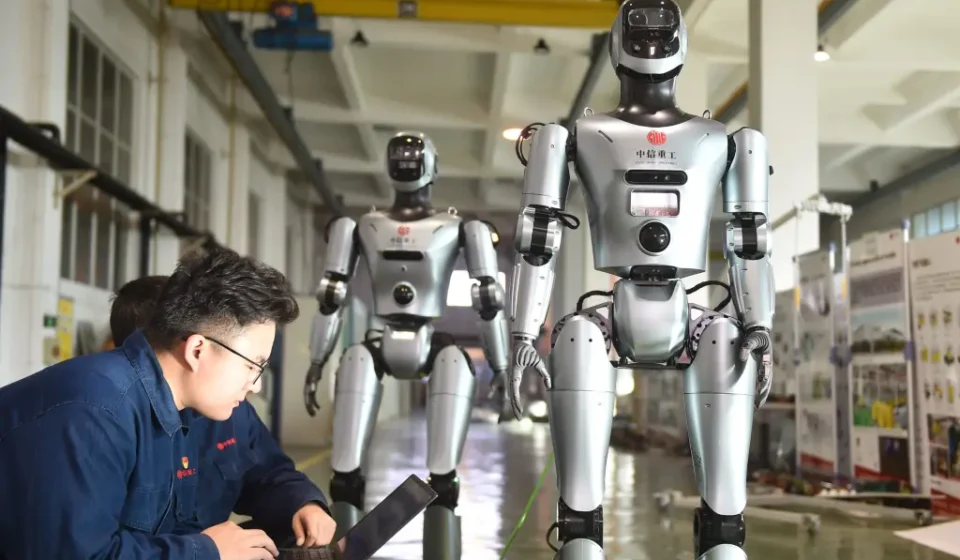
However, the financial implications of the restructuring remain unclear. Reassigning researchers does not necessarily mean that robotics development will become less expensive, particularly if the company intends to build and demonstrate its own humanoid machines. OpenAI has previously indicated that it is developing a humanoid robot, with chief executive Sam Altman targeting a first public demonstration in 2027.
The wider commercial landscape is also changing. Robotics companies have attracted investment on the assumption that machines will require specialised intelligence and extensive hardware-specific development. The possibility that general-purpose models could perform an increasing share of these functions may challenge parts of that business model, although companies with real-world deployment experience and proprietary operational data could retain competitive advantages.
OpenAI’s decision to dissolve its standalone robotics team marks a change in organisational structure and research priorities, but it does not establish that specialised robotics development has reached its limits. The company’s stated objective remains the development of general-purpose robots, with its researchers now working within broader AI and Applied organisations.
The central question is whether improvements in foundation models can translate into reliable physical performance across different machines and environments. Success in simulations and controlled experiments is an important step, but commercial deployment requires safety, precision, low-latency operation and the ability to respond to unexpected conditions.
For the robotics industry, the restructuring raises a broader strategic question: will the future of intelligent machines be driven primarily by general-purpose AI models, specialised robotic systems or a combination of both? Current research and industry experience suggest that the relationship between foundational intelligence, hardware expertise and real-world training data will remain central to the answer.
Sources: The restructuring was first reported by Fortune in Wen Shao’s exclusive investigation into OpenAI’s robotics reorganisation, which includes the company’s explanation and comments from robotics researchers. The technical potential and limitations of general-purpose AI in robotic manipulation are explored in the research paper An Unexpected Robot Policy: Early Evaluations of GPT-6 Astra on RoboDojo and Beyond. Additional context on the development of embodied AI and robot-learning systems is available through NVIDIA Research, Google DeepMind’s robotics research, and the Stanford Institute for Human-Centered Artificial Intelligence’s 2026 AI Index. OpenAI’s earlier humanoid robotics partnership with Figure was announced in February 2024, before Figure moved towards developing its own robotic AI.
