




















US judge blocks Trump’s plan to close historic Washington golf course
A federal court has ordered East Potomac Park to remain accessible to the public until at least 28 November, finding that the administration’s stated reasons for its planned closure were pretextual and that its actions likely violated federal law.
A federal judge has temporarily blocked the Trump administration from closing East Potomac Park and its public golf course in Washington, DC, halting a planned 15-month shutdown for redevelopment while a legal challenge proceeds.
US District Judge Ana Reyes issued a temporary restraining order on Saturday, 14 November, preventing the government from closing the park and East Potomac Golf Links during the hours they were open that day. The order remains in effect until 28 November or until further direction from the court.
In her 30-page decision, Reyes described the administration’s stated justifications for the closure as pretextual and found that officials had likely violated federal environmental and administrative law in their haste to meet the president’s announced deadline. The ruling does not resolve the underlying lawsuit or permanently prohibit the proposed redevelopment. The Associated Press reported the order’s precise terms in its account of the decision.
“The government proposes to close a historic park, daily enjoyed by Washingtonians of all stripes, indefinitely,” Reyes wrote. She added that the administration had not plausibly demonstrated that it would suffer harm from temporarily preserving public access.
Importantly, the judge did not require the government to continue operating the golf course or actively managing the park. The administration remains free to undertake repairs in accordance with existing court requirements, but cannot use the suspension of golf operations as a reason to exclude the public from the property.
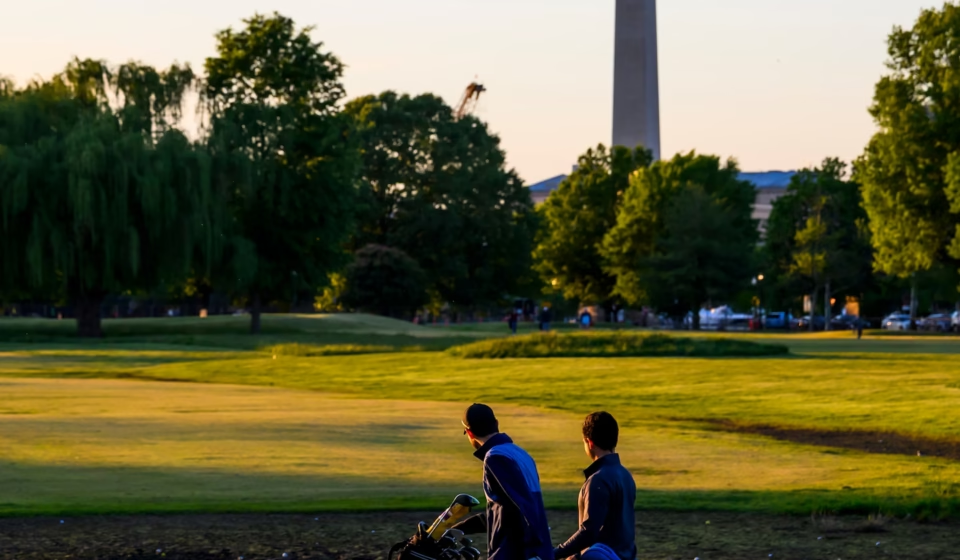
The dispute centres on East Potomac Golf Links, a public recreational facility located approximately two miles south of the White House. The site includes an 18-hole course, two nine-hole courses, a driving range, practice facilities and other recreational areas within East Potomac Park.
President Donald Trump announced in October that the site would close from 15 November for an extensive renovation expected to last approximately 15 months. He said the project would transform the existing facility into a championship-level golf destination capable of hosting major tournaments while remaining open to the public.
Trump described the existing course as “Trash Island” and argued that its infrastructure required substantial improvements. He cited dangerous and diseased trees, deteriorating facilities and a collapsing seawall as reasons for redevelopment.
The administration’s proposed redesign involves replacing the existing golf layout with a championship-style course associated with Fazio Design. The Washington Post reported that the proposal would substantially change the site’s recreational facilities and raised questions about the future accessibility of the park for existing users.
The legal challenge began in February, when the DC Preservation League and two local golfers sued the federal government over the redevelopment plans. The plaintiffs argue that the proposed transformation could alter the character of the public facility, reduce affordable access and violate federal environmental and administrative requirements.
The dispute intensified as the proposed closure date approached. The administration argued that the park needed to close because of safety concerns, particularly the condition of the seawall, and because National Links Trust, the facility’s existing operator, was due to end its management of the site.
However, Reyes questioned why the entire park needed to close when the administration had not demonstrated that immediate work was necessary across the property. She also examined why potentially dangerous sections could not be isolated while other areas remained accessible.
In its detailed coverage, The Washington Post reported that the judge questioned the government’s explanation for treating the seawall as an urgent threat after years of documented deterioration. The court also considered the administration’s lack of an immediate repair plan and the absence of identified funding for the estimated seawall project.
The judge found that the government’s stated reasons for closing the entire site were pretextual, rather than adequately supported by the circumstances presented to the court. She also questioned the decision to end the existing operator’s role, suggesting that the administration had created the operational problem it subsequently relied upon to justify closure.
The ruling further addressed the National Park Service’s failure to complete the required notice-and-comment process before imposing a closure that would significantly change public use of the park.
Reyes wrote that public consultation requirements could not be bypassed simply because the agency wanted to meet the president’s 15 November deadline. Her findings concern the legality of the government’s actions at this stage of the proceedings; they are not a final ruling on every aspect of the redevelopment proposal.
The closure dispute follows an earlier confrontation over the removal of hundreds of trees at East Potomac Park.
In October, the National Park Service began cutting trees after providing the court with very limited advance notice. Reyes subsequently halted further tree removal without court approval and imposed additional notification requirements before permanent changes could be made to the site.
The earlier proceedings raised questions about whether the tree removal was genuinely connected to routine maintenance or was intended to advance the administration’s wider redevelopment plan.
The Washington Post’s report on the October injunction details the judge’s findings and the conflicting accounts presented by government officials. The Associated Press also examined how Trump’s public announcements about the project complicated the administration’s legal position in its earlier investigation.
The latest order therefore forms part of a broader judicial effort to preserve the existing condition of the park while the legality of the proposed redevelopment is examined.
Reyes has also initiated a separate inquiry into whether Justice Department and Interior Department lawyers made misleading representations to the court, withheld relevant information or breached professional ethical obligations during the litigation.
The inquiry includes questions about the timing of the government’s notifications concerning the project and whether officials adequately corrected earlier statements about the redevelopment plans.
The judge has considered appointing a special master, an independent legal professional, to examine the conduct in question. The Justice Department has objected to the proposed arrangement, arguing against the appointment and the need for an external inquiry. The Washington Post reported on the dispute in its coverage of the judge’s decision to proceed with scrutiny of government lawyers.
The inquiry does not establish that government lawyers committed misconduct. Its purpose is to determine whether their conduct during the proceedings complied with the court’s requirements and professional standards.
The case raises broader questions about executive authority over publicly owned recreational spaces and the legal obligations governing changes to historic government property.
For Washington residents, East Potomac Park serves purposes beyond golf. Its walking and cycling routes, open spaces and recreational facilities make it a public asset used by a wider community. Closing the entire site would therefore affect people who have no direct connection to the golf course.
The court’s intervention preserves public access for the time being, but it does not prevent the administration from continuing to develop its proposal. The Justice Department said the ruling does not prohibit planning for a world-class golf facility and maintained that the National Park Service can restrict access where public safety requires it.
The immediate legal question is whether the government can proceed with its intended closure and redevelopment while complying with federal environmental, administrative and procedural requirements. The wider dispute concerns how presidential directives should be implemented when they affect public land and established community use.
The next stage will depend on further court proceedings and the separate examination of government lawyers’ conduct. Until then, the administration cannot implement the planned park-wide closure under the announced timetable, although lawful repairs and further planning remain possible.
Sources
- Reuters — US judge again blocks Trump’s makeover plan for DC golf course, 15 November 2026 — independent confirmation of the ruling, its legal basis and the distinction between public access and golf operations.
- Associated Press — Judge temporarily blocks Trump from moving ahead on Washington public golf course redevelopment, 14 November 2026 — order’s wording, the two weeks and the Justice Department’s response.
- The Washington Post — Judge blocks Trump administration from closing East Potomac Park, 14 November 2026 — detailed account of the judge’s reasoning and the administration’s safety arguments.
- CNN — Judge halts Trump plan to redevelop Washington, DC, golf course, 14 November 2026 — additional reporting on the legal requirements and earlier tree-removal dispute.
- Bloomberg Law — Judge blocks plans to close DC golf course targeted by Trump, 15 November 2026 — legal analysis of the judge’s findings on the administration’s stated reasons for closure.
- The Washington Post — Judge in golf course case says inquiry into DOJ lawyers will proceed, 14 November 2026 — separate inquiry into government lawyers’ conduct.
